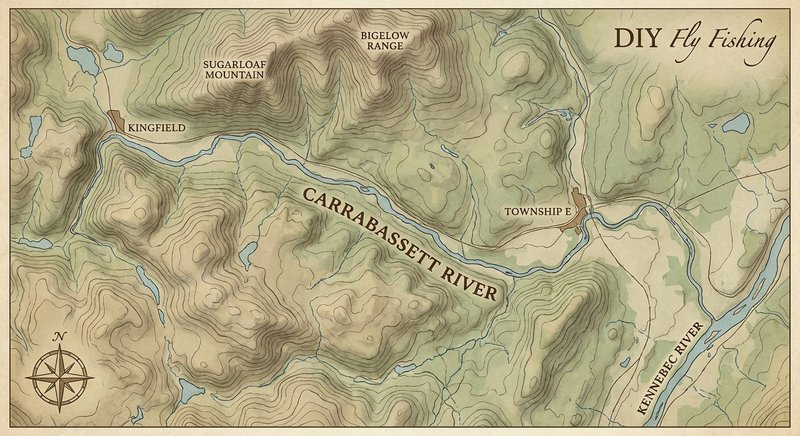
Carrabassett River
Fly fishing in Maine · Beginner · Best seasons: Summer, Fall
Target Species
Brook Trout
About This Water
Western Maine stream near Sugarloaf. Wild brook trout in mountain water.
Fishing Recommendations
Welcome to the high country of Western Maine. As your guide, I can tell you that the Carrabassett River is one of the most quintessential "freestone" experiences in New England. Flowing from the shadows of Sugarloaf Mountain down through the town of Kingfield, it offers everything a mountain angler desires: crystal-clear pools, tumbling pocket water, and vibrant, wild Brook Trout.
Here is your comprehensive guide to fly fishing the Carrabassett.
🎣 Location Overview
The Carrabassett is a classic Maine mountain river. It is characterized by high gradients, massive granite boulders, and high oxygen content. What makes it special is its accessibility paired with its rugged beauty; Route 27 parallels much of the river, yet once you step into the canopy, you feel miles away from civilization.
The river is divided into two personalities:
- The Upper River (Above Kingfield): This is "pocket water" heaven. It’s fast, cold, and rugged. You are fishing for wild, native Brookies in a high-alpine environment.
- The Lower River (Below Kingfield): The river widens and slows slightly. While Brook Trout are still present, you’ll also find stocked Rainbows and occasional Brown Trout.
🐟 Target Species & Behavior
Species: Primarily Native/Wild Brook Trout.
Behavior:
- Opportunistic Feeders: Because the growing season in the Maine mountains is short, these fish are not usually as selective as Henry's Fork trout. If it looks like food and is presented naturally, they will strike.
- Holding Patterns: In the summer, they hold in "the bubbles"—the highly oxygenated water at the head of pools or behind large boulders. In the fall, they move toward gravelly tailouts and tributaries to prepare for spawning.
- Size: Expect wild fish in the 6–10 inch range, with "trophies" reaching 12–14 inches. What they lack in size, they make up for in stunning red-bellied coloration and ferocity.
📅 Best Times to Fish
Summer (Late June – August)
- Conditions: This is the time for dry fly action. However, the Carrabassett can get low and warm in August.
- Timing: Focus on "Thermal Refugia." Look for where cold-water tributaries (like Poplar Stream) enter the main stem.
- Best Time of Day: "First light and last light." The evening caddis hatch can be prolific.
Fall (September – October)
- Conditions: This is the prime window. The water cools, and the Brook Trout dawn their spawning colors. They become aggressive and territorial.
- Timing: The entire month of September is gold. Note that many sections close to fishing in October to protect spawning beds (check current IFW regs).
- Best Time of Day: Mid-day. As the autumn sun warms the water even a few degrees, the fish become much more active.
🪰 Recommended Flies & Techniques
Dry Flies (The Bread & Butter)
Because the water is fast, you need high-visibility flies that float well.
- Royal Wulff / Humpy: (Size 12-16) Classic attractor patterns that the Brookies love.
- Elk Hair Caddis: (Size 14-18) Tan or olive. Perfect for the evening "skating" technique.
- Stimulators: (Size 10-14) Great for imitating the large stoneflies found in the Carrabassett.
Nymphs
- Pheasant Tail: (Size 14-18) The gold standard for Maine.
- Prince Nymph: (Size 12-16) The "bling" helps in the churning pocket water.
- Copper John: (Red or Blue, Size 14-16) Heavy enough to get down fast in deep slots.
Streamers
- Black Ghost: A traditional Maine pattern. Very effective in the fall.
- Muddler Minnow: Can be fished as a dry, a hopper, or swung as a streamer.
Techniques
- High-Sticking: In the pocket water, keep as much fly line off the water as possible to avoid "drag" caused by conflicting currents.
- Dry-Dropper: A favorite here. Run a large Stimulator with a small Pheasant Tail nymph tied 18 inches below it.
- The "Skate": In the evening, don't be afraid to twitch your dry fly. Brookies are often triggered by movement.
💡 Pro Tips & Local Knowledge
- Focus on the Boulders: In the stretch between Valley Crossing and Kingfield, every large boulder has a "pillow" of soft water in front of it and a "seam" behind it. Fish the front, then the sides, then the back.
- Stealth Matters: The water is Gin-clear. If you can see the fish, they have likely already seen you. Wear earthy colors and move slowly.
- The "Kingfield Dam": The pools below the old dam in Kingfield often hold larger-than-average fish that moved up from the Kennebec drainage.
- Check the Tributaries: If the main river is running high after a rain, duck into the smaller feeder streams. They clear up faster and are full of eager small trout.
⚠️ Important Information
- Access: Route 27 offers numerous pull-offs. Look for the "Working Forest" signs and informal angler paths. The area around Bigelow Station and Valley Crossing offers some of the best public access.
- Regulations: Maine fishing laws are "zonal." The Carrabassett has specific sections that are Fly Fishing Only (FFO) or Artificial Lures Only (ALO). Always consult the Maine IFW "Open Water" Lawbook before casting.
- Wading Safety: The rocks in the Carrabassett are notoriously slippery and "rolly." Studded felt boots and a wading staff are highly recommended.
- Wildlife: This is moose and bear country. Be aware of your surroundings, especially when hiking into the more remote upper sections.
Guide’s Final Word: The Carrabassett isn't about catching 20-inch fish; it’s about the purity of the pursuit. Bring a light 3-weight or 4-weight rod, a box of bushy dries, and enjoy one of the most beautiful rivers Maine has to offer. Tight lines!
Bug Hatches & Matching Flies
| Hatch | Type | Peak months | Time of day | Hook sizes | Matching flies |
|---|---|---|---|---|---|
| Hendrickson Ephemerella subvariabilis | mayfly | May, June | Afternoon | #12-14 | Red Quill #12-14, Hendrickson Emerger #14, Pheasant Tail #12-14 |
| March Brown Maccaffertium vicarium | mayfly | June | Afternoon | #10-12 | March Brown American #10-12, Hare's Ear Nymph #10-12, March Brown Wet Fly #12 |
| Blue-Winged Olive (BWO) Baetis / Acerpenna | mayfly | May, September, October | Mid-day/Afternoon | #18-22 | RS2 #18-20, BWO Sparkle Dun #18-22, Micro Mayfly #20 |
| Grannom (Mother's Day Caddis) Brachycentrus | caddis | May | Morning/Afternoon | #14-16 | Elk Hair Caddis (Olive) #14-16, Pupa Larva (Green) #14-16, Deep Sparkle Pupa #16 |
| Spotted Sedge Hydropsyche | caddis | June, July, August | Evening | #14-18 | Tan Elk Hair Caddis #14-18, Holy Grail (Tan) #16, Hydropsyche Larva #14-16 |
| Isonychia (Slate Drake) Isonychia bicolor | mayfly | July, August, September | Late Afternoon/Evening | #10-12 | Iso Parachute #10-12, Prince Nymph #10-14, Isonychia Cripple #12 |
| Light Cahill Stenacron / Stenonema | mayfly | June, July | Evening | #12-14 | Light Cahill Dry #12-14, Gold Ribbed Hare's Ear #14 |
| Golden Stonefly Acroneuria | stonefly | June, July | Morning/Evening | #6-10 | Golden Stone #8-10, Pat's Rubber Legs #6-10, 20 Incher #8-12 |
| Yellow Sally Isoperla | stonefly | June, July | Afternoon/Evening | #14-16 | Yellow Sally Dry #14-16, Iron Lotus (Yellow) #16 |
| Terrestrials Formicidae / Coleoptera | terrestrial | July, August, September | All Day | #12-18 | Cinnamon Ant #14-18, Black Foam Beetle #12-16, Chernobyl Ant #10-12 |