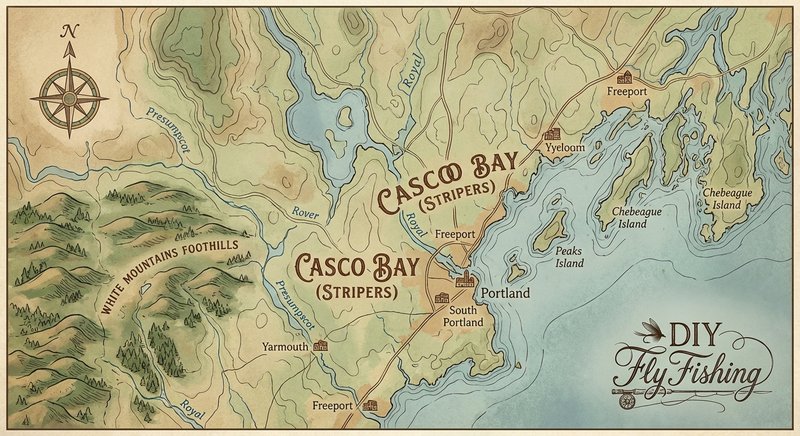
Casco Bay (Stripers)
Fly fishing in Maine · Intermediate · Best seasons: Summer, Fall
Target Species
Striped Bass, Bluefish, Mackerel
About This Water
Southern Maine coast with excellent striped bass. Fly fishing the flats and islands.
Fishing Recommendations
Welcome to the rocky coast of Maine. As your guide to Casco Bay, you are looking at one of the most diverse and visually stunning fly fishing arenas on the Atlantic seaboard. Stretching from Cape Elizabeth to the Phippsburg peninsula, Casco Bay is a "calendar land" of over 300 islands, massive ledge systems, sprawling mudflats, and powerful river mouths.
Here is your comprehensive guide to fly fishing these storied waters.
🎣 Location Overview
Casco Bay is the "Gateway to Midcoast Maine." What makes it special is the sheer variety of habitats compressed into one area. You can fish a 2-foot deep sand flat in the morning and a 40-foot deep ledge with crashing surf in the afternoon.
The water here is cold, clear, and nutrient-rich, fueled by the Gulf of Maine. The "Calendar Islands" create a labyrinth of current seams, pinch points, and tidal "rivers" between landmasses. Anglers love it because it offers both technical sight-fishing opportunities and "blitz" style fishing where the water boils with activity.
🐟 Target Species & Behavior
- Striped Bass (Stripers): The undisputed king of the bay.
- Behavior: In early summer, they push into the estuaries (Presumpscot, Royal, and Harraseeket rivers) to warm up and chase herring. As the water warms, they move to the "rocks and suds" of the outer islands.
- Feeding: They focus on "mosh pits" of bait—alewives, Atlantic herring, silversides, and the prized sand eels.
- Bluefish: The "Yellow-eyed Devils" usually arrive in July and August.
- Behavior: They are nomadic and aggressive. You’ll find them by looking for "bluefish slicks" (a calm, oily patch on the water that smells like watermelon/cucumber) or birds diving frantically.
- Mackerel: Often treated as bait, but on a 4-weight fly rod, they are a blast.
- Behavior: They travel in massive schools in the deeper channels between islands.
📅 Best Times to Fish
- The Season: Late May through mid-October.
- Prime Time (June): This is the "migration" window. Fresh, hungry fish arrive. Focus on the estuaries and river mouths.
- The Dog Days (July/August): Fishing becomes more nocturnal or light-dependent. Focus on the outer islands where the water stays cool (55–65°F).
- The Fall Blitz (September/October): The "Run." Fish are gorging for their southward migration. This is when you see the biggest surface feeds.
- Time of Day: Dawn and dusk (low light) are paramount. However, on the flats, a high sun (10 AM – 2 PM) is actually better for spotting cruising fish against the sand.
- Tide: Generally, the outgoing tide is preferred. It flushes bait out of the marshes and concentrates it in the channels.
🪰 Recommended Flies & Techniques
Top Fly Patterns
- Clouser Minnow: (Chartreuse/White or Olive/White). The gold standard. If you only have one fly, this is it.
- Hollow Fleye / Deceiver: (White/Grey). Best for imitating larger Atlantic Herring.
- Sand Eel Imitations: (Mushmouths or EP fibers). Essential for the outer beaches and islands.
- Gurglers & Bob’s Banger: (White or Black). For heart-stopping topwater strikes during low light.
- Ray’s Fly: A local Rhode Island/Maine classic for slim-profile baitfish.
Techniques & Presentation
- The "Strip-Set": Never trout-set (lifting the rod). Keep your tip low and pull the line hard with your stripping hand to set the hook in a Striper's tough mouth.
- Intermediate Lines: 90% of your fishing should be done with a clear-tip intermediate sink line. It gets the fly just under the surface chop.
- Structure Fishing: Cast into the "white water" where waves hit the ledges. Bass sit in the turbulent bubbles waiting for disoriented bait.
💡 Pro Tips & Local Knowledge
- The "Shadow Line": At night, fish the piers in Portland Harbor. Stripers sit just inside the dark side of a shadow line created by dock lights, waiting for bait to swim through the light.
- Seal Management: If you see seals, the fishing usually dies. They are better predators than you. Move to a different cove or island if a seal starts following your boat.
- Temperature Matters: If the water hits 70°F in the rivers, move toward the open ocean. Stripers are uncomfortable in warm water and will seek the "ledge" water near Mackworth Island or the Hussey Sound.
- Find the Birds: "Working birds" (Terns and Gulls) are your best fish finders. Terns are more reliable; they pick off the small bait that Stripers push to the surface.
⚠️ Important Information
- Licensing: You must register with the Maine Saltwater Recreational Fishing Registry. It is usually a nominal fee (around $1-$2) or included with a freshwater license, but it is mandatory.
- Regulations: Striped Bass have a "Slot Limit." As of current regulations, you may only keep fish between 28" and less than 31". Everything else must be released. Always use non-offset circle hooks if using bait, though as a fly angler, ensure you are using barbless hooks for easier releases.
- Safety: The Gulf of Maine is dangerous. The tides can swing 9–12 feet. If you are wading the flats, be extremely mindful of the incoming tide cutting you off from the shore. If boating, beware of "ledge hopping"—the granite rocks here will eat a fiberglass hull for breakfast.
- Gear: A 9-foot, 8-weight or 9-weight rod is the standard. Use a 15lb–20lb fluorocarbon leader. No tapered leader is necessary; 4–6 feet of straight fluoro works fine for these aggressive fish.
Tight lines, and enjoy the salt spray!
Bug Hatches & Matching Flies
| Hatch | Type | Peak months | Time of day | Hook sizes | Matching flies |
|---|---|---|---|---|---|
| Cinder Worm Alitta succinea | midge | May, June | Evening | #2-6 | Red-Butt Cinder Worm #4-6, Floating Foam Worm #2-6, Gamechanger Worm #4 |
| Flying Ants Formicidae | terrestrial | August, September | Afternoon | #14-18 | Black Foam Ant #16-18, Fur Ant #14-16 |
| Salt Marsh Midge Chironomidae | midge | June, July, August | Morning/Evening | #18-22 | Zebra Midge #18-20, Griffith's Gnat #20-22 |
| Salt Marsh Grasshopper Acrididae | terrestrial | August, September | Afternoon | #4-10 | Rainy's Hopper #6-10, Joe's Hopper #8-12 |
| Green Beetle Popillia japonica | terrestrial | July, August | Afternoon | #10-14 | Foam Beetle #12-14, Japanese Beetle #10-12 |
| Dragonfly Anisoptera | terrestrial | July, August | Afternoon | #2-6 | Deer Hair Dragonfly #4-6, Adult Damselfly #8-10 |
| Salt Marsh Cricket Gryllus pennsylvanicus | terrestrial | August, September | Evening/Night | #6-10 | Black Foam Cricket #8-10, Letort Hopper (Black) #10 |
| March Fly Bibionidae | terrestrial | May | Afternoon | #12-14 | Bibio Hopper #12-14, Black Gnat #14 |