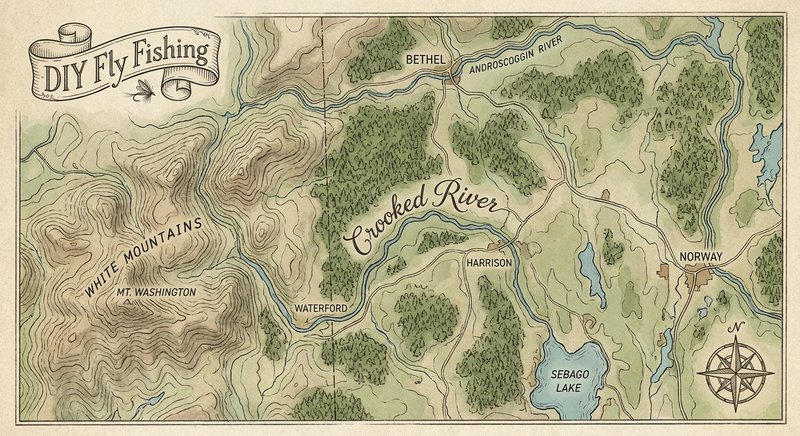
Crooked River
Fly fishing in Maine · Beginner · Best seasons: Spring, Summer, Fall
Target Species
Brown Trout, Landlocked Salmon, Brook Trout
About This Water
Southern Maine river feeding Sebago Lake. Brown trout and landlocked salmon.
Fishing Recommendations
The Crooked River is arguably the most vital river system in Southern Maine. Flowing roughly 60 miles from Songo Pond in Bethel to Sebago Lake, it serves as the primary spawning tributary for Sebago’s world-famous indigenous Landlocked Salmon. This is "classic Maine" fishing: tannic-colored water, heavily forested banks, and wild, athletic fish.
🎣 Location Overview
The Crooked River is a quintessential freestone stream. It meanders through the Maine woods, characterized by its deep tea-colored (tannic) water, sandy bottoms interspersed with granite boulder gardens, and extensive log jams.
What makes it special is its wild character. Unlike many rivers in the Northeast, the Crooked is not heavily stocked; it relies on natural reproduction. It is a federally protected "Wild Salmon Seedbed." Anglers love it because it offers a sense of remote wilderness just an hour from Portland, providing a technical challenge and the chance to hook into a legendary Sebago Salmon.
🐟 Target Species & Behavior
- Landlocked Salmon: These are the river's crown jewels. They are silver, acrobatic, and aggressive. In the spring and fall, they migrate from Sebago Lake into the river. They hold in the faster oxygenated water (bubble lines) and at the heads of deep pools.
- Brook Trout: Mostly resident fish, though some "salter-style" brookies move up from the lake. They are found in the colder upper reaches and in the shadows of undercut banks and fallen timber.
- Brown Trout: While less numerous than salmon, the river holds some very large, holdover Browns. They are nocturnal and secretive, usually hunkered down in the deepest, slowest holes during the day.
Feeding Behavior: These fish are opportunistic. In the spring, they focus heavily on Smelt (the primary forage of Sebago Lake). During the summer, they transition to caddis and stoneflies, and in the fall, the Salmon become territorial and will strike out of aggression.
📅 Best Times to Fish
- Spring (May – June): This is the high-water season. As the ice melts and the smelt begin their run, the Salmon follow them into the lower river. This is the best time for streamers.
- Summer (July – August): The river gets low and clear. Focus on the early morning (5:00 AM – 9:00 AM) or the "magic hour" before dark. This is peak dry-fly time for Brookies. Note: Keep an eye on water temperatures; if it hits 70°F, stop fishing to protect the Salmon.
- Fall (September – October): This is the Prime Window. The Salmon move up in massive numbers for their autumn spawn. The fish are in their "spawning colors" (darker with vibrant spots) and are extremely aggressive.
🪰 Recommended Flies & Techniques
Streamers (Best for Spring & Fall)
- Grey Ghost or Black Ghost: Classic Maine patterns that mimic smelt.
- Wooly Bugger (Olive or Black): Size 6-10. Dead-drift them or swing them through riffles.
- Muddler Minnow: Excellent for mimicking sculpins or large grasshoppers.
Nymphing (Consistent year-round)
- Pheasant Tail Nymph: Size 14-18. A staple for the river’s mayfly population.
- Prince Nymph: Size 12-14. Great "attractor" pattern for the darker water.
- Pudding Stick / Caddis Larva: The Crooked has a massive caddis population.
Dry Flies (Summer Months)
- Elk Hair Caddis (Tan/Orange): Size 14-16.
- Royal Wulff: High visibility in the tannic water.
- Stimulators: Size 8-12 in orange or yellow.
Presentation Tip: When fishing for Salmon, the "Downstream Swing" is lethal. Cast 45 degrees downstream, let the fly swing across the current, and give it small, rhythmic twitching motions.
💡 Pro Tips & Local Knowledge
- The "Smelt" Connection: If you are fishing the lower sections (near Edes Falls) in May, use a streamer with a bit of silver flash. The Salmon are looking for the shimmer of a smelt.
- Focus on Wood: The Crooked River is full of fallen trees. While you will lose some flies, the biggest fish live inside those log jams. Learn to "skip" your flies under overhanging branches.
- Stealth is Key: Despite the dark water, these fish are spooky. Wear drab clothing and avoid wading deeply if you don't have to. Approach pools from downstream.
- Twin Bridges to Bolsters Mills: This stretch offers some of the best gravel beds for spawning and generally holds a higher concentration of fish in the fall.
⚠️ Important Information
- Regulations: The Crooked River is strictly Catch and Release for all trout and salmon.
- Tackle Restrictions: It is Artificial Lures/Flies Only. Using bait is strictly prohibited and heavily enforced to protect the wild salmon fry.
- Access points:
- Edes Falls: Near the mouth of the river (Casco/Naples).
- Twin Bridges: Where Route 11 crosses the river (Harrison/Otisfield).
- Bolsters Mills: A historic bridge with good access and deep pools.
- Permits: A standard Maine Freshwater Fishing License is required. You can purchase these online at the MDIFW website.
- Wading Safety: The river has many "sandy drop-offs." One step can be 2 feet deep, the next can be 5 feet. Use a wading staff.
Bug Hatches & Matching Flies
| Hatch | Type | Peak months | Time of day | Hook sizes | Matching flies |
|---|---|---|---|---|---|
| Blue-Winged Olive Baetis / Pseudocloeon | mayfly | April, May, September, October | Mid-day | #18-22 | BWO Sparkle Dun #18-22, Pheasant Tail Nymph #18-20, RS2 #20-22 |
| Hendrickson Ephemerella subvaria | mayfly | May | Afternoon | #12-14 | Red Quill #12-14, Hendrickson Emerger #12-14, Gold Ribbed Hare's Ear #12-14 |
| Grannom Caddis Brachycentrus | caddis | May | Morning/Afternoon | #14-16 | Elk Hair Caddis (Olive) #14-16, LaFontaine's Deep Sparkle Pupa #14-16, Peacock Caddis #16 |
| Sulphur / Pale Evening Dun Ephemerella dorothea | mayfly | June, July | Evening | #16-18 | Sulphur Parachute #16-18, Sulphur CDC Emerger #16-18 |
| Light Cahill Stenonema ithaca | mayfly | June, July | Late Afternoon/Evening | #12-14 | Light Cahill #12-14, Cream Usual #14 |
| Alderfly Sialis hastata | other | June | Afternoon | #10-12 | Alder Fly #10-12, Black Gnat #12 |
| Spotted Sedge Hydropsyche | caddis | June, July, August | Evening | #14-18 | Tan Elk Hair Caddis #14-16, Prince Nymph #14-18, Hydropsyche Larva #14-16 |
| Giant Black Stonefly Pteronarcys dorsata | stonefly | May, June | Evening/Night | #4-8 | Kaufmann's Stone (Black) #6-8, Stimulator (Black) #8-10 |
| Terrestrials (Ants and Beetles) Formicidae / Coleoptera | terrestrial | July, August, September | All Day | #14-20 | Black Foam Ant #16-18, Cinnamon Ant #14-18, Joan Wulff’s Hoppers #10-14 |