Brassua Lake
Fly fishing in Maine · Intermediate · Best seasons: Spring, Summer, Fall
Target Species
Landlocked Salmon, Brook Trout
About This Water
Moosehead region lake with landlocked salmon. Remote wilderness setting.
Fishing Recommendations
Welcome to the Maine Northwoods. As your guide, I’m excited to break down Brassua Lake. Located just west of the massive Moosehead Lake, Brassua is often overlooked by the crowds, which is exactly why seasoned Maine anglers love it. It offers a more intimate, wild experience while still producing trophy-sized Landlocked Salmon and some of the finest wild Brook Trout in the region.
🎣 Location Overview
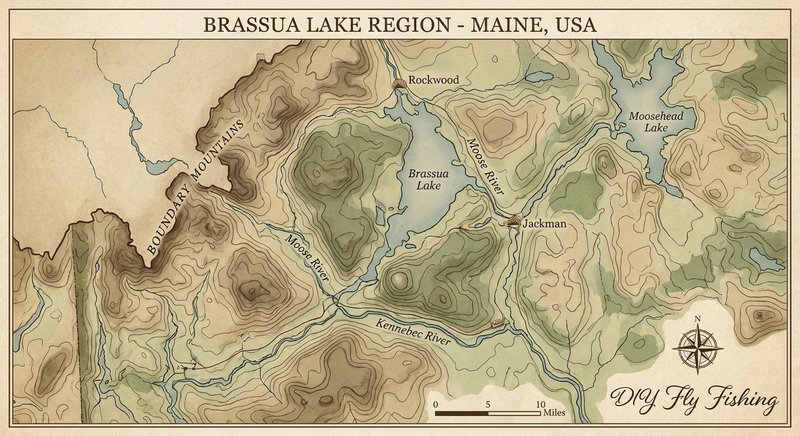
Brassua Lake is a roughly 9,000-acre impoundment fed by the Moose River. While it is a large body of water, it feels much more manageable than neighboring Moosehead. It is characterized by its rocky shorelines, numerous submerged stumps and logs (remnants of its history as a logging reservoir), and its relationship with the Moose River, which flows in from the west and out through the Brassua Dam into Moosehead Lake.
The lake is "classic Maine"—pine-fringed horizons, the call of loons, and the silhouette of Mount Kineo in the distance. The water is cool, stained slightly "tea-colored" by tannins, and holds oxygen well, making it a prime habitat for cold-water salmonids.
🐟 Target Species & Behavior
Landlocked Salmon
The "Kings of the Northwoods." These fish are known for their acrobatic leaps and aggressive strikes.
- Behavior: They are pelagic, meaning they follow the bait—specifically Rainbow Smelt. In the spring, they follow the smelt into the shallows and river mouths. In the summer, they go deep (30–50 feet). In the fall, they congregate near the Moose River inlet and the dam outlet to prepare for spawning.
Brook Trout
Brassua holds "square-tails" that are often native or wild-reared.
- Behavior: Brookies are more structure-oriented than salmon. You’ll find them tucked into the "rearing" areas near the mouths of cool-water tributaries like Misery Stream. They are opportunistic feeders, moving from aquatic insects (nymphs/dries) to small baitfish as they grow larger.
📅 Best Times to Fish
Spring (Ice-Out to Mid-June)
- The Window: This is the pinnacle. As soon as the ice clears (usually late April/early May), the smelt begin their spawn.
- Conditions: Salmon and trout are in the top 10 feet of the water column. This is the best time for fly casters to hit the shorelines and river mouths.
Summer (July - August)
- The Window: Early morning (dawn) and the last hour of light.
- Conditions: The lake "stratifies." Fish head deep to find the thermocline. Fly fishing becomes difficult on the open lake unless you use fast-sinking lines, but the Moose River sections remain productive.
Fall (September - October)
- The Window: September is "trophy month."
- Conditions: Fish move toward the inlets/outlets. They become highly territorial and dawn their vibrant spawning colors. The Brookies turn a fiery orange, and the Salmon develop their iconic "kype" (hooked jaw).
🪰 Recommended Flies & Techniques
Top Fly Patterns
- Streamers (The Maine Tradition):
- Grey Ghost: Mimics the Rainbow Smelt perfectly.
- Black Ghost: Great for overcast days.
- Mickey Finn: The yellow/red combo is a classic "attractor" for aggressive Brookies.
- Soft-hackle Streamers: Size 6-10 in olive or white.
- Dry Flies:
- Elk Hair Caddis (Tan/Olive): Massive caddis hatches occur in June.
- Royal Wulff: A high-visibility attractor for choppy water.
- Blue Winged Olive (BWO): Vital for those drizzly September afternoons.
- Nymphs:
- Pheasant Tail (14-18): Standard for the Moose River.
- Prince Nymph (12-14): Great for the faster water near the dam.
Techniques
- Trolling Streamers: Use a sinking-tip line and a long leader (9-12ft). Paddle or use a small motor at a "brisk walk" pace, pulsing the rod tip to give the fly a darting motion.
- Casting to Structure: In the spring, target rocky points and submerged wood. Cast streamers toward the shore and strip back fast.
- The "Swing": In the Moose River sections, use a classic down-and-across swing with a streamer to imitate a disoriented smelt.
💡 Pro Tips & Local Knowledge
- Focus on "Brassua Station": The area where the Moose River enters the lake is a magnet for fish. The moving water brings oxygen and food. Even in summer, this inflow is cooler than the main lake.
- Watch the Wind: Brassua can get "nasty" quickly. A west wind can create significant swells. If the wind picks up, move to the eastern shore or duck into the protected coves near Misery Stream.
- Misery Stream: This is a vital tributary on the south shore. In the heat of summer, the "thermal refuge" at the mouth of Misery Stream can hold a surprising number of Brook Trout.
- The Smelt Factor: If you see birds (gulls/terns) diving in the middle of the lake, get there. They are feeding on smelt pushed to the surface by schools of Salmon.
⚠️ Important Information
- Access: There is a primary boat launch on the northeastern side (near the dam) and access via the Moose River on the western side. A 4WD vehicle is recommended for some of the logging roads.
- Regulations: Maine Department of Inland Fisheries & Wildlife (MDIFW) has specific rules for Brassua.
- Check the Lawbook: Look for "Special Fishing Laws" (S-Code). Brassua often has specific length limits on Salmon and bag limits on Brookies to protect the wild population.
- Barbless: While not always required by law, using barbless hooks is highly recommended for easy release of wild fish.
- Permits: You must have a valid Maine Fishing License. You can purchase these online (MOSES system) or at local shops in Rockwood or Greenville.
- Safety: This is remote country. Cell service is spotty at best. Carry a map, a compass/GPS, and plenty of bug spray—the black flies in June are legendary.
Guide’s Final Word: Brassua is a "thinking angler’s" lake. It doesn't always give up its secrets on the first cast, but for those who study the wind and the smelt, it offers the quintessential Maine fly fishing experience. Tight lines!
Bug Hatches & Matching Flies
| Hatch | Type | Peak months | Time of day | Hook sizes | Matching flies |
|---|---|---|---|---|---|
| Hendrickson Ephemerella subvaria | mayfly | May, June | Afternoon | #12-14 | Red Quill #12-14, Hendrickson Nymph #12-14, Light Cahill #14 |
| Blue-Winged Olive Baetis / Drunella | mayfly | May, September, October | Late Morning/Afternoon | #18-22 | BWO Sparkle Dun #18-22, Pheasant Tail #18-20, RS2 #20 |
| Grannom Caddis Brachycentrus | caddis | May | Morning/Evening | #14-16 | Elk Hair Caddis (Olive) #14-16, Deep Sparkle Pupa #14-16, Peacock Caddis #16 |
| Giant Yellow Drake (Hex) Hexagenia limbata | mayfly | June, July | Dusk/Night | #4-8 | Hexagenia Dry #6-8, Hex Nymph #4-8, Wiggle Frenchman #6 |
| Green Drake Ephemera guttulata | mayfly | June | Evening | #8-12 | Green Drake Paradox #10-12, Coffin Fly #8-10, Hare's Ear (Olive) #10 |
| Sulfur / Pale Evening Dun Ephemerella invaria | mayfly | June, July | Evening | #14-18 | Sulfur Parachute #14-18, Sulfur Emerger #16-18, Gold Ribbed Hare's Ear #14-16 |
| White Miller Nectopsyche | caddis | July, August | Evening | #14-16 | White Elk Hair Caddis #14-16, LaFontaine's Emerger #14, White Wulff #12-14 |
| Spotted Sedge Hydropsyche | caddis | June, July, August | Morning/Evening | #14-16 | Tan Elk Hair Caddis #14-16, Hydropsyche Larva #14-16, Goddard Caddis #14 |
| Flying Ant Hymenoptera | terrestrial | August, September | Afternoon | #14-18 | Black Foam Ant #14-18, Cinnamon Flying Ant #16, Fur Ant #18 |