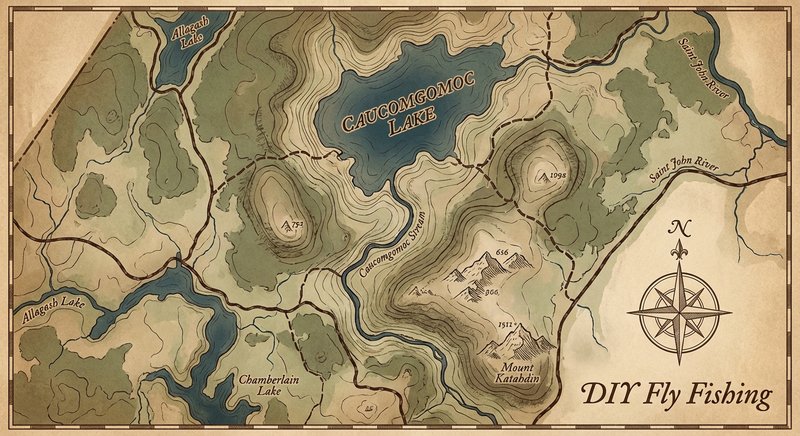
Caucomgomoc Lake
Fly fishing in Maine · Advanced · Best seasons: Summer, Fall
Target Species
Brook Trout, Lake Trout
About This Water
Remote northern Maine lake with brook trout. Pristine wilderness waters.
Fishing Recommendations
Welcome to the "Deep North." As a guide in the North Maine Woods (NMW), I can tell you that Caucomgomoc Lake is one of those legendary destinations that defines the Maine wilderness experience. It is remote, rugged, and rewards the angler who understands the nuances of big water and the seasonal movements of wild fish.
Here is your comprehensive guide to fly fishing Caucomgomoc Lake.
🎣 Location Overview
Caucomgomoc (pronounced kaw-com-go-muck) is a massive, 4,400-acre body of water situated deep in the North Maine Woods, northwest of Moosehead Lake. What makes this area special is its isolation; you won't find paved roads, cell service, or luxury resorts here.
The lake is characterized by rocky shorelines, deep glacial basins reaching over 80 feet, and a series of critical inflows and outflows—most notably Caucomgomoc Stream, which connects to Black Pond. Anglers love it because it offers a "dual threat" fishery: the ability to chase trophy-sized wild Brook Trout and high-volume Lake Trout (Togue) in a setting that looks exactly as it did 100 years ago.
🐟 Target Species & Behavior
- Wild Brook Trout: These are the crown jewels. In a lake this size, Brookies grow large by feeding on smelt. During the summer, they are light-sensitive and temperature-sensitive, holding in deep "spring holes" or near the thermocline. In the fall, they undergo a spectacular color transformation and move toward the gravelly inlets and the outlet stream to spawn.
- Lake Trout (Togue): Caucomgomoc has a very healthy population of Togue. They are aggressive predators that shadow schools of landlocked smelt. Unlike the Brookies, which might sip a dry fly under the right conditions, Togue are almost exclusively a sub-surface game for the fly angler.
📅 Best Times to Fish
Summer (July – August)
- Conditions: The surface water warms up, pushing fish deep.
- Strategy: This is "sink-tip" season. Focus on the early morning (4:00 AM – 8:00 AM) and the last hour of light. During the day, fish will be 20–40 feet down.
- Window: Look for "cool down" periods after a summer storm, which can trigger a temporary bite near the surface.
Fall (September)
- Conditions: This is the prime window. As water temperatures drop, the fish move shallow.
- Strategy: This is the best time for the fly angler. Brook trout become aggressive and territorial.
- Window: The last two weeks of September (before the season closes on many North Woods waters) are peak for size and color.
🪰 Recommended Flies & Techniques
For Lake Trout (Summer/Fall)
- Technique: Vertical jigging with a fly or "trolling" a fly using a heavy 300-400 grain sinking line from a canoe or boat.
- Fly Patterns:
- Grey Ghost or Black Ghost: Classic Maine smelt imitations (Size 2-6).
- Clouser Minnows: White/Chartreuse or Blue/White to mimic deep-water baitfish.
For Brook Trout (Summer)
- Technique: Fishing the "Spring Holes." Use a long leader and weighted nymphs.
- Fly Patterns:
- Pheasant Tail Nymphs: Size 14-18.
- Copper Johns: In red or copper.
For Brook Trout (Fall)
- Technique: Streamer stripping near the mouth of Caucomgomoc Stream or casting to rising fish in the evening.
- Fly Patterns:
- The Hornberg: A Maine staple. Fish it as a dry, or strip it like a streamer.
- Muddler Minnow: Excellent for mimicking large forage or sculpins.
- Maple Syrup: A classic North Woods streamer that Brookies can't resist.
- Soft Hackles: During an evening caddis hatch, a Partridge and Orange can be deadly.
💡 Pro Tips & Local Knowledge
- The Outlet is King: The stretch of Caucomgomoc Stream between the dam and Black Pond is legendary. In the fall, large Brookies congregate here. Focus on the deep pools and the "tails" of the runs.
- Watch the Wind: Caucomgomoc is a large east-west oriented lake. It can whip up "whitecaps" in minutes. If you are in a canoe, stay close to the windward shore.
- The Smelt Factor: Everything in this lake revolves around smelt. If you find the bait on your fishfinder (or see them dimpling the surface), the predators are nearby. Use flies with a bit of "Flashabou" to mimic the shimmer of a stressed smelt.
- Temperature Matters: Carry a stream thermometer. Don't bother fishing the shallows for Brookies if the water is over 68°F; you’re wasting your time and stressing the fish. Find the cold inflows.
⚠️ Important Information
- Access: You must enter through the North Maine Woods (NMW) gate system (usually the Caribou Checkpoint or Telos Gate). There is a per-person, per-night fee. Roads are gravel logging roads; trucks with high clearance and a full-sized spare tire are mandatory.
- Regulations: Maine fishing laws are zone-specific. Caucomgomoc is in the North Zone.
- Always check the current Maine IF&W Open Water Lawbook for specific bag limits and tackle restrictions (many areas are Fly Fishing Only or Artificial Lures Only).
- Safety: You are 2+ hours from the nearest hospital. Carry a satellite communication device (Garmin inReach or similar), a first aid kit, and plenty of bug spray—the black flies and mosquitoes are world-class.
Guide’s Final Word: Caucomgomoc isn't a place where you'll catch 50 fish a day, but it is a place where you can catch the Brook Trout of a lifetime in total silence. Respect the water, barbless hooks are preferred for easy release, and keep your eyes peeled for moose on the drive in!
Bug Hatches & Matching Flies
| Hatch | Type | Peak months | Time of day | Hook sizes | Matching flies |
|---|---|---|---|---|---|
| Hexagenia (The Hex) Hexagenia limbata | mayfly | June, July | Dusk/Evening | #4-8 | Hexagenia Spinner #4-6, Wiggle Hex Nymph #6-8, Paradrake #6-8 |
| Hendrickson Ephemerella subvaria | mayfly | May, June | Afternoon | #12-14 | Red Quill #12-14, Hendrickson Emerger #12-14, Pheasant Tail #12-16 |
| Green Drake Ephemera guttulata | mayfly | June, July | Evening | #8-10 | Green Drake Cripple #8-10, Hairwing Green Drake #8-10 |
| Spotted Sedge Hydropsyche spp. | caddis | June, July, August | Evening | #14-18 | Elk Hair Caddis #14-18, LaFontaine's Deep Sparkle Pupa #14-16 |
| Blue-Winged Olive (BWO) Baetis spp. | mayfly | May, September, October | Afternoon | #18-22 | RS2 #20-22, BWO Parachute #18-22 |
| Giant Orange Sedge Pycnopsyche spp. | caddis | August, September | Dusk/Night | #8-10 | Stimulator (Orange) #8-10, Goddard Caddis #8-10 |
| Black Carpenter Ant Camponotus pennsylvanicus | terrestrial | July, August | Anytime | #10-14 | Chernobyl Ant #10-12, Black Foam Ant #12-16 |
| White-Gloved Howdy Isonychia bicolor | mayfly | July, August | Late Afternoon/Evening | #10-12 | Isonychia Parachute #10-12, Zug Bug #10-14 |
| Chironomids (Midges) Chironomidae | midge | May, June, September | Morning | #18-24 | Zebra Midge #18-22, Griffith's Gnat #18-24 |