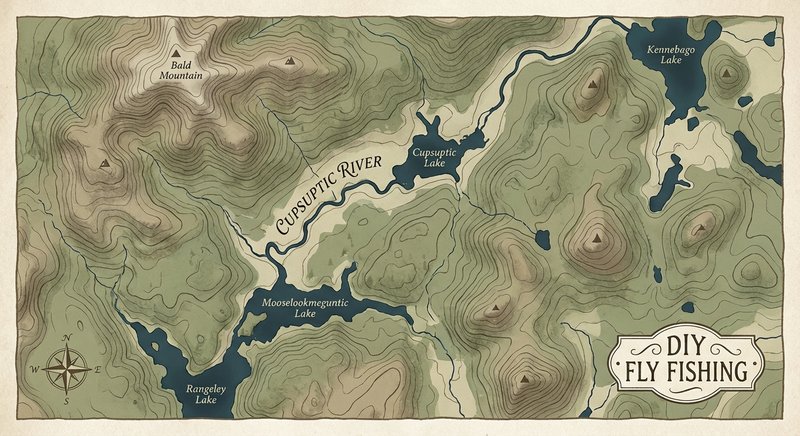
Cupsuptic River
Fly fishing in Maine · Intermediate · Best seasons: Summer, Fall
Target Species
Brook Trout
About This Water
Oxford County stream with wild brook trout. Remote wilderness setting.
Fishing Recommendations
The Cupsuptic River is one of the crown jewels of the Rangeley Lakes region in Western Maine. It is a quintessential Northwoods freestone river that offers a rugged, remote experience for anglers seeking wild, native Brook Trout. Unlike many rivers that have been heavily altered, the Cupsuptic remains a bastion of the "old Maine" fishing tradition.
🎣 Location Overview
Flowing through the wild timberlands north of Oquossoc, the Cupsuptic River eventually empties into the northern end of Mooselookmeguntic Lake. It is a diverse fishery divided into two distinct personalities: the lower river, which is characterized by slower meanders and deep pools influenced by the lake, and the upper river (above Cupsuptic Falls), which is a classic high-gradient stream filled with pocket water, plunge pools, and gravel runs.
What makes this water special is its connectivity. It serves as a vital spawning and nursery ground for the massive wild Brook Trout that live in the big lakes. When you fish here, you aren't just fishing for local residents; you are often targeting "lake-run" fish that can reach sizes rarely seen in other eastern rivers.
🐟 Target Species & Behavior
- Wild Brook Trout: These are the primary stars. Resident fish average 6–10 inches and are brilliantly colored. However, during the seasonal runs, fish weighing 2 to 5 pounds move into the river from Mooselookmeguntic.
- Landlocked Salmon: While the focus here is Brookies, you will frequently encounter Salmon, especially in the lower reaches and below the falls during the spring and fall.
Behavior:
- Summer: Resident fish hold in the "refrigerators"—the deep, oxygenated bubbles at the base of falls or where cold-water springs enter the main stem. They are opportunistic feeders but can be extremely "splashy" and quick.
- Fall: The behavior shifts to aggression and territory. Large lake-run Brookies are not looking for a meal as much as they are defending their space or reacting to a "nuisance" fly. They hold in deep "holding pools" before moving onto the shallow gravel redds (which you should never fish over).
📅 Best Times to Fish
Summer (July – August)
Summer fishing is about finding the coldest water. Focus on the upper river above the falls.
- Best Time: Dawn and dusk. The "Hex" hatch (Giant Mayfly) can occur on the lower, slower sections in early July, leading to incredible dry fly action at last light.
- Conditions: Low, clear water requires a stealthy approach and long, fine leaders.
Fall (September)
This is the "prime time" for the Cupsuptic.
- Best Time: The last two weeks of September are legendary. As water temperatures drop and autumn rains raise the river levels, the big lake fish begin their ascent.
- Conditions: Overcast, drizzly days are best. The fish feel more secure moving in low-light conditions, and the "big boys" are less likely to stay tucked under logs.
🪰 Recommended Flies & Techniques
Dry Flies
- The Hornberg: If you only carry one fly in Maine, this is it. Fish it as a dry, or twitch it under the surface like a streamer.
- Royal Wulff & Humpy: High-visibility attractors for the fast-moving pocket water.
- BWO (Blue Winged Olive): Essential for those rainy September afternoons.
- Usual or Haystack: Excellent for the riffles; they float high and look like everything and nothing at once.
Nymphs
- Pheasant Tail (Size 14-18): A staple for the resident trout.
- Prince Nymph: The flash works well in the tea-colored "tannic" water common in Maine.
- Eggs/Beads: In late September, an egg pattern can be deadly when the fish are in spawning mode.
Streamers
- Black Ghost or Grey Ghost: Classic Maine patterns that mimic the smelt these fish feed on in the lake.
- Muddler Minnow: Excellent when hopped along the bottom or swung through a run.
- Wooly Bugger (Black or Olive): The ultimate "searching" fly for deep pools.
Techniques
- The "Maine Swing": Cast a streamer quartering downstream, let it swing through the current, and give it short, erratic strips at the end of the swing.
- Stealth Approach: Because the water is often crystal clear, approach pools from downstream and stay low. Vibrations on the bank will spook a wild Brookie faster than a bad cast.
💡 Pro Tips & Local Knowledge
- The "Big Falls": Cupsuptic Falls is a major barrier. Fishing the pools immediately below the falls in September is a high-reward (but high-pressure) strategy.
- The Meanders: For a more solitary experience, take a canoe or kayak into the "Meanders" section above the lake but below the logging bridge. This is prime "Hex" water in the summer.
- Watch the Gauge: The Cupsuptic is a freestone river. If it rains hard, it gets muddy fast. If it’s a drought year, the fish will retreat to the deepest holes or back to the lake. Check local reports in Oquossoc before heading out.
- Bushwhacking: The best fishing is often a half-mile walk away from any road access. Bring a GPS and a sense of adventure.
⚠️ Important Information
- Access: Access is primarily via the Morton Cutoff and various logging roads. These are working forest roads—log trucks always have the right of way. Be prepared for gravel roads and carry a spare tire.
- Regulations: Maine's fishing regulations are specific and can change by section.
- Most of the Cupsuptic is Fly Fishing Only (FFO).
- Many sections are Catch and Release or have very strict length limits.
- Always check the current Maine MDIFW Open Water Regulations (look for the "North Zone" and the "S-Codes").
- Safety: This is Moose and Bear country. Keep a clean camp and watch the roads at dusk. Cell service is non-existent once you leave the main highway, so tell someone where you are going.
- Etiquette: If you see another angler’s truck at a small pull-off, move to the next one. There is plenty of river for everyone.
Bug Hatches & Matching Flies
| Hatch | Type | Peak months | Time of day | Hook sizes | Matching flies |
|---|---|---|---|---|---|
| Quill Gordon Epeorus pleuralis | mayfly | May | Midday | #12-14 | Quill Gordon Dry #12-14, Gold Ribbed Hare's Ear #12-14 |
| Hendrickson Ephemerella subvaria | mayfly | May, June | Afternoon | #12-14 | Hendrickson Dark #12-14, Red Quill #14, Pheasant Tail #12-14 |
| Blue-Winged Olive Baetis spp. | mayfly | May, September, October | Midday/Afternoon | #18-22 | BWO Sparkle Dun #18-22, RS2 #20-22 |
| Grannom Caddis Brachycentrus | caddis | May | Morning/Afternoon | #14-16 | Elk Hair Caddis (Olive) #14-16, Deep Sparkle Pupa #14-16 |
| March Brown Maccaffertium vicarium | mayfly | June | Afternoon | #10-12 | March Brown American #10-12, March Brown Wet Fly #10-12 |
| Eastern Green Drake Ephemera guttulata | mayfly | June | Evening | #8-10 | Green Drake Fanwing #8-10, Coffin Fly #8-10 |
| Light Cahill Stenacron interpunctatum | mayfly | June, July | Evening | #12-14 | Light Cahill #12-14, Cream Usual #14 |
| Golden Stonefly Acroneuria spp. | stonefly | June, July | Morning/Evening | #6-10 | Kaufmann's Stone (Golden) #6-10, Stimulator (Orange/Yellow) #8-12 |
| Flying Ant Formicidae | terrestrial | August, September | Midday | #16-20 | Black Flying Ant #16-20, Cinnamon Ant #18 |