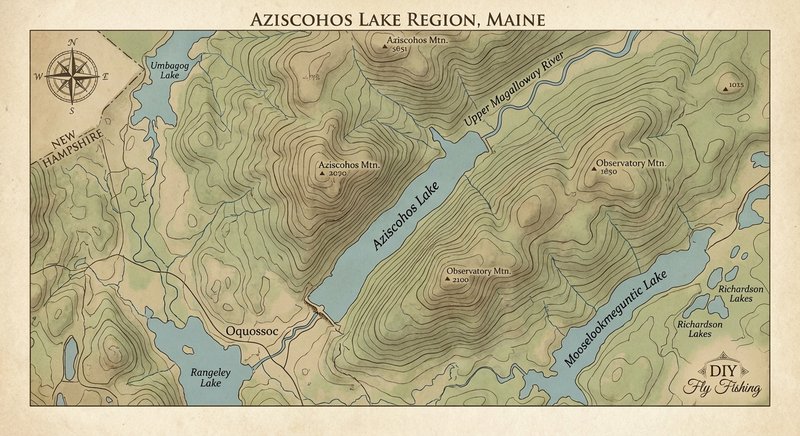
Aziscohos Lake
Fly fishing in Maine · Intermediate · Best seasons: Spring, Summer, Fall
Target Species
Landlocked Salmon, Brook Trout
About This Water
Remote western Maine lake with landlocked salmon. Source of Magalloway River.
Fishing Recommendations
Welcome to the wild heart of the Rangeley Lakes region. As a guide in these waters, I can tell you that Aziscohos Lake (pronounced a-zis-ko-hos) is one of Maine’s most storied fisheries. It is a man-made impoundment of the Magalloway River, creating a 6,700-acre wilderness lake that feels much more like a flooded forest than a traditional bowl-shaped pond.
Here is your comprehensive guide to fly fishing Aziscohos Lake.
🎣 Location Overview
Aziscohos is unique because of its "wild" character. Unlike some of the more developed lakes in the Rangeley chain, Aziscohos is rugged, surrounded by timberland, and largely undeveloped.
What makes it special for the fly angler is the structure. When the valley was dammed in 1911, the forest was flooded, leaving behind a maze of submerged stumps and timber. This provides incredible overhead cover for trout and salmon. The lake is long and narrow, fed primarily by the Upper Magalloway River at its northern end, which acts as a massive "conveyor belt" of cold water and nutrients.
🐟 Target Species & Behavior
Landlocked Atlantic Salmon
These are the "silver bullets" of Maine. In Aziscohos, they are known for their acrobatic leaps.
- Behavior: They are pelagic hunters, constantly chasing Rainbow Smelt.
- Where they hold: In the spring, they are in the top 10 feet of water near rocky points and river mouths. In summer, they drop deep into the thermocline (30–50 feet).
- Feeding: 90% of their diet is smelt. If you find the bait, you find the salmon.
Brook Trout
Aziscohos holds "heritage" strain wild Brook Trout that can reach trophy sizes (3–5 lbs are caught every season).
- Behavior: More structure-oriented than salmon. They love the flooded timber, submerged boulders, and the cooler "spring holes" near the mouths of tributary streams.
- Feeding: While they eat smelt, they are much more insect-focused than salmon, keyed into caddis, mayflies, and terrestrial patterns in the summer.
📅 Best Times to Fish
Spring (Ice-Out to Mid-June)
- The Window: This is the prime season. As soon as the ice breaks (usually early to mid-May), the smelt move toward the shores and tributaries to spawn.
- Conditions: The water is cold, and the fish are shallow. You can catch trophy fish on a floating line right against the bank.
Summer (July to August)
- The Window: Mid-summer requires a change in tactics.
- Best Time: Dawn and dusk. The "Hexagenia" (Giant Mayfly) hatch typically occurs in late June or early July, providing some of the best dry-fly fishing of the year at twilight.
Fall (September)
- The Window: September is spectacular. The Brook Trout take on their vivid spawning colors (crimson bellies).
- Conditions: As water temperatures drop, fish move toward the northern end of the lake and into the Magalloway River for their spawning runs.
🪰 Recommended Flies & Techniques
Top Fly Patterns
- Streamers (The Maine Tradition):
- Grey Ghost or Black Ghost: Classic smelt imitations.
- Herb Johnson’s Pink Lady: A local legend for Aziscohos salmon.
- Mickey Finn: High visibility for stained water.
- Dry Flies:
- Hexagenia Limbata: Size 6–8, for the summer evening hatches.
- Royal Wulff & Humpy: Great attractor patterns for choppy water.
- Stimulators: To mimic the large stoneflies found in the Magalloway.
- Nymphs:
- Pheasant Tail (Size 12–16) and Zebra Midges.
Techniques
- Stripping Streamers: Using a fast-sinking tip line (Type 3 or 5), cast toward the "gray ghosts" (submerged standing dead trees) and strip back with erratic, 6-inch jerks to mimic a wounded smelt.
- Trolling the Fly: Many local guides "flat-line" troll. Use a long leader (12–15 ft) and a weighted streamer, rowing or using a slow electric motor to cover the shorelines.
- The "Dry-Dropper": In the summer, use a large hopper or Stimulator on top with a small Pheasant Tail nymph hanging 3 feet below.
💡 Pro Tips & Local Knowledge
- The "Magalloway Mouth": The northern end where the Magalloway River enters the lake is a magnet for fish. Even in the heat of summer, this area stays cooler and holds fish.
- Watch the Wind: Aziscohos is oriented North-to-South. A strong North or South wind can create dangerous "waves with teeth." Always watch the weather; if the wind picks up, the "wind lanes" (foam lines) often trap insects and attract cruising trout.
- The "Maine Twitch": When fishing streamers, don't just strip. Give the rod tip a rhythmic twitch. This makes the feathers of a classic Maine streamer "breathe" in the water.
- Fish the Wood: Don't be afraid to lose flies. The fish live inside the flooded timber. If you aren't casting tight to the stumps, you're missing the big Brookies.
⚠️ Important Information
- Access: The primary access is at Black Brook Cove Campground (South end) where there is a boat launch. There is also limited access at the North end via logging roads (Lincoln Plantation).
- Regulations: Maine fishing laws are specific. Aziscohos has length limits and bag limits designed to protect the wild population. Always check the current Maine MDIFW Open Water Lawbook before heading out.
- Safety: This is remote country. Cell service is spotty to non-existent. Bring a physical map, a spare tire, and plenty of bug spray (the black flies in June are legendary).
- Boating: Be extremely careful of submerged logs. "Propeller-eating" stumps lurk just inches below the surface, even far from shore. Navigate with caution.
Guide’s Final Word: Aziscohos is a place for the angler who loves solitude and wild fish. It won't give up its secrets easily, but when you hook a 20-inch wild Brookie in the shadow of Aziscohos Mountain, you'll understand why we keep coming back.
Bug Hatches & Matching Flies
| Hatch | Type | Peak months | Time of day | Hook sizes | Matching flies |
|---|---|---|---|---|---|
| Hendrickson Ephemerella subvaria | mayfly | May, June | Afternoon | #12-14 | Red Quill #12-14, Hendrickson Emerger #14, Pheasant Tail #12-14 |
| Hex Hexagenia limbata | mayfly | June, July | Evening/Dusk | #6-10 | Hexagenia Dry #6-8, Hex Wiggle Nymph #8-10, Floating Hex Nymph #8 |
| Green Drake Ephemera guttulata | mayfly | June, July | Evening | #8-12 | Green Drake Paradrake #10, Coffin Fly #8-10, Drake Emerger #10 |
| Blue-Winged Olive Baetis | mayfly | May, September, October | Afternoon | #18-22 | BWO Sparkle Dun #18-20, RS2 #20-22, BWO Parachute #18-22 |
| Spotted Sedge Hydropsyche | caddis | June, July, August | Evening | #14-16 | Elk Hair Caddis #14-16, LaFontaine Sparkle Pupa #14-16, Deep Sparkle Pupa #14-16 |
| Flying Ants Formicidae | terrestrial | August, September | Afternoon | #14-18 | Black Fur Ant #14-16, Chernobyl Ant #12-14, Flying Ant (Wings) #16-18 |
| Grannom Caddis Brachycentrus | caddis | May | Morning/Afternoon | #14-16 | Grannom Pupa #14-16, Peacock Caddis #14-16, Apple Sedge #14 |
| Sulphur Ephemerella invaria | mayfly | June, July | Evening | #14-16 | Sulphur Parachute #14-16, Sulphur Cripple #14-16, Sulphur nymph #14-16 |