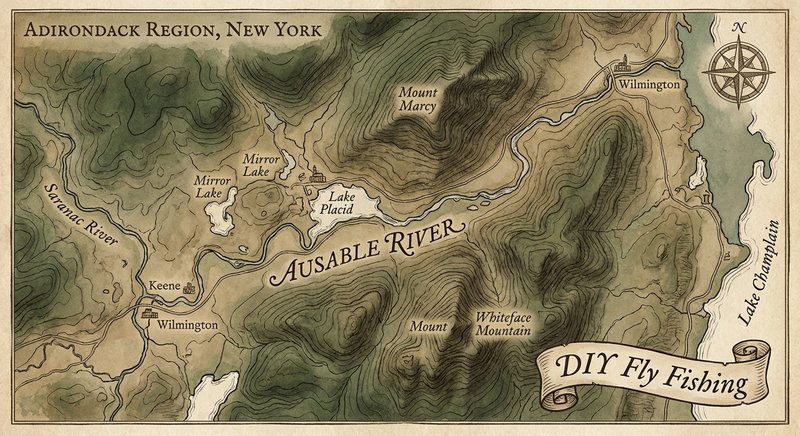
Ausable River
Fly fishing in New York · Intermediate · Best seasons: Spring, Summer, Fall
Target Species
Brown Trout, Brook Trout, Rainbow Trout
About This Water
Adirondack gem with excellent wild brown and brook trout fishing. Beautiful mountain scenery.
Fishing Recommendations
Welcome to the "Adirondack Classic." As a guide in these mountains, I can tell you that the West Branch of the Ausable River is arguably the most famous trout stream in the Eastern United States.
Born in the high peaks of the Adirondacks near Lake Placid, the Ausable is a high-gradient, boulder-strewn freestone river. It is rugged, beautiful, and demands respect. Whether you are chasing the ghost of Fran Betters or looking for a trophy Brown, here is your guide to fishing the Ausable.
🎣 Location Overview
The Ausable is divided into the East and West Branches, which meet at Au Sable Forks. While the East Branch offers excellent fishing for wild Brookies, the West Branch is the crown jewel.
What makes it special is its "Pocket Water." Because the river drops significantly in elevation, the water is highly oxygenated, allowing it to hold trout even when other Eastern rivers get too warm. The riverbed is a labyrinth of ancient Adirondack granite boulders, creating thousands of small "pockets" where trout wait for food. It is scenic, powerful, and offers a true wilderness feel despite being easily accessible from the road.
🐟 Target Species & Behavior
- Brown Trout: The primary target. You’ll find both wild and heavily stocked Browns. They are the kings of the deep pools and the undercut banks. They are notoriously selective during major hatches but can be aggressive toward streamers in low light.
- Rainbow Trout: Highly active in the faster "white water." They love the oxygenated riffles and the heads of pools. They are known for their aerial acrobatics when hooked in the heavy current.
- Brook Trout: The native soul of the Adirondacks. While found in the West Branch, they dominate the colder, smaller tributaries and the upper reaches of the East Branch. They are opportunistic feeders but easily spooked.
Behavior Note: These fish are "current-oriented." Because the water moves fast, they don't have long to decide. If your drift is natural, they strike hard. If there is a hint of drag, they will ignore it.
📅 Best Times to Fish
- Spring (Late May – June): This is the Prime Window. The water levels usually drop to fishable levels by mid-May. This coincides with the legendary Hendrickson and March Brown hatches.
- Summer (July – August): Focus on the early mornings and late evenings. During the heat of the day, trout retreat to the "bubbling" water at the base of falls or deep plunge pools for oxygen.
- Fall (September – October): A magical time. The crowds thin, the foliage is world-class, and the Browns become aggressive as they prepare to spawn. The Isonychia hatch in September provides some of the year's best dry-fly action.
🪰 Recommended Flies & Techniques
The "Ausable Trilogy" (Must-Haves)
You cannot fish this river without the patterns perfected by local legend Fran Betters:
- Ausable Wulff: The ultimate high-visibility attractor. It floats high in the rough stuff.
- Haystack: A precursor to the Sparkle Dun; it sits in the film and is deadly during hatches.
- The Usual: Made from the fur of a rabbit's foot, it mimics almost any emerger.
Other Effective Patterns
- Dry Flies: Hendrickson (May), March Brown (June), Light Cahill (July), Isonychia (Sept), and Tan Caddis.
- Nymphs: Pheasant Tail (#14-18), Pat’s Rubber Legs (for high water), and Bead-head Prince Nymphs.
- Streamers: Black or Olive Woolly Buggers, and the Black Ghost (a classic NE pattern).
Techniques
- High-Sticking/Euro Nymphing: Because the currents are so complex, keeping your fly line off the water is essential to avoid drag.
- Dry-Dropper: This is my "go-to" guide rig here. A buoyant Ausable Wulff with a weighted Pheasant Tail nymph 18 inches below it.
- Short Casts: Don't try to be a hero with 50-foot casts. Most fish are caught within 20 feet of your rod tip in the nearby pockets.
💡 Pro Tips & Local Knowledge
- The "Greased Bowling Ball" Factor: The rocks in the Ausable are notoriously slippery and round. Studded wading boots are not optional—they are a safety requirement. A wading staff is highly recommended.
- Focus on the Seams: Look for where fast water meets slow water. That thin "seam" is the conveyor belt of food.
- Wilmington Notch: This stretch is breathtakingly beautiful with high cliffs, but it requires a bit of a hike down. It holds some of the best wild fish in the river.
- Monument Falls: A popular spot for a reason. It offers great access and a mix of pocket water and deeper runs.
⚠️ Important Information
- Regulations: The West Branch has a famous Catch and Release Only section that runs from the mouth of Holcomb Pond Outlet downstream to the Route 86 bridge in Wilmington. Check the NYSDEC website for the most current boundary markers.
- Licensing: A New York State freshwater fishing license is required (available online or at local shops like the Hungry Trout).
- Temperature Watch: If the water temperature hits 70°F (21°C), stop fishing. The fish are under high stress from low oxygen. This typically only happens in late July or August during heatwaves.
- Access: Much of the river runs along Route 86. Look for the yellow "Fishing Access" signs. Most of the river is open to the public, but always respect private property near the lower sections.
Tight lines, and enjoy the Adirondack air. There is no place quite like it when the March Browns are dancing!
Bug Hatches & Matching Flies
| Hatch | Type | Peak months | Time of day | Hook sizes | Matching flies |
|---|---|---|---|---|---|
| Hendrickson Ephemerella subvaria | mayfly | April, May | Afternoon | #12-14 | Hendrickson Pink Lady #12-14, Red Quill #12-14, Pheasant Tail #12-14 |
| Blue-Winged Olive (BWO) Baetis / Drunella | mayfly | April, May, September, October | Mid-day/Afternoon | #18-22 | RS2 #20-22, BWO Parachute #18-22, Micro-Mayfly #18-20 |
| March Brown Maccaffertium vicarium | mayfly | May, June | Afternoon | #10-12 | March Brown Western #10-12, Gold Ribbed Hare's Ear #10-12, March Brown Emerger #10-12 |
| Isonychia (Slate Drake) Isonychia bicolor | mayfly | June, July, August, September | Late Afternoon/Evening | #10-12 | Iso Parachute #10-12, Prince Nymph #10-14, Zug Bug #10-12 |
| Grannom Caddis Brachycentrus | caddis | April, May | All Day | #14-16 | Elk Hair Caddis (Olive) #14-16, Deep Sparkle Pupa #14-16, LaFontaine Emerger #14-16 |
| Giant Stonefly Pteronarcys dorsata | stonefly | May, June | Evening/Night | #4-8 | Pats Rubber Legs (Black/Brown) #4-8, Stimulator #6-10, Kaufmann's Stone #6-8 |
| Light Cahill Stenacron interpunctatum | mayfly | June, July | Evening | #12-14 | Light Cahill #12-14, Cream Usual #12-16, Gold Ribbed Hare's Ear (Light) #12-14 |
| White Wulff / White Miller Ephoron leukon | mayfly | August | Evening | #12-14 | White Wulff #10-12, White Miller #12-14, Ephoron Nymph #12-14 |
| Tricos Tricorythodes | mayfly | July, August, September | Morning | #22-26 | Trico Spinner #22-26, Griffith's Gnat #20-24 |