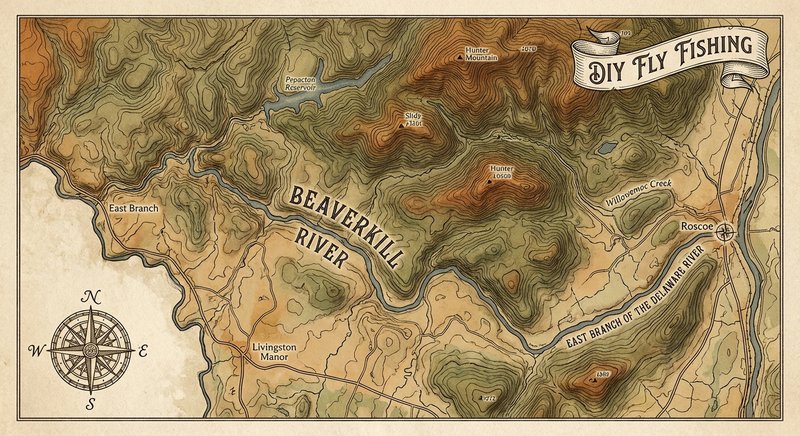
Beaverkill River
Fly fishing in New York · Intermediate · Best seasons: Spring, Summer, Fall
Target Species
Brown Trout, Rainbow Trout
About This Water
The birthplace of American fly fishing. Historic water with excellent hatches and wild trout.
Fishing Recommendations
Welcome to the "Cradle of American Fly Fishing." As a guide, there is no river I treat with more reverence than the Beaverkill. Flowing through the Catskill Mountains of New York, this is where the traditions of dry fly fishing in America were born and refined.
Here is your comprehensive guide to fishing the legendary Beaverkill River.
🎣 Location Overview
The Beaverkill is a classic freestone river, meaning its flow and temperature are dictated by snowmelt, rainfall, and springs rather than dam releases. It is divided into two distinct sections:
- The Upper Beaverkill: Located above the village of Roscoe. It is smaller, more intimate, and characterized by quick pockets and tumbling runs. Much of this water is private, but there are several well-marked Public Fishing Rights (PFR) stretches.
- The Lower Beaverkill: Beginning at the famous Junction Pool (where the Willowemoc Creek meets the Beaverkill), the river widens significantly. This is the "big water" featured in history books—expansive pools with names like Cairns, Schoolhouse, and Painter’s Bend.
Anglers love the Beaverkill not just for the fish, but for the history. When you cast a fly here, you are casting where legends like Theodore Gordon and Sparse Grey Hackle once stood.
🐟 Target Species & Behavior
The Beaverkill is home to Brown Trout and Rainbow Trout.
- Brown Trout: The river's soul. You’ll find both wild and holdover browns. They are notoriously "educated" and technical. They hold in the classic spots: the "cushion" in front of large boulders, the tail-outs of long pools during a hatch, and deep undercut banks during the heat of the day.
- Rainbow Trout: Generally more aggressive than the browns, rainbows are often found in the faster, oxygenated riffles and at the heads of the pools.
- Behavior: These fish are highly keyed into insect cycles. Because of the pressure they receive, a "micro-drag" on your fly that might go unnoticed elsewhere will result in a refusal here.
📅 Best Times to Fish
Spring (April – June)
- The Prime Window: This is the peak. May and June offer the most prolific hatches in the Eastern US.
- Conditions: High water in April requires heavy nymphs and streamers. By mid-May, the dry fly fishing becomes world-class.
Summer (July – August)
- The Danger Zone: As a freestone river, the Beaverkill can get lethally warm (above 70°F).
- Strategy: Fish the early mornings (6 AM – 10 AM). Always carry a thermometer. If the water hits 68°F, stop fishing to protect the trout. Focus on the "No-Kill" sections which often have cooler thermal refuges.
Fall (September – October)
- The Return: As water temperatures drop, the fish become active again to bulk up for winter or the brown trout spawn.
- Conditions: Lower, crystal-clear water. This requires stealth and long, fine leaders.
🪰 Recommended Flies & Techniques
Dry Flies (The Gold Standard)
The "Catskill Style" dry fly was invented here—sparse tie, stiff hackle.
- Patterns: Hendrickson (May), Red Quill, March Brown, Light Cahill (June), and Blue Winged Olives (Spring/Fall).
- Terrestrials: Ants and Beetles are essential in mid-summer.
Nymphing
When there is no rising fish, go sub-surface.
- Patterns: Pheasant Tail (size 14-18), Gold-Ribbed Hare’s Ear, and Prince Nymphs.
- Technique: "High-sticking" in the pocket water of the Upper Beaverkill or using a subtle strike indicator in the deep Lower pools.
Streamers
- Patterns: Woolly Buggers (Black or Olive) and the classic Mickey Finn (a nod to the river's history).
- Technique: Swing them through the tail-outs of pools during low light or strip them aggressively through deep holes during high-water spring days.
💡 Pro Tips & Local Knowledge
- The 70-Degree Rule: Local guides are fierce protectors of the river. If you are seen playing a fish in 72-degree water, expect a stern talking-to. Check the USGS gauges before you drive.
- The Junction Pool: Visit it once for the novelty (it's where the current supposedly flows "backward"), but don't spend your whole day there—it’s the most pressured spot on the river.
- Long Leaders: Use 9 to 12-foot leaders tapering to 5x or 6x. The "Beaverkill Flat" water is glass-calm; a heavy fly line landing over a fish will spook it instantly.
- Match the Hatch... and the Size: Sometimes the fish aren't picky about the pattern, but they are obsessed with the size. If you see rises but no takes, drop down one hook size.
⚠️ Important Information
- Regulations: New York State has specific "Catch and Release" (No-Kill) sections on the Beaverkill. These are clearly marked with signage. Outside of these, standard NY DEC trout regulations apply.
- Licenses: A New York State Fishing License is required for anyone 16 or older. You can buy them online or at any local fly shop in Roscoe (known as "Trout Town USA").
- Access: Look for the yellow "Public Fishing Rights" signs. Respect private property, as the patchwork of public and private land is complex.
- Safety: The rocks in the Beaverkill are famously "greased." Use felt-soled boots (where legal) or studs, and a wading staff is highly recommended for the Lower River.
Guide’s Final Word: The Beaverkill rewards the patient angler. Don't just rush into the water. Sit on the bank, watch for five minutes, identify the rhythm of the rises, and then make your move. Tight lines!
Bug Hatches & Matching Flies
| Hatch | Type | Peak months | Time of day | Hook sizes | Matching flies |
|---|---|---|---|---|---|
| Quill Gordon Epeorus pluralis | mayfly | April | Midday to Early Afternoon | #12-14 | Quill Gordon Dry #12-14, Quill Gordon Wet #12-14 |
| Hendrickson Ephemerella subvaria | mayfly | April, May | Afternoon | #12-14 | Red Quill #12-14, Hendrickson Nymph #12-14, Hendrickson Emerger #12-14 |
| Grannom Caddis Brachycentrus | caddis | April, May | Morning/Afternoon | #14-16 | Elk Hair Caddis (Olive) #14-16, Peacock Pupa #14-16 |
| March Brown Maccaffertium vicarium | mayfly | May, June | Late Afternoon | #10-12 | March Brown Dry #10-12, Hare's Ear Nymph #10-12 |
| Sulphur Ephemerella dorothea | mayfly | May, June | Evening | #16-18 | Sulphur Parachute #16-18, Sulphur Cripple #16-18 |
| Green Drake Ephemera guttulata | mayfly | June | Late Evening | #8-10 | Coffin Fly #8-10, Green Drake Nymph #8-10 |
| Blue-Winged Olive Baetis | mayfly | April, May, September, October | Afternoon/Overcast Days | #18-22 | BWO Sparkle Dun #18-22, RS2 #20-22 |
| Isonychia Isonychia bicolor | mayfly | June, July, August, September | Late Afternoon/Evening | #10-12 | Iso Parachute #10-12, Zug Bug #10-12 |
| Light Cahill Stenacron interpunctatum | mayfly | June, July | Evening | #12-14 | Light Cahill Dry #12-14 |
| Ants and Beetles Formicidae/Coleoptera | terrestrial | July, August, September | All Day | #14-20 | Flying Ant #16-18, Black Foam Beetle #14-16 |