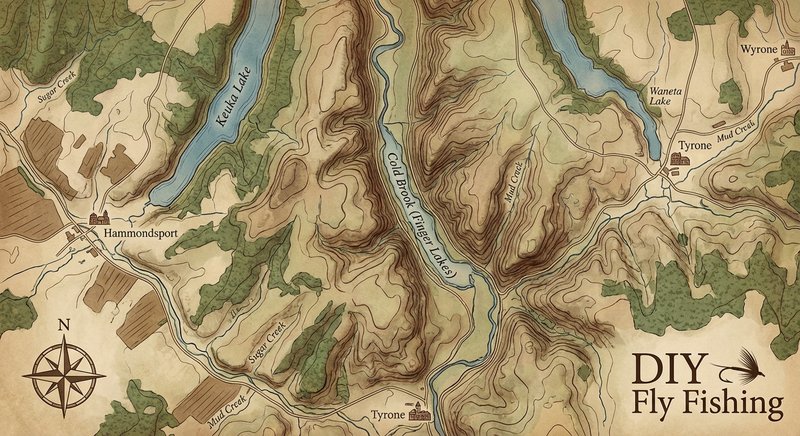
Cold Brook (Finger Lakes)
Fly fishing in New York · Beginner · Best seasons: Spring, Summer, Fall
Target Species
Brown Trout, Rainbow Trout
About This Water
Keuka Lake tributary with wild brown trout. Scenic Finger Lakes fishing.
Fishing Recommendations
Cold Brook, located in the beautiful Pleasant Valley just south of Keuka Lake, is one of the "hidden gems" of the Finger Lakes region. While it doesn't get the same national press as the Salmon River or the Delaware, local sticks know it as a premier destination for lake-run trout.
Here is your comprehensive guide to fly fishing Cold Brook, New York.
🎣 Location Overview
Cold Brook is the primary tributary to the south end of Keuka Lake, entering near the village of Hammondsport. It is a quintessential spring-fed limestone stream that winds through a mix of agricultural land and dense woodlots.
What makes Cold Brook special is its temperature profile. True to its name, it stays significantly cooler than many other area tributaries during the summer months, providing a thermal refuge for trout. The stream features a classic "pool-and-riffle" structure with plenty of undercut banks and woody debris. It is famous for the seasonal migrations of massive Rainbow and Brown trout moving up from the depths of Keuka Lake to spawn.
🐟 Target Species & Behavior
- Rainbow Trout: These are primarily "lake-run" fish. They enter the system in late winter and spring. They are hard-fighting, acrobatic, and often reach sizes of 20+ inches. They hold in the faster water at the heads of pools or behind gravel bars.
- Brown Trout: You will find two types here. Small resident browns (8–12 inches) live in the stream year-round and are very wary. The lake-run browns enter the stream in the fall (October/November). These are the "monsters" of Cold Brook—heavy-bodied, aggressive, and often found hugging the deepest undercuts or dark wood piles.
- Feeding Habits: Resident fish focus on aquatic insects (Caddis, Mayflies) and terrestrials. Lake-run fish aren't feeding actively to grow, but rather out of aggression or instinct; they target egg patterns, nymphs, and small streamers.
📅 Best Times to Fish
- Spring (Mid-March – May): This is the "Main Event." As the ice thaws and spring rains arrive, the Rainbows move up from Keuka Lake. April 1st (the traditional season opener) is often crowded but highly productive.
- Summer (June – August): Focus on the early morning or late evening. This is the time for resident fish. Look for "Cold Water" seeps. If the water temp exceeds 68°F, give the fish a break and stop fishing.
- Fall (October – December): The run of Lake-run Browns begins. This is arguably the best time for a trophy fish. Target the days immediately following a rain event when the water is "tannin-stained" or slightly murky.
- Prime Conditions: High, dropping, and clearing water. When the creek is gin-clear, the large lake-run fish become extremely spooky and difficult to catch.
🪰 Recommended Flies & Techniques
Nymphing (The Bread & Butter)
90% of the fish in Cold Brook are caught on the swing or a dead drift under the surface.
- Patterns:
- Eggs: Glo-bugs or Sucker Spawn in Oregon Cheese, Pink, or Chartreuse.
- Nymphs: Bead-head Pheasant Tails (#14-16), Hare’s Ears, and Prince Nymphs.
- Stoneflies: Large black or golden stonefly nymphs (#8-12) are killers during high water.
Dry Fly (Summer/Resident Fish)
- Patterns: Elk Hair Caddis (#14-18), Blue Winged Olives (#18-22), and Terrestrials (Ants and Beetles) in late summer.
Streamers (The "Big Fish" Hunt)
- Patterns: Black or Olive Woolly Buggers (#6-10) or Zonkers.
- Technique: "Low and Slow." Swing the streamer through the deep holes and twitch it past submerged logs.
Presentation Tips
- Stealth is Mandatory: Because Cold Brook is relatively small and clear, wear earthy colors and move slowly. If you can see the fish, they have likely already seen you.
- Light Tippet: For resident fish, 5X or 6X is necessary. For lake-run fish, you need the strength of 3X or 4X fluorocarbon to prevent break-offs on submerged wood.
💡 Pro Tips & Local Knowledge
- The "State Land" Stretch: Focus your efforts on the sections buffered by the Urbana State Forest and the areas marked with "Public Fishing Rights" (PFR) signs. These areas are well-managed and have the best habitat.
- Follow the Rain: Cold Brook reacts quickly to rain. The best fishing is often 12–24 hours after a storm when the water has a "milky" green color. This gives the fish a sense of security to move out of the deep cover.
- Look for "Redds": In the spring and fall, you will see cleared-out gravel patches (redds) where fish are spawning. Do not fish for trout sitting directly on these nests. It is unethical and harms the future of the fishery. Target the deep water behind or below the spawning areas where "drop-back" fish are feeding.
⚠️ Important Information
- Regulations: New York State has specific Finger Lakes Tributary Regulations.
- Between April 1 and December 31, fishing is generally allowed from sunrise to sunset.
- Note the Single Hook Point rule: Most Finger Lakes tributaries require a single-pointed hook with a gap no larger than 1/2 inch. Always check the current NYSDEC Fishing Regulations Guide before heading out.
- Permits: A valid New York State Fishing License is required for anyone 16 or older.
- Access: Much of the land surrounding Cold Brook is private. Only fish where you see the yellow and blue "Public Fishing Rights" signs. Always respect landowners to ensure future access for all anglers.
- Wading: The stream bottom is mostly gravel and silt. Cleated wading boots are helpful, but be careful not to stir up too much silt as you walk, as it can spook fish downstream.
Guide’s Final Word: Cold Brook is a thinking angler's stream. It rewards patience, stealth, and a light touch. If you find the right pool after a fresh rain in November, you might just hook the largest Brown Trout of your life. Tight lines!
Bug Hatches & Matching Flies
| Hatch | Type | Peak months | Time of day | Hook sizes | Matching flies |
|---|---|---|---|---|---|
| Early Black Stonefly Taeniopteryx spp. | stonefly | March, April | Late Morning/Afternoon | #14-18 | Early Black Stone #14-16, Little Black Sloan #16-18 |
| Blue Winged Olive Baetis spp. | mayfly | April, May, September, October | Midday | #18-22 | RS2 #20-22, BWO Parachute #18-22 |
| Hendrickson Ephemerella subvaria | mayfly | April, May | Afternoon | #12-14 | Red Quill #12-14, Pheasant Tail #12-14 |
| Grannom Caddis Brachycentrus spp. | caddis | April, May | All Day/Evening | #14-16 | LaFontaine's Deep Sparkle Pupa #14-16, Elk Hair Caddis (Olive) #14-16 |
| Sulphur Ephemerella invaria/dorothea | mayfly | May, June | Late Afternoon/Evening | #14-18 | Sulphur Parachute #16-18, Sulphur Snowshoe Emerger #14-18 |
| Light Cahill Stenacron canadense | mayfly | June, July | Evening | #12-14 | Light Cahill #12-14, Gold Ribbed Hare's Ear #12-14 |
| Trico Tricorythodes spp. | mayfly | July, August, September | Early Morning | #22-26 | Trico Spinner #22-24, Zebra Midge #22-26 |
| Terrestrials (Ants/Beetles) Formicidae / Coleoptera | terrestrial | July, August, September | All Day | #12-18 | Black Foam Beetle #14-16, Cinnamon Ant #16-18 |