Black River
Fly fishing in New York · Beginner · Best seasons: Summer, Fall
Target Species
Smallmouth Bass, Brown Trout
About This Water
Jefferson County river with smallmouth bass and some trout. Scenic Adirondack foothills fishing.
Fishing Recommendations
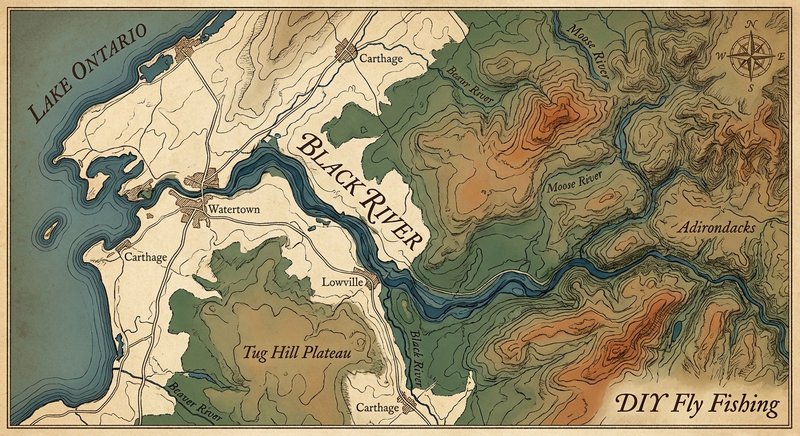
The Black River in Northern New York is one of the most underrated and diverse fisheries in the Northeast. Originating in the Adirondack Mountains and flowing through the Tug Hill region before emptying into Lake Ontario, it offers a dramatic transition from mountain trout water to powerful, ledge-filled smallmouth territory.
As a guide, I categorize the Black River as a "working river" that has reclaimed its wild roots. It is rugged, often tannic (tea-colored), and holds some of the hardest-fighting river smallmouths you will ever encounter.
🎣 Location Overview
The Black River is unique because of its geography. The upper sections near Forestport and Lyons Falls feel like classic Adirondack trout water—cool, forest-canopied, and pristine. As it moves toward Lowville and Watertown, it transforms into a wider, more powerful river with massive limestone shelves, deep pools, and significant rapids.
What makes it special is the tannic water. The high iron and organic content give the water a dark "root beer" tint. This affects how fish see light and makes for an incredible "big fly" fishery. Anglers love it because, unlike the nearby Salmon River, it remains relatively uncrowded for most of the summer and fall.
🐟 Target Species & Behavior
Smallmouth Bass
- Behavior: These are "current-oriented" bass. They behave more like trout than pond bass, often sitting in the "seams" where fast water meets slow water.
- Holding Spots: Look for the "Black River Ledges." The riverbed is full of shale and limestone shelves. Bass tuck directly under these ledges to ambush prey.
- Feeding: They keyed in on two primary sources: Crawfish and Emerald Shiners.
Brown Trout
- Behavior: Found primarily in the upper reaches (above Lyons Falls) and near the mouths of cold-water tributaries like the Otter Creek or Independence River.
- Holding Spots: Look for deep undercut banks and the "tail-outs" of long pools. During the fall, they become highly territorial.
- Feeding: In the summer, they rely on caddis and stonefly hatches. In the fall, they shift almost entirely to a high-protein diet (sculpins and smaller trout).
📅 Best Times to Fish
- Summer (June – August): This is the "Golden Era" for Smallmouth. The water temperature is perfect for metabolic activity. Focus on the early morning (5:00 AM – 9:00 AM) and the last two hours of light for spectacular topwater action.
- Fall (September – October): This is my favorite time. As the water cools, the Smallmouth "school up" and feed heavily for winter. This is also when the resident Brown Trout become aggressive.
- Prime Windows: Keep an eye on the Tug Hill rainfall. The Black River rises quickly. The best fishing occurs 24-48 hours after a rain event when the water is receding but still slightly turbid.
🪰 Recommended Flies & Techniques
For Smallmouth Bass
- Topwater: BoogleBugs (Size 4) in Yellow or Black. The "pop and pause" technique over the ledges is lethal.
- Streamers: Game Changers or Sculpin Helmets. Use high-contrast colors. Because of the dark water, Black/Purple or Chartreuse/White combinations out-fish natural colors 3-to-1.
- Crayfish: Clouser Crayfish or any lead-eyed pattern hopped along the bottom.
For Brown Trout
- Nymphing: Pheasant Tails (Size 14-16) and Prince Nymphs. In the tannic water, a bit of "flash" (bead head) helps the fish track the fly.
- Dry Flies: Elk Hair Caddis (Tan, Size 14) and Stimulators (Orange/Yellow).
Presentation Tip: The "Swing and Twitch"
When fishing streamers for Smallmouth, cast 45 degrees downstream, let the fly swing into the soft water behind a rock, and give it two sharp "jerks" of the rod tip. That change in direction usually triggers the strike.
💡 Pro Tips & Local Knowledge
- The "Watertown Whitewater" Secret: Some of the best Smallmouth fishing in the state is right in the city of Watertown. The river drops over several dams and ledges here. Focus on the "pocket water" below the falls.
- Color Matters: In the tea-colored water, fish have a hard time seeing subtle olives and browns. Use Black flies to create a strong silhouette against the surface, or Fluorescent Orange/Chartreuse to grab attention in the depths.
- The Kayak Advantage: Much of the Black River is difficult to wade because of the "slippery-as-ice" limestone. A kayak or a drift boat allows you to reach the mid-river islands and ledges that shore anglers can't touch.
- The "Fall Transition": In late September, the Smallmouth move out of the fast riffles and into the deepest holes (10–15 feet). Switch to heavy sink-tip lines to get your streamers down to them.
⚠️ Important Information
Access
- Public Access: There are excellent DEC boat launches in Glenfield, Castorland, and Dexter.
- Wading: Be extremely careful. The limestone shelves can drop from 2 feet to 8 feet deep in a single step. Use a wading staff and felt-soled boots with studs.
Regulations
- The Black River has specific regulations depending on the section.
- Bass: Generally, the season opens the 15th of June.
- Trout: Many upper sections are "Open Year Round" but check the NY DEC Region 6 syllabus for specific tributary closures.
Safety
The Black River is used for hydroelectric power. Water levels can rise suddenly due to dam releases. If you notice the water getting muddy or seeing floating debris, move to high ground immediately.
Guide’s Final Word: If you want a trophy Smallmouth that fights like a freight train, fish the Black River from Lowville to Carthage in mid-September. Bring a 7-weight rod and your biggest black streamers. You won't be disappointed.
Bug Hatches & Matching Flies
| Hatch | Type | Peak months | Time of day | Hook sizes | Matching flies |
|---|---|---|---|---|---|
| Blue Winged Olive Baetis | mayfly | April, May, September, October | Midday | #18-22 | BWO Sparkle Dun #18-22, Pheasant Tail #18-20, RS2 #20-22 |
| Hendrickson Ephemerella subvariabilis | mayfly | May | Afternoon | #12-14 | Red Quill #12-14, Hendrickson Emerger #14, Gold Ribbed Hare's Ear #12-14 |
| Grannom Caddis Brachycentrus | caddis | May | Morning/Afternoon | #14-16 | Elk Hair Caddis (Olive) #14-16, LaFontaine's Deep Sparkle Pupa #14-16, Holy Grail #14-16 |
| Sulphur Ephemerella invaria/rotunda | mayfly | June | Evening | #14-18 | Sulphur Parachute #14-18, Sulphur Soft Hackle #16-18, Mercer's Poxy Back Sulphur #16-18 |
| Eastern Green Drake Ephemera guttulata | mayfly | June | Evening/Dusk | #8-12 | Green Drake Paradun #8-10, Coffin Fly #8-10, Grey Fox Variant #12 |
| Slate Drake Isonychia bicolor | mayfly | June, July, August, September | Afternoon/Evening | #10-14 | Iso Parachute #12-14, Isonychia Nymph #10-12, Zug Bug #12-14 |
| Light Cahill Stenacron / Stenonema | mayfly | June, July | Evening | #12-16 | Light Cahill #12-16, Cream Usual #14-16, Gold Ribbed Hare's Ear (Light) #14-16 |
| Tan Caddis Hydropsyche | caddis | June, July, August | Morning/Evening | #14-18 | Elk Hair Caddis (Tan) #14-18, Pupa Fly #16, Peeping Caddis #14-16 |
| Terrestrials (Ants/Beetles) Formicidae / Coleoptera | terrestrial | July, August, September | All Day | #12-18 | Black Foam Ant #16-18, Chernobyl Ant #10-12, Crow Beetle #14-16 |
| Giant Black Stonefly Pteronarcys dorsata | stonefly | May, June | Night/Early Morning | #4-8 | Pat's Rubber Legs #6-8, Kaufmann's Stone #6-10, Black Stimulator #8-10 |