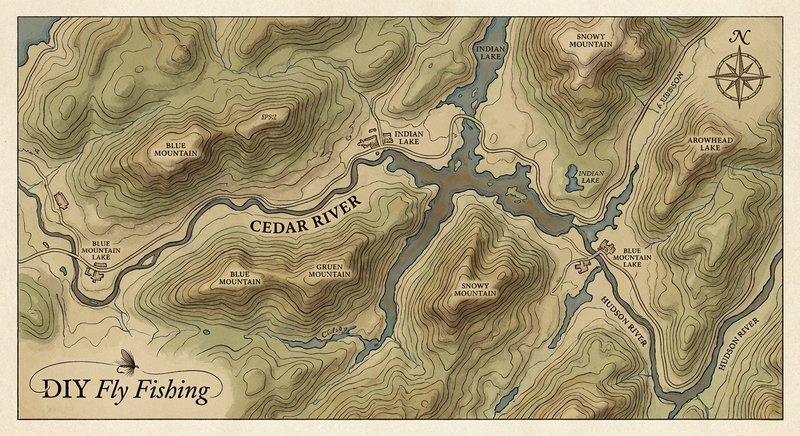
Cedar River
Fly fishing in New York · Intermediate · Best seasons: Summer, Fall
Target Species
Brook Trout
About This Water
Central Adirondack stream with wild brook trout. Remote wilderness fishing.
Fishing Recommendations
The Cedar River is one of the Adirondack Park’s true gems. Flowing through the rugged backcountry of Hamilton County, it offers a quintessential "North Country" fly fishing experience. This is a river of dual personalities: the upper reaches near Cedar River Flow are wild, intimate, and tannic, while the lower sections towards the confluence with the Hudson River become swifter and more technical.
For the angler seeking wild, native Brook Trout in a landscape that looks exactly as it did 100 years ago, the Cedar is a premier destination.
🎣 Location Overview
The Cedar River is a classic Adirondack freestone stream. It is characterized by its tea-colored (tannic) water, a result of the surrounding hemlock forests and wetlands. The riverbed is a mix of ancient Adirondack boulders, cobble, and sandy bends.
What makes it special is its remoteness. Much of the river flows through the Blue Mountain Wild Forest and the Hudson Gorge Wilderness. It isn't a "roadside" stream in its most productive stretches; it requires a bit of hiking or paddling, which keeps the crowds away and the trout less pressured than the more famous Ausable or Upper Delaware.
🐟 Target Species & Behavior
The star of the show here is the Wild Brook Trout. While you may occasionally find a brown trout in the lower reaches near the Hudson, the Cedar is Brookie territory.
- Behavior: These are opportunistic feeders but remain highly skittish. Because the water is often nutrient-poor, they can't afford to be too picky, but they are incredibly sensitive to shadows and heavy wading.
- Holding Water: In the summer, they hold in the "pockets" behind boulders and in the deep, oxygenated bubbles at the base of small falls. In the fall, they move toward gravelly tailouts and spring-fed tributaries for spawning.
- Diet: Their diet consists mainly of small stoneflies, caddis, and terrestrial insects (ants and beetles) that fall from the dense overhanging canopy.
📅 Best Times to Fish
While the river is open from April 1 to Oct 15, your requested focus on Summer and Fall is actually the prime time for this specific water.
- Summer (Late June – August):
- The Window: Focus on early morning (6 AM – 10 AM) and "the magic hour" just before dusk.
- Conditions: As water temperatures rise, Brookies seek "thermal refugia." Look for cold-water seeps or where smaller, colder mountain brooks enter the main stem. If the water exceeds 68°F, please stop fishing to protect the trout.
- Fall (September – October 15):
- The Window: Mid-day becomes more productive as the sun warms the water slightly.
- Conditions: This is the most beautiful time to be on the Cedar. The Brookies take on their brilliant spawning colors (deep oranges and red halos). They become more aggressive as they prepare for the spawn, often striking at larger attractor patterns.
🪰 Recommended Flies & Techniques
Top Fly Patterns
- Dry Flies:
- Royal Wulff or Royal Coachman (Size 12-16): The white wings are easy to see in the dark, tannic water.
- Elk Hair Caddis (Tan/Olive, Size 14-18): A staple for the evening rise.
- Black Ants & Foam Beetles (Size 14-18): Essential for summer afternoons.
- Nymphs:
- Bead-head Pheasant Tail (Size 14-18): Mimics almost any dark aquatic larva.
- Prince Nymph (Size 12-16): The "flash" works well in the tea-colored water.
- Streamers:
- Black Ghost or Mickey Finn (Size 8-12): Classic Adirondack patterns that mimic small dace or brook trout fry.
Techniques
- The "Dry-Dropper": This is the most effective way to fish the Cedar. Use a buoyant Royal Wulff as your indicator and hang a small Pheasant Tail nymph 18-24 inches below it.
- Dapping: In the tight, brushy upper sections, you won't be casting much. Use a short line and "dap" your fly into the pockets behind logs.
- Stealth: Keep a low profile. If you can see the fish, they have likely already seen you. Wear earthy colors (greens and browns) to blend into the forest.
💡 Pro Tips & Local Knowledge
- Focus on the "Flow": The section below Cedar River Flow (the dam) provides consistent cold water. This area is a hotspot for Brookies.
- The Chain of Lakes Road: This road provides several access points. Park at the designated trailheads and walk at least 15-20 minutes away from the bridge. The fishing quality improves exponentially the further you get from the road.
- The "Tannic Trick": Because the water is dark, fish have a harder time seeing subtle flies. Don't be afraid to use flies with a bit of "bling"—bead heads, krystal flash, or bright white wings help the fish track the fly in the amber water.
- Check the Gauge: The Cedar is rain-dependent. If it’s been a drought, it can get very low and bony. Check the USGS gauge for "Cedar River near Indian Lake." You want a steady or slightly dropping flow for the best luck.
⚠️ Important Information
- Access: Much of the river is within the Forest Preserve (Public Land), but there are sections of private "camps." Always look for "Posted" signs. The most popular access is via the Cedar River Road out of Indian Lake.
- Regulations:
- New York State general angling regulations apply, but many sections are Catch and Release or have specific size limits for trout. Always check the current NYSDEC Freshwater Fishing Regulations before heading out.
- Safety: This is bear and moose country. Carry a whistle and be aware of your surroundings. Cell service is non-existent once you leave the town of Indian Lake—tell someone where you are going and when you expect to return.
- The Bug Factor: In June and July, the "Adirondack Air Force" (black flies and deer flies) is brutal. Bring heavy-duty repellent or a head net.
Bug Hatches & Matching Flies
| Hatch | Type | Peak months | Time of day | Hook sizes | Matching flies |
|---|---|---|---|---|---|
| Hendrickson Ephemerella subvariabilis | mayfly | May | Afternoon | #12-14 | Red Quill #12-14, Hendrickson Emerger #14, Pheasant Tail #12-14 |
| Blue-Winged Olive Baetis spp. | mayfly | May, September, October | Late Morning/Afternoon | #18-22 | RS2 #20-22, Parachute BWO #18-22, WD-40 #20 |
| Grannom Caddis Brachycentrus | caddis | May | All Day | #14-16 | Elk Hair Caddis (Green body) #14-16, Peacock Caddis #16, Deep Sparkle Pupa #14-16 |
| March Brown Maccaffertium vicarium | mayfly | June | Afternoon | #10-12 | March Brown Parachute #10-12, Hare's Ear Nymph #10-12, March Brown Wet Fly #12 |
| Sulphurs Ephemerella dorothea | mayfly | June, July | Evening | #16-18 | Sulphur Parachute #16-18, Sulphur Spinner #16-18, Split Case Sulphur #16 |
| Light Cahill Stenacron interpunctatum | mayfly | June, July, August | Late Afternoon/Evening | #12-14 | Light Cahill #12-14, Gold Ribbed Hare's Ear #14 |
| Isonychia Isonychia bicolor | mayfly | June, September | Late Afternoon | #10-12 | Iso Parachute #10-12, Zug Bug #10-12, Prince Nymph #10-14 |
| Golden Stonefly Acroneuria spp. | stonefly | June, July | Morning/Evening | #8-12 | Golden Stone Nymph #8-12, Stimulator (Yellow) #10-12, Pats Rubber Legs #8-12 |
| Cinnamon Caddis Hydropsyche | caddis | June, July, August | Evening | #14-18 | Elk Hair Caddis (Tan) #14-18, LaFontaine's Emergent Pupa #16, Frenchie #14-16 |
| Ants and Beetles Formicidae / Coleoptera | terrestrial | July, August, September | All Day | #12-18 | Black Foam Ant #14-18, Cinnamon Ant #14-16, Black Beetle #12-16 |