Cold River
Fly fishing in New York · Advanced · Best seasons: Summer, Fall
Target Species
Brook Trout
About This Water
Remote Adirondack wilderness stream with native brook trout. True backcountry fishing.
Fishing Recommendations
The Cold River in the Adirondack Mountains of New York is the holy grail for backcountry brook trout enthusiasts. Flowing through the heart of the High Peaks Wilderness, it is one of the most remote and pristine rivers in the Eastern United States. This is not a "roadside" fishery; it is a destination for the angler who values solitude, scenery, and wild, native fish over trophy sizes.
🎣 Location Overview
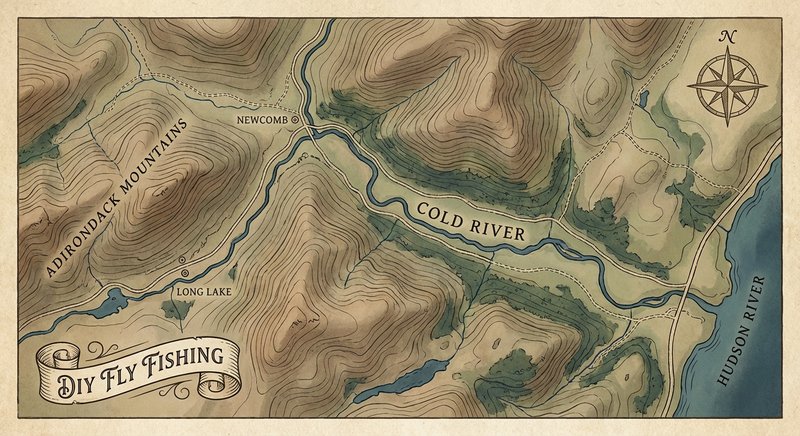
The Cold River is a major tributary of the Raquette River, winding through a valley flanked by the Seward Range and the Santanoni Mountains. What makes it special is its wildness. There are no roads, no cell service, and no dams. The water is classic Adirondack "freestone"—crystal clear but often tea-colored due to natural tannins from the surrounding forest and bogs.
The river features a diverse mix of fast-moving pocket water, deep mysterious pools, and long, flat "deadwaters." Anglers love it because it offers a glimpse into what brook trout fishing was like 200 years ago. It is also famous for its history, specifically as the home of Noah John Rondeau, the "Hermit of Cold River," who lived in the wilderness here for decades.
🐟 Target Species & Behavior
The primary (and usually only) target is the Wild Brook Trout. These are native, self-sustaining populations.
- Size: Expect fish in the 6-10 inch range, with a "trophy" backcountry brooky reaching 12-14 inches.
- Behavior: These fish are highly opportunistic due to the short Adirondack growing season and nutrient-poor water. They aren't usually "picky" eaters, but they are extremely spooky. In the clear, shallow water, a shadow or a heavy footfall will send them darting under boulders.
- Holding Water: In the summer, they congregate in highly oxygenated riffles or near "spring holes" (colder groundwater seeps). In the fall, they move toward gravelly tailouts and smaller tributaries to prepare for spawning.
📅 Best Times to Fish
Summer (Late June – August)
- Conditions: This is the most accessible time for the long hike in. However, water temperatures can rise.
- Strategy: Focus on the early morning (dawn to 10 AM) and the "golden hour" before dusk. Use a thermometer; if the water is over 68°F, stop fishing to protect the trout.
- The "Bug" Factor: Be prepared for the infamous Adirondack black flies and mosquitoes.
Fall (September – October 15)
- Conditions: This is the "Prime Time." As air temperatures drop, the water cools and the brook trout become incredibly aggressive.
- Visuals: The fish take on their brilliant spawning colors—deep orange bellies and ivory-edged fins. The fall foliage provides a world-class backdrop.
- Window: Mid-September is arguably the best fishing of the year. Note that the NY trout season on inland waters generally ends October 15.
🪰 Recommended Flies & Techniques
Because these fish are opportunistic, you don't need 500 patterns. You need a few patterns that you can present accurately.
Top Fly Patterns
- Dry Flies:
- Ausable Wulff: A local Adirondack classic that floats high in heavy pocket water.
- Royal Wulff: High visibility and attracts aggressive strikes.
- Elk Hair Caddis (Tan/Olive): Mimics the abundant caddis life.
- Terrestrials (Summer): Black Ants, Foam Beetles, and small Grasshoppers.
- Nymphs:
- Gold Ribbed Hare’s Ear (#14-18): A great generalist.
- Pheasant Tail: Best for mimicking small mayfly nymphs.
- Streamers:
- Black or Olive Woolly Bugger (#10-12): Best for the deep pools or when the water is slightly high/off-color.
- Mickey Finn: A classic bucktail that brook trout find irresistible.
Techniques
- The "Dry-Dropper": A buoyant dry fly with a small nymph suspended 18 inches below is the most effective way to cover the pocket water.
- Upstream Stealth: Always fish moving upstream. Approach pools from behind, staying low to the ground to avoid being silhouetted against the sky.
- Short Line Nymphing: Much of the river is tight and technical. You’ll often find yourself "dapping" or using very short casts to reach pockets behind boulders.
💡 Pro Tips & Local Knowledge
- Focus on the Confluences: Where smaller, colder mountain brooks enter the Cold River, the fishing is often significantly better, especially in the heat of August.
- Rondeau’s Hermitage: Fishing the stretch near the "Hermit’s" old home site (near the junction of the Northville-Placid Trail and the Calkins Brook Trail) is historically significant and remains some of the best water on the river.
- The "Tea" Factor: Because the water is tannin-stained, high-visibility flies (white wings, bright colors) help you see the fly, and darker silhouettes (black/coffee) help the fish see the fly against the water.
- Tenkara: This river is perfectly suited for Tenkara fishing. The ability to keep the line off the complex currents of the pocket water is a massive advantage here.
⚠️ Important Information
- Access: This is a serious undertaking. The two main ways in are hiking from Coreys (Raquette River Trailhead) or hiking from Long Lake via the Northville-Placid Trail. Expect a 10–14 mile hike to reach the heart of the river. Many anglers choose to backpack in and stay at one of the lean-tos (Shattuck Clearing or Seward lean-tos).
- Regulations: Always check the current NYSDEC Freshwater Fishing Regulations. Most of this water falls under "General" regs, but being in a Wilderness Area, there are strict rules regarding camping, fires, and group sizes.
- Safety: You are in a remote area. Carry a satellite messenger (like a Garmin inReach), bear-proof food storage (bear canisters are required in the High Peaks Wilderness), and a comprehensive first-aid kit.
- Leave No Trace: These wild brook trout are a fragile resource. Use barbless hooks, handle fish with wet hands, and keep them in the water. Pack out everything you pack in.
Bug Hatches & Matching Flies
| Hatch | Type | Peak months | Time of day | Hook sizes | Matching flies |
|---|---|---|---|---|---|
| Hendrickson Ephemerella subvaria | mayfly | May | Afternoon | #12-14 | Red Quill #12-14, Hendrickson Emerger #12-14, Pheasant Tail Nymph #12-14 |
| Grannom Caddis Brachycentrus | caddis | May | Morning/Afternoon | #14-16 | Peacock Caddis #14-16, Green Weenie #14-16, LaFontaine's Deep Sparkle Pupa #14-16 |
| March Brown Maccaffertium vicarium | mayfly | June | Afternoon | #10-12 | March Brown American #10-12, Gold Ribbed Hare's Ear #10-12, March Brown Wet Fly #10-12 |
| Eastern Green Drake Ephemera guttulata | mayfly | June | Evening | #8-10 | Green Drake Paradrake #8-10, Coffin Fly #8-10, Green Drake Nymph #8-10 |
| Golden Stonefly Acroneuria | stonefly | June, July | Evening/Night | #6-10 | Stimulator (Yellow) #8-12, Golden Stone Nymph #6-10, Pats Rubber Legs #8-10 |
| Light Cahill Stenacron interpunctatum | mayfly | June, July | Evening | #12-14 | Light Cahill #12-14, Cahill Emerger #12-14 |
| Blue-Winged Olive Baetis vagans | mayfly | May, September, October | Afternoon | #18-22 | BWO Sparkle Dun #18-22, RS2 #18-22, Micro-Mayfly Nymph #18-20 |
| Black Carpenter Ant Camponotus pennsylvanicus | terrestrial | July, August | All Day | #12-16 | Black Foam Ant #14-16, Flying Ant #14-16 |
| Cinnamon Sedge Hydropsyche | caddis | July, August | Evening | #14-18 | Elk Hair Caddis (Tan) #14-18, Soft Hackle Hare's Ear #14-16 |