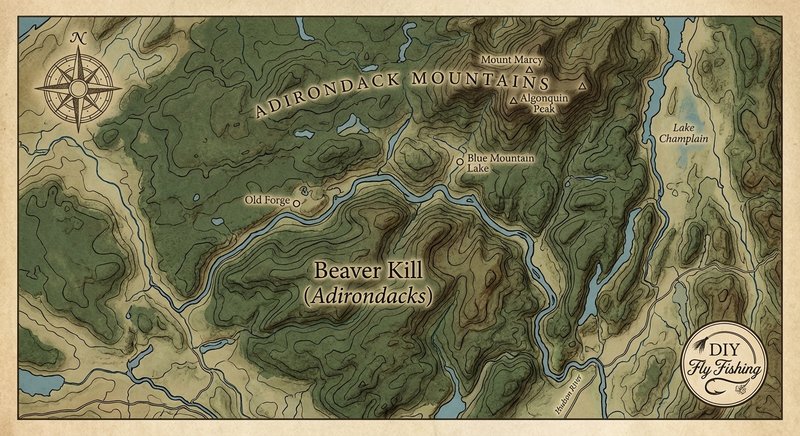
Beaver Kill (Adirondacks)
Fly fishing in New York · Beginner · Best seasons: Summer, Fall
Target Species
Brook Trout
About This Water
Not to be confused with the Catskill Beaverkill. Adirondack stream with brook trout.
Fishing Recommendations
It is crucial to first make a distinction: this is not the famous "Beaverkill River" of the Catskills. The Beaver Kill of the Adirondacks (specifically the West Canada Creek Wilderness and Siamese Ponds Wilderness area) is a rugged, remote, and quintessential freestone mountain stream.
For the angler seeking solitude and vibrant, wild Brook Trout in a "Blue Lines" setting, this is hallowed ground.
🎣 Location Overview
The Adirondack Beaver Kill is a tributary of the West Canada Creek. Unlike its southern namesake, which is famous for wide pools and heavy hatches, the Adirondack version is a classic high-elevation brook trout stream.
The water is "tea-colored" due to natural tannins from the surrounding hemlocks and peat bogs. It features a high gradient with a "pocket water" character—lots of plunge pools, boulders, and undercut banks. What makes it special is the lack of crowds. While the Catskills can feel like a parking lot, the Adirondack Beaver Kill requires a hike and a sense of adventure, rewarding anglers with some of the most beautiful native Brook Trout in the eastern United States.
🐟 Target Species & Behavior
The primary (and often only) target here is the Wild Brook Trout.
- Behavior: These are opportunistic feeders. Due to the nutrient-poor nature of high-altitude freestone streams, these fish cannot afford to be picky. However, they are extremely "spooky." In this crystal-clear (though tinted) water, a shadow or a heavy footfall will send them darting under a rock for an hour.
- Where they hold: Look for "bubbles and foam." Brookies love the highly oxygenated water at the head of a pool. They also hold tight to undercut banks and behind large boulders where the current breaks.
- Diet: Their diet consists of small stoneflies, caddis, and terrestrial insects (ants/beetles) that fall from the dense canopy.
📅 Best Times to Fish
While many trout streams shut down in the heat, the Beaver Kill stays cooler longer due to its elevation and forest cover.
- Summer (June - August): This is the prime window for dry fly fishing. The water levels have stabilized, and the fish are looking up.
- Time of Day: Early morning and late evening are best, though the canopy provides enough shade for decent mid-day fishing.
- Fall (September - October): This is the most magical time. The Brook Trout take on their spawning colors—deep oranges and vivid reds.
- Time of Day: Mid-day becomes better as the water temperatures drop.
- Note: Be mindful of spawning beds (redds) in late October; avoid stepping on clean gravel patches.
🪰 Recommended Flies & Techniques
Top Fly Patterns
- Dry Flies:
- Royal Wulff (Size 14-18): The ultimate "attractor." High visibility is key in the broken water.
- Elk Hair Caddis (Tan/Olive, Size 16): Mimics the prolific caddis hatches.
- Black Ants & Foam Beetles (Size 16-18): Absolute must-haves for Summer.
- Nymphs:
- Bead-head Pheasant Tail (Size 16-20): A standard for a reason.
- Prince Nymph (Size 14-16): The "flash" helps fish see it in the tannin-stained water.
- Streamers:
- Black Nose Dace or Small Wooly Bugger (Size 10-12): Use these in the deeper pools to find the "trophy" 10-inchers.
Techniques & Presentation
- High-Sticking: Because the current is complex, minimize the amount of fly line on the water. Keep your rod tip high and "lead" your dry fly through the pockets.
- Stealth is Everything: Dress in earthy tones (camo or olive). Approach the pool from downstream and stay low—sometimes even kneeling.
- Short Casts: You will rarely need to cast more than 15–20 feet. Accuracy and a soft landing are more important than distance.
💡 Pro Tips & Local Knowledge
- The "One-Cast" Rule: In these small pools, your first cast is your best chance. If you mess up the drift or slap the water, move to the next pocket.
- Focus on the Confluences: Where small, unnamed trickles enter the Beaver Kill, the water is often a few degrees cooler. Brookies will stack up in these spots during a hot July.
- Gear Up Light: A 2-weight or 3-weight rod (7 to 8 feet) is perfect. Anything heavier is overkill and makes it harder to navigate the thick brush.
- The "Adirondack Bushwhack": Be prepared for no cell service and difficult wading. The rocks are slippery; felt soles (where legal) or studs are highly recommended.
⚠️ Important Information
Access
The Beaver Kill can be accessed via trails within the West Canada Creek Wilderness. Most anglers access it from the area near Nobleboro or by hiking in from the Indian Lake/Jessup River side. Be prepared for a hike; the best fishing is usually 2+ miles from the nearest trailhead.
Regulations & Permits
- License: A valid New York State Fishing License is required.
- Specific Rules: This area generally falls under "Inland Trout Stream" regulations, but always check the NYS DEC Fishing Guide for the current year, as some wilderness sections may have "Catch and Release only" or "Artificial Lures Only" designations.
- Wilderness Ethics: This is a "Leave No Trace" area. Carry out what you carry in.
Special Considerations
- Black Flies: In June and early July, the biting flies can be brutal. Bring high-quality repellent or a head net.
- Bears: This is black bear country. If you are camping or carrying food, use a bear-resistant canister or hang your bag.
- Water Safety: Adirondack weather changes fast. A bright morning can turn into a torrential downpour by 2:00 PM, causing small streams to rise rapidly.
Bug Hatches & Matching Flies
| Hatch | Type | Peak months | Time of day | Hook sizes | Matching flies |
|---|---|---|---|---|---|
| Quill Gordon Epeorus pleuralis | mayfly | April, May | Midday to Afternoon | #12-14 | Quill Gordon Dry #12-14, Quill Gordon Wet #12-14 |
| Hendrickson Ephemerella subvariabilis | mayfly | May | Afternoon | #12-14 | Red Quill #12-14, Hendrickson Sparkle Dun #12-14 |
| Grannom Caddis Brachycentrus | caddis | May | Morning/Afternoon | #14-16 | Elk Hair Caddis (Dark) #14-16, Peacock Caddis #14-16 |
| March Brown Maccaffertium vicarium | mayfly | May, June | Midday | #10-12 | March Brown American #10-12, Hare's Ear Nymph #10-12 |
| Sulfur Ephemerella dorothea | mayfly | June, July | Evening | #14-18 | Sulfur Parachute #16-18, Sulfur Emerger #14-18 |
| Light Cahill Stenacron interpunctatum | mayfly | June, July, August | Evening/Dusk | #12-14 | Light Cahill Dry #12-14, Cream Usual #12-16 |
| Golden Stonefly Acroneuria | stonefly | June, July | Evening/Night | #8-12 | Golden Stone Nymph #8-12, Stimulator (Yellow) #8-12 |
| Blue-Winged Olive Baetis | mayfly | May, September, October | Afternoon | #18-22 | BWO Parachute #18-22, RS2 (Grey/Olive) #20-22 |
| Slate Drake Isonychia bicolor | mayfly | June, August, September | Late Afternoon | #10-12 | Isonychia Parachute #10-12, Zug Bug #10-14 |
| Ants and Beetles Formicidae / Coleoptera | terrestrial | July, August, September | All Day | #12-18 | Black Foam Ant #14-18, Crowe Beetle #12-16 |