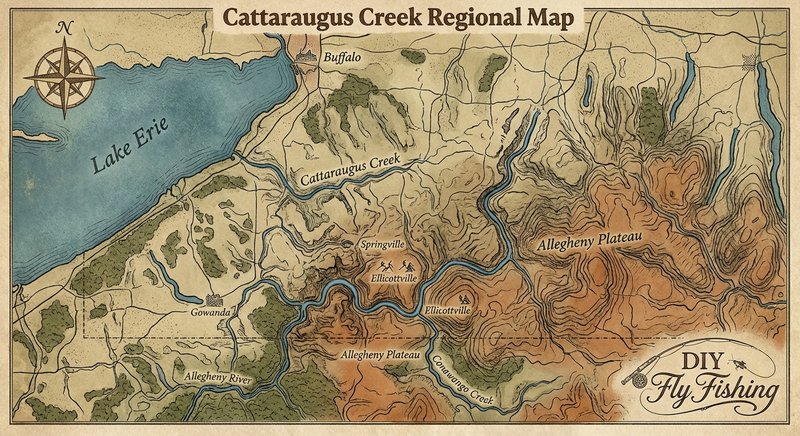
Cattaraugus Creek
Fly fishing in New York · Intermediate · Best seasons: Fall, Winter, Spring
Target Species
Steelhead, Brown Trout
About This Water
Western NY steelhead fishery. Lake Erie tributary with excellent fall and spring runs.
Fishing Recommendations
Welcome to "The Cat." As a guide in the Great Lakes region, I can tell you that Cattaraugus Creek is the crown jewel of New York’s Lake Erie tributaries. It is a "big water" experience that feels more like a Pacific Northwest river than a typical East Coast stream.
Here is your comprehensive guide to fly fishing Cattaraugus Creek.
🎣 Location Overview
Cattaraugus Creek, or simply "The Cat," flows through the scenic Zoar Valley and the Seneca Nation of Indians (SNI) reservation before emptying into Lake Erie at Irving, NY.
What makes this river special is its scale and character. Unlike the smaller "ditch-style" tributaries nearby, the Cat is wide, powerful, and framed by towering shale cliffs and clay banks. It is famous for its "steelhead green" water—a specific milky-emerald hue caused by suspended clay particles. When the water has 12–24 inches of visibility, it offers some of the best steelhead fishing in the world.
🐟 Target Species & Behavior
Steelhead
These are primarily the "Manistee" strain—hard-fighting, acrobatic fish that enter the river from Lake Erie.
- Behavior: In the early fall, they are aggressive and will chase swung flies in the faster riffles. As water temperatures drop in winter, they move into deep, slow-moving "wintering" holes and become more lethargic, requiring dead-drifted presentations.
- Holding Water: Look for the "seams" where fast and slow water meet, tailouts of large pools, and the soft water in front of or behind large boulders.
Brown Trout
While Steelhead are the main draw, the Cat sees a respectable run of Lake-run Brown Trout in the fall.
- Behavior: Browns are stealthier and often hold tighter to the banks, under log jams, or in deeper, darker undercut ledges compared to the Steelhead.
📅 Best Times to Fish
- Fall (Late September – November): This is the prime window. The first big rains in late Sept/early Oct trigger the migration. Fish are fresh, silver, and incredibly strong.
- Winter (December – February): Fishing is highly dependent on ice. If the river remains open, the fishing can be stellar, but you must fish deep and slow. The crowds disappear during this time.
- Spring (March – April): This period features "drop-back" fish (heading back to the lake) and fresh spring runners. Drop-backs are hungry and very aggressive.
- The "Magic" Window: Always check the USGS Gauge at Gowanda. You are looking for a dropping hydrograph. If the river is above 1,000 CFS, it’s generally too dangerous and muddy. The "sweet spot" is usually 300 to 600 CFS.
🪰 Recommended Flies & Techniques
1. Swinging (Spey or Switch)
The Cat is one of the best rivers in the East for Spey casting.
- Patterns: Intruders (Pink/White, Black/Blue), Bunny Leeches, and the "Egg-Hucking" Leech.
- Technique: Cast 45 degrees downstream, mend to sink the fly, and let it swing through the tension of the current.
2. Indicator Nymphing
The most productive method for sheer numbers.
- Patterns:
- Eggs: Estaz Eggs (Peach, Chartreuse, Orange), Sucker Spawn, and Glow-Bugs.
- Nymphs: Size 8–12 Stoneflies (Black, Golden), Prince Nymphs, and Hare’s Ears.
- Technique: Use a long leader (9–12ft) and enough split shot to get the fly to the "tick" the bottom.
3. Streamer Stripping
- Patterns: Wooly Buggers (Olive, Black) and Zonkers.
- Technique: Effective in early fall or late spring when fish are active. Work the banks and soft edges.
💡 Pro Tips & Local Knowledge
- The "Steelhead Green" Rule: If you can see your boots in knee-deep water, the fishing is perfect. If it looks like chocolate milk, go get a burger and wait a day; the clay takes time to settle.
- Wading Safety: The Cat has a "slippery as grease" bottom due to the clay and shale. Studded felt boots and a wading staff are non-negotiable.
- Focus on the Zoar Valley: For those willing to hike, the Zoar Valley MUA (Multiple Use Area) offers breathtaking scenery and less-pressured fish. It is rugged, so bring water and a map.
- Cover Water: Steelhead are migratory. If you don't have a hit in 20 minutes, move 50 yards. Don't "marry" a hole unless you see fish surfacing.
⚠️ Important Information
- Seneca Nation Permit: A significant portion of the best water is on the Seneca Nation of Indians Reservation. A New York State fishing license is NOT enough. You must purchase a separate Seneca Nation Fishing License (available online or at local bait shops in Irving/Gowanda).
- Regulations: Pay close attention to the "Catch and Release" sections and seasonal closures on certain tributaries. The main stem has specific bag limits.
- Respect the Land: Much of the river borders private property or tribal land. Always use designated access points and pack out what you pack in.
Guide’s Final Word: The Cat is a moody river. She can be chocolate brown one day and world-class the next. Be patient with the conditions, respect the power of the water, and you’ll find yourself hooked into some of the finest Steelhead in the Great Lakes basin.
Bug Hatches & Matching Flies
| Hatch | Type | Peak months | Time of day | Hook sizes | Matching flies |
|---|---|---|---|---|---|
| Blue Winged Olive Baetis spp. | mayfly | April, May, September, October | Midday | #18-22 | RS2 #18-22, Parachute Adams #18-22, Pheasant Tail #18-20 |
| Hendrickson Ephemerella subvaria | mayfly | April, May | Afternoon | #12-14 | Red Quill #12-14, Hendrickson Emerger #12-14, Hare's Ear Nymph #12-14 |
| Grannom Caddis Brachycentrus | caddis | April, May | Morning/Afternoon | #14-16 | Peacock Caddis #14-16, Holy Grail #14-16, LaFontaine's Deep Pupa #14-16 |
| Sulphur Ephemerella invaria | mayfly | May, June | Evening | #14-18 | Sulphur Parachute #14-18, Sulphur Cripple #16, Gold Ribbed Hare's Ear #14-16 |
| March Brown Maccaffertium vicarium | mayfly | May, June | Afternoon | #10-12 | March Brown American #10-12, March Brown Spider #12, March Brown Nymph #10-12 |
| Slate Drake Isonychia bicolor | mayfly | June, September, October | Afternoon/Evening | #10-12 | Iso Parachute #10-12, Zug Bug #10-12, Isonychia Nymph #10-12 |
| Light Cahill Stenacron interpunctatum | mayfly | June, July | Evening | #12-14 | Light Cahill #12-14, Cahill Emerger #14 |
| Ants and Beetles Hymenoptera / Coleoptera | terrestrial | July, August, September | All Day | #12-18 | Chernobyl Ant #12-14, Black Foam Ant #16-18, Crow Beetle #14-16 |
| Chironomids Midge | midge | January, February, March, December | Midday | #18-24 | Zebra Midge #18-22, Griffith's Gnat #20-22, Black Beauty #20-22 |