Boquet River
Fly fishing in New York · Intermediate · Best seasons: Spring, Summer, Fall
Target Species
Brown Trout, Brook Trout, Landlocked Salmon
About This Water
Eastern Adirondack stream with wild brown and brook trout. Scenic fishing near Lake Champlain.
Fishing Recommendations
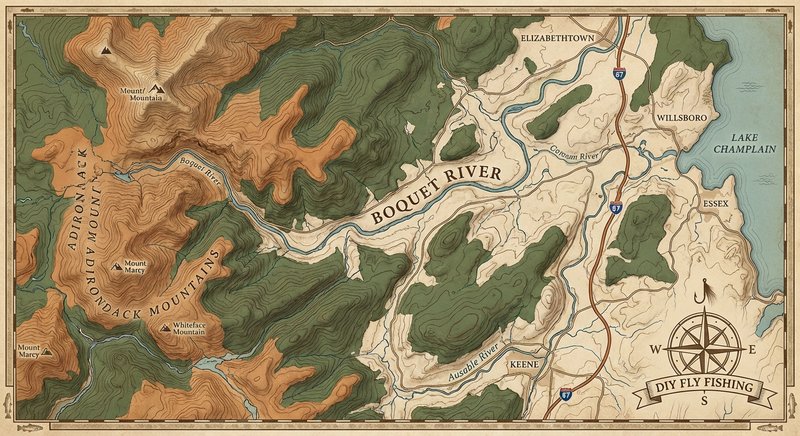
The Boquet River is one of the Adirondacks’ most storied and diverse fisheries. Flowing from the high peaks of the Dix Mountain Wilderness down to the shores of Lake Champlain at Willsboro, it offers a "Dr. Jekyll and Mr. Hyde" experience: a rugged, mountain freestone stream in its upper reaches and a powerful migratory corridor in its lower sections.
As your guide, here is the comprehensive breakdown for fishing the Boquet.
🎣 Location Overview
The Boquet (pronounced bo-KWET) is celebrated for its accessibility and its dual nature.
- The Upper River: Above the town of Elizabethtown, the river is a classic Adirondack freestone stream. It features cold, oxygenated water, pocket water, and plunge pools surrounded by boulders.
- The Lower River: Below the cascades in Willsboro, the river transforms into a prime destination for migratory salmonids. The river is "special" because it is one of the most successful spawning tributaries for Lake Champlain’s Landlocked Atlantic Salmon, thanks to a major dam removal and fish passage project in Willsboro.
🐟 Target Species & Behavior
Landlocked Atlantic Salmon
The crown jewel of the Boquet. These fish spend most of their lives in Lake Champlain and enter the river to spawn. Unlike Pacific salmon, they do not die after spawning and can be very aggressive.
- Holding: Look for them in deep "staging" pools, behind large boulders, or in the bubbly water at the head of runs.
Brown Trout
Predominantly found in the middle reaches (around Elizabethtown and Lewis). They are wary and prefer overhead cover.
- Feeding: They transition from nymphs in early spring to heavy evening hatches in June, becoming nocturnal and predatory (streamer eaters) in late summer.
Brook Trout
The native heartbeat of the upper Boquet and its tributaries (like the North Branch).
- Behavior: Opportunistic feeders. They hold in the "soft" water behind rocks and in small plunge pools. They favor cold, clean water—if the temperature rises, they head for the spring-fed feeders.
📅 Best Times to Fish
Spring (Mid-April – June)
- The Draw: The "Smelt Run." Salmon follow the baitfish into the lower river.
- Conditions: High water is common. Bring sinking tips.
- Hatch: Look for Hendricksons in May—this is the first major dry fly event of the year.
Summer (July – August)
- The Draw: Dry fly fishing for trout in the upper reaches.
- Conditions: Water can get low and warm. Pro Tip: Carry a thermometer. If the water is over 68°F, stop fishing to protect the trout.
- Time of Day: First light and the final 90 minutes of "magic hour" before dark.
Fall (September – October)
- The Draw: The Main Salmon Run. This is the peak season for many anglers.
- Conditions: Salmon move on the heels of a rain event. A rise in water levels triggers a massive push of fish from the Lake.
🪰 Recommended Flies & Techniques
For Landlocked Salmon
- Streamers: Grey Ghost, Black Ghost, and the Mickey Finn. These mimic the smelt they crave.
- Wet Flies: Traditional Atlantic Salmon flies like the Blue Charm or Green High Lander work well when swung on a tension line.
- Nymphs: Large Stoneflies (size 6-10) and egg patterns (in late fall).
For Brown & Brook Trout
- Dry Flies:
- Spring: Hendrickson (12-14), Blue Winged Olive (18-22).
- Summer: Elk Hair Caddis (14-16), Royal Wulff (for the fast water), and Terrestrials (Ants and Beetles in size 14-18).
- Nymphing: The Frenchie or a Pheasant Tail under a New Zealand-style indicator is lethal in the pocket water.
- Streamers: Wooly Buggers in Olive or Black are the "meat and potatoes" for the Boquet.
💡 Pro Tips & Local Knowledge
- The "Willsboro Cascade": In the fall, focus on the stretches in Willsboro near the old dam site. The fish stack up here before moving into the upper gravel beds.
- Stealth in the Upper River: The upper Boquet is crystal clear. If you can see the trout, they have already seen you. Wear drab clothing, keep a low profile, and cast from downstream to upstream.
- The "Smelt Swing": When fishing for Salmon in the spring, use a "down and across" swing. Cast at a 45-degree angle downstream, let the fly swing through the current, and wait. Salmon often strike just as the fly begins to straighten out.
- Check the North Branch: If the main stem is running muddy after a rain, the North Branch often clears up faster and holds some of the best wild Brook Trout fishing in the region.
⚠️ Important Information
- Access: New York State has purchased many Public Fishing Rights (PFR). Look for the yellow and black "Public Fishing Stream" signs along Route 9 and Route 22.
- Regulations:
- The Boquet has Special Regulations for the lower section (Lake Champlain tributary rules).
- Between the bridge on Route 22 and the Lake, there are specific hook size restrictions (often single-point hooks only) to prevent snagging.
- Always check the NYSDEC Freshwater Fishing Regulations guide before your trip, as salmon limits and season dates are strictly enforced.
- Wading: The Boquet can be slippery! The rocks are "greased" with algae. Studded wading boots and a wading staff are highly recommended, especially in the swifter sections near Elizabethtown.
Guide’s Final Word: The Boquet is a river that rewards the patient angler. Whether you’re chasing a 5-pound leaping salmon or a 6-inch jeweled Brookie, respect the water and enjoy the Adirondack solitude. Tight lines!
Bug Hatches & Matching Flies
| Hatch | Type | Peak months | Time of day | Hook sizes | Matching flies |
|---|---|---|---|---|---|
| Hendrickson Ephemerella subvaria | mayfly | May | Afternoon | #12-14 | Red Quill #12-14, Hendrickson Emerger #12-14, Pheasant Tail #12-14 |
| Blue-Winged Olive Baetis species | mayfly | April, May, September, October | Mid-day/Afternoon | #18-22 | BWO Sparkle Dun #18-22, RS2 #20-22, Baetis Nymph #18-20 |
| Grannom Caddis Brachycentrus | caddis | May | Morning/Afternoon | #14-16 | Peacock Caddis #14-16, Apple Gum Caddis Pupa #14-16, Deep Sparkle Pupa #14-16 |
| Sulfur Ephemerella invaria/rotunda | mayfly | June | Evening | #14-18 | Sulfur Parachute #14-18, Sulfur Spinner #14-18, Split Case Sulfur Nymph #14-16 |
| Slate Drake Isonychia bicolor | mayfly | July, August, September | Afternoon/Evening | #10-12 | Iso Parachute #10-12, Zug Bug #10-12, Isonychia Wet Fly #10-12 |
| Light Cahill Stenonema/Stenacron | mayfly | June, July | Evening | #12-14 | Light Cahill #12-14, Hare's Ear #12-14 |
| Golden Stonefly Acronuria | stonefly | June, July | Morning/Evening | #8-12 | Golden Stimulator #8-12, Pat's Rubber Leg #8-12, 20 Incher #8-10 |
| Tan Caddis Hydropsyche | caddis | June, July, August | Evening | #14-18 | Elk Hair Caddis #14-18, LaFontaine's Emergent Pupa #14-16, Holy Grail #14-18 |
| Black Ant Formicidae | terrestrial | July, August, September | All Day | #14-18 | Cinnamon Ant #16-18, Black Foam Ant #14-18 |
| Trico Tricorythodes | mayfly | August, September | Early Morning | #22-26 | Trico Spinner #22-26, Trico Dun #22-24 |