Cayuga Inlet
Fly fishing in New York · Intermediate · Best seasons: Fall, Spring
Target Species
Brown Trout, Landlocked Salmon, Rainbow Trout
About This Water
Finger Lakes tributary with brown trout and salmon. Fall runs from Cayuga Lake.
Fishing Recommendations
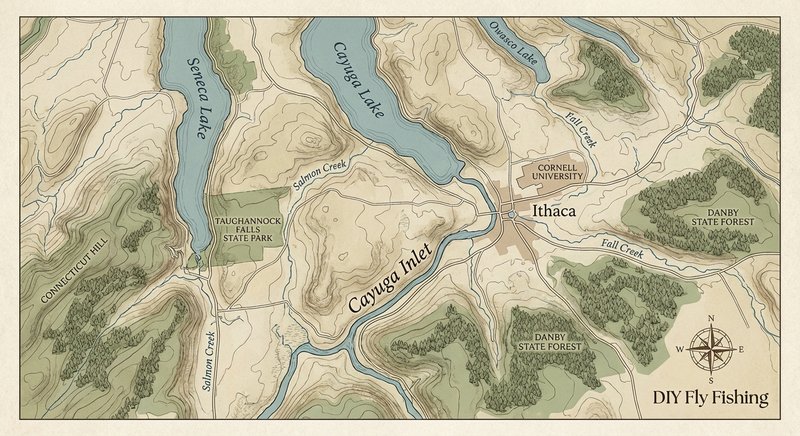
Welcome to the Finger Lakes, one of the most unique freshwater fisheries in the United States. Cayuga Inlet is the primary tributary to Cayuga Lake, entering at the southern tip in Ithaca, New York. It is a premier destination for anglers seeking "lake-run" fish—behemoths that live in the deep, cold depths of the lake and migrate into the creek to spawn.
Here is your guide to mastering the Cayuga Inlet.
🎣 Location Overview
Cayuga Inlet is a medium-sized tributary known for its deep pools, undercut banks, and gravel runs. Unlike the rocky, high-gradient streams of the Rockies, the Inlet is a classic "low-gradient" winding waterway.
What makes it special is the Cayuga Inlet Fish Ladder (operated by the DEC). This facility manages the migration of invasive species (like Sea Lamprey) while allowing massive lake-run Brown Trout, Landlocked Salmon, and Rainbow Trout to pass upstream. Anglers love it because it offers the chance to hook a 10-pound fish in a stream only 20 feet wide. It provides a "big game" feel in an intimate, pastoral setting.
🐟 Target Species & Behavior
- Brown Trout: These are "lake-run" browns, often silver when they first enter from the lake, turning buttery gold as they spend time in the river. They are predatory and aggressive but can be spooky in low water.
- Landlocked Salmon: These are Atlantic Salmon that never go to the ocean. They are acrobatic, fast, and highly sensitive to water temperature. They love oxygenated water and are often found in the faster "bubbles" at the head of pools.
- Rainbow Trout (Steelhead): Primarily a spring run. These fish are powerful and tend to hold in the "tail-outs" of pools or behind spawning beds (redds).
- Behavior: These fish are not in the river to eat; they are there to spawn. However, they maintain their predatory instincts and will strike out of territorial aggression or memory.
📅 Best Times to Fish
Fall (Late September – Early December)
- Focus: Landlocked Salmon and Brown Trout.
- Window: The peak is usually late October through mid-November.
- Conditions: Look for "the push." A heavy rain that raises the water level and drops the temperature is the dinner bell for these fish to move from the lake into the creek.
Spring (March – May)
- Focus: Rainbow Trout (Steelhead).
- Window: Late March and April are prime.
- Conditions: As the snow melts and the water warms into the 40s (Fahrenheit), the Rainbows begin their ascent.
Time of Day
- Low Light is King: First light and dusk are significantly more productive. These fish are wary; high sun often sends them into the deepest, darkest undercut banks where they are hard to reach.
🪰 Recommended Flies & Techniques
Top Fly Patterns
- Egg Patterns: Glo-bugs, Sucker Spawn, and Estaz Eggs (size 10-14) in orange, chartreuse, and "oregon cheese."
- Nymphs: Stoneflies (size 8-12) in black or brown, and Hare's Ears or Prince Nymphs (size 12-16).
- Streamers: Woolly Buggers (black or olive), Egg-Sucking Leeches, and Zonkers.
- Soft Hackles: For Landlocked Salmon, a swinging wet fly like a Partridge and Orange can be deadly.
Effective Techniques
- Indicator Nymphing: The most common method. Use a floating line, a long leader (9ft 3X), and enough split shot to get the egg or nymph to the bottom. The fly must "dead drift" at the same speed as the current.
- The "Tributary Swing": Using a light switch rod or a single-handed rod, cast streamers or soft hackles at a 45-degree angle downstream and let the current swing the fly across the holding water. This often triggers an aggression strike from Salmon.
💡 Pro Tips & Local Knowledge
- Target the Undercuts: Cayuga Inlet has soft banks. Huge Browns will tuck so far under the bank that you can't see them. If you aren't bouncing your fly off the dirt on the far bank, you aren't close enough.
- Watch the "Redds": You will see fish on shallow gravel nests (redds). Do not fish for these fish. It is unethical and harms the future of the fishery. Instead, fish the deep "slot" or pool immediately behind the redd, where non-spawning fish are waiting to eat drifting eggs.
- The "Ithaca Stealth": The water can be very clear. Wear earthy tones (camo/olive), move slowly, and avoid splashing. If you see a fish, it has likely already seen you.
- Check the USGS Gauge: Before driving, check the "Cayuga Inlet at Ithaca" water gauge online. You want a "dropping" hydrograph after a rain event. "Chocolate milk" water is hard to fish; "Steelhead green" (slightly stained) is perfect.
⚠️ Important Information
- Access: The area around the Coy Glen and the reaches upstream of the Fish Ladder (near Floral Ave/Rt 13) are popular. There are several DEC public fishing rights (PFR) easements. Look for the yellow "Public Fishing Stream" signs.
- Regulations: EXTREMELY IMPORTANT. New York Finger Lakes Tributary regulations are different from standard inland trout laws.
- Season: Generally April 1 through Dec 31 for most of the Inlet, but check the specific section as some lower areas are open year-round.
- Hook Size: There are strict limits on hook gap size (usually 1/2 inch or less) and the distance between a fly and a split shot to prevent "snagging."
- Night Fishing: Prohibited on most tributaries; you must be off the water between sunset and sunrise.
- License: A valid New York State Fishing License is required.
Guide’s Final Word: Cayuga Inlet is a gem of the Northeast. Treat the fish with respect, use a sturdy 6-weight or 7-weight rod to land them quickly, and keep them in the water for photos. Good luck!
Bug Hatches & Matching Flies
| Hatch | Type | Peak months | Time of day | Hook sizes | Matching flies |
|---|---|---|---|---|---|
| Blue-Winged Olive Baetis / Pseudocloeon | mayfly | April, May, September, October | Mid-day/Afternoon | #18-22 | RS2 #18-22, Parachute Adams #18-22, Pheasant Tail #18-22 |
| Hendrickson Ephemerella subvaria | mayfly | April, May | Afternoon | #12-14 | Hendrickson Dry #12-14, Red Quill #14, Hendrickson Nymph #12-14 |
| Grannom Caddis Brachycentrus | caddis | April, May | Morning/Afternoon | #14-16 | Elk Hair Caddis (Olive) #14-16, Peeking Caddis #14-16, LaFontaine's Deep Pupa #14-16 |
| March Brown Maccaffertium vicarium | mayfly | May, June | Afternoon | #10-12 | March Brown Dry #10-12, Gold Ribbed Hare's Ear #10-14 |
| Light Cahill Stenonema / Stenacron | mayfly | June, July | Evening | #14-16 | Light Cahill Dry #14-16, Cream Variant #14-16 |
| Spotted Sedge Hydropsyche | caddis | June, July, August | Evening | #14-18 | Tan Elk Hair Caddis #14-18, Hydropsyche Larva #14-16, Soft Hackle Hare's Ear #14-18 |
| Trico Tricorythodes | mayfly | July, August, September | Morning | #22-26 | Trico Spinner #22-26, Griffith's Gnat #20-24 |
| Common Midge Chironomidae | midge | January, February, March, December | All Day | #18-24 | Zebra Midge #18-22, Palomino Midge #20-24, WD-40 #20-22 |
| Terrestrials (Ants/Beetles) Formicidae / Coleoptera | terrestrial | July, August, September | Afternoon | #12-18 | Black Foam Ant #14-18, Flying Ant #16-18, Coffee's Sparkle Beetle #12-16 |