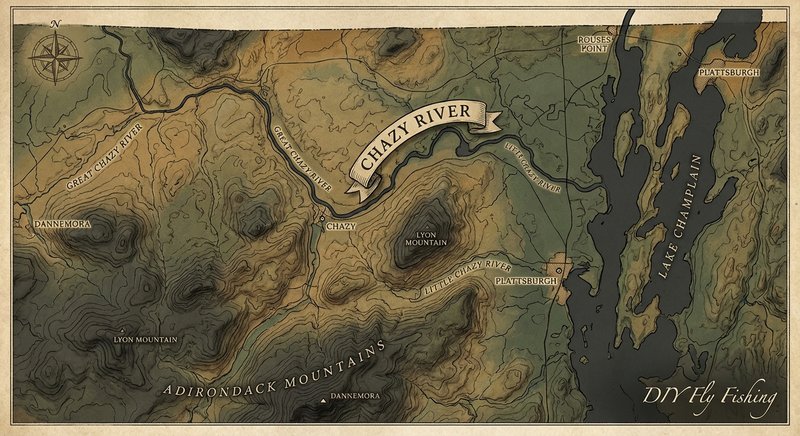
Chazy River
Fly fishing in New York · Beginner · Best seasons: Spring, Summer, Fall
Target Species
Brown Trout, Smallmouth Bass
About This Water
Lake Champlain tributary with brown trout and bass. Northern NY fishing opportunity.
Fishing Recommendations
The Great Chazy River in Northeastern New York is one of the Adirondack region’s most underrated gems. Flowing from the mountains near Lyon Mountain down to the flats of Lake Champlain, it offers a "tale of two rivers": a classic cold-water trout fishery in its upper reaches and a world-class smallmouth bass fishery as it nears the lake.
As your guide, here is the comprehensive breakdown for fishing the Great Chazy.
🎣 Location Overview
The Great Chazy River is characterized by its diversity. In the upper stretches around Ellenburg and Mooers, you’ll find classic Adirondack pocket water, tumbling riffles, and deep, cool pools carved into the bedrock. This is prime trout territory.
As the river flows east toward the town of Champlain, the gradient levels out, the water warms slightly, and the habitat shifts toward large boulders, submerged logs, and slower glides. This lower section is a Smallmouth Bass paradise. The river is special because it lacks the heavy "tourist" pressure of the nearby Ausable, offering a more solitary experience with highly productive water.
🐟 Target Species & Behavior
Brown Trout
- Behavior: The Chazy’s Browns are a mix of stocked fish and hardy holdovers. They are notorious for hugging the undercut banks and hiding under the shadows of overhanging alders.
- Holding Spots: Look for "bubbles lines" where current seams meet. In the heat of summer, they move into the oxygenated "white water" at the heads of pools.
- Feeding: They are opportunistic but can be selective during the Hendrickson or Caddis hatches. They have a strong preference for large streamers during high-water events.
Smallmouth Bass
- Behavior: These are "river-run" fighters. They are significantly more aggressive than their lake-dwelling cousins.
- Holding Spots: Look for "slack water" behind large mid-river boulders and the deep tail-outs of long pools. They love structure—if you see a fallen tree in the water, there is a Smallmouth under it.
- Feeding: Their diet consists heavily of crayfish and emerald shiners moving up from Lake Champlain.
📅 Best Times to Fish
Spring (Late April – June)
- The Window: This is the peak for Brown Trout.
- Conditions: Watch for the Hendrickson hatch in May. Water levels can be high from snowmelt, so sinking tip lines are often necessary early in the season.
- Bass: Smallmouth begin moving up-river from Lake Champlain to spawn in late May/early June (check local regulations for catch-and-release seasons).
Summer (July – August)
- The Window: Early morning (5 AM – 9 AM) and the "Magic Hour" before sunset.
- Conditions: Trout fishing slows down as water temps rise; anglers should carry a thermometer and stop fishing for trout if water hits 68°F. However, this is prime time for Smallmouth. They are most active in the heat and will smash topwater poppers all day.
Fall (September – October)
- The Window: Late morning through mid-afternoon.
- Conditions: As water temperatures drop, Brown Trout become aggressive and territorial before spawning. Smallmouth feed heavily to bulk up for winter. The fall foliage provides a spectacular backdrop.
🪰 Recommended Flies & Techniques
For Brown Trout
- Dry Flies: Light Cahill (#14-16), Elk Hair Caddis (#12-18), and Royal Wulff (#12).
- Nymphs: Pheasant Tail (#14-18), Gold-Ribbed Hare’s Ear (#12-16), and Pat’s Rubber Legs (Stonefly) in black or brown.
- Streamers: Black or Olive Woolly Buggers (#6-10) and Muddler Minnows.
- Technique: High-stick nymphing through the riffles is the most consistent producer.
For Smallmouth Bass
- Topwater: BoogleBugs or foam poppers in yellow, green, or white.
- Subsurface: Clouser Minnows (chartreuse/white), Sculpin patterns, and Hellgrammite imitations.
- Technique: "The Swing." Cast your streamer quartering downstream, let it swing through the current, and give it short, erratic strips as it straightens out.
💡 Pro Tips & Local Knowledge
- The Mooers "Transition Zone": The stretch of river near the village of Mooers is where the trout and bass water overlaps. On a good June day, it is entirely possible to catch a 16-inch Brown Trout and a 3-lb Smallmouth in the same pool.
- Match the Crayfish: The Chazy has a massive population of rusty crayfish. If you aren't sure what to throw for bass, use a heavy-beaded streamer in a "burnt orange" or "olive brown" color and bounce it along the bottom.
- Watch the Gauge: The Chazy is a "flashy" river, meaning it rises and falls quickly after rain. Check the USGS gauge at Perry Mills. If the flow is spiking, stick to the edges with large, dark streamers.
- Stealth Matters: In the upper trout sections, the water can get very clear. Long leaders (9-12 feet) and a stealthy approach (don't splash!) are required for the larger holdover Browns.
⚠️ Important Information
Access Information
- Public Fishing Rights (PFR): New York State has purchased public fishing rights on significant portions of the Great Chazy. Look for the yellow "Public Fishing Stream" signs.
- Key Access Points:
- Route 11 crossings between Ellenburg and Mooers.
- The Recreation Park in the village of Champlain (excellent bass access).
- The bridge at Perry Mills.
Regulations & Permits
- License: A valid New York State Freshwater Fishing License is required.
- Rules: Much of the river falls under statewide regulations, but always check the NYSDEC Region 5 syllabus for specific creel limits or "catch and release only" seasonal windows, especially for Smallmouth Bass in the spring.
Special Considerations
- Wading Safety: The river bed can be incredibly slippery (slick clay and smooth stones). Studded wading boots and a wading staff are highly recommended.
- Private Property: While there is plenty of PFR, some land remains strictly private. Always respect "Posted" signs to ensure future access for all anglers.
Bug Hatches & Matching Flies
| Hatch | Type | Peak months | Time of day | Hook sizes | Matching flies |
|---|---|---|---|---|---|
| Blue-Winged Olive Baetis / Acerpenna | mayfly | April, May, September, October | Midday | #18-22 | RS2 #20-22, Parachute Adams #18-22, Pheasant Tail #18-20 |
| Hendrickson Ephemerella subvaria | mayfly | Late April, May | Afternoon | #12-14 | Red Quill #12-14, Hendrickson Emerger #12-14, Gold Ribbed Hare's Ear #12-14 |
| Grannom Caddis Brachycentrus | caddis | May | Late Morning/Afternoon | #14-16 | Elk Hair Caddis (Olive) #14-16, Pupa-Zel #14-16, Peacock Caddis #14-16 |
| March Brown Maccaffertium vicarium | mayfly | Late May, June | Afternoon | #10-12 | March Brown Western #10-12, Spaced-out March Brown #10-12 |
| Light Cahill Stenonema / Stenacron | mayfly | June, July | Evening | #12-14 | Light Cahill #12-14, Cream Usual #12-16 |
| Slate Drake Isonychia bicolor | mayfly | June, September | Late Afternoon/Evening | #10-12 | Iso Parachute #10-12, Prince Nymph #10-14, Zug Bug #10-12 |
| Giant Golden Stonefly Hesperoperla pacifica | stonefly | June, July | Evening/Night | #6-10 | Golden Stone Nymph #6-10, Stimulator (Yellow) #8-12 |
| Trico Tricorythodes | mayfly | July, August, September | Early Morning | #22-26 | Trico Spinner #22-26, Sunken Trico Spinner #24 |
| Terrestrials (Ants/Beetles) Formicidae / Coleoptera | terrestrial | July, August | All Day | #12-18 | Black Foam Ant #14-18, Crowe Beetle #12-16 |