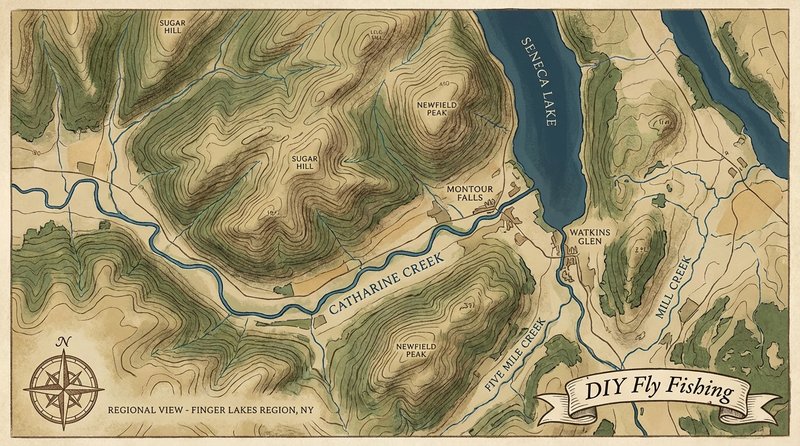
Catharine Creek
Fly fishing in New York · Beginner · Best seasons: Spring, Fall
Target Species
Rainbow Trout, Brown Trout
About This Water
Seneca Lake tributary famous for spring rainbow runs. Popular Finger Lakes fishery.
Fishing Recommendations
Catharine Creek, located in the Finger Lakes region of New York, is often referred to as the "Rainbow Trout Capital of the Northeast." As an expert guide, I can tell you that this isn't your typical pastoral trout stream; it is a legendary tributary of Seneca Lake known for its grueling runs of massive, lake-run salmonids.
Here is your comprehensive guide to fishing Catharine Creek.
🎣 Location Overview
Catharine Creek is a relatively small, winding tributary that flows into the southern end of Seneca Lake at Watkins Glen. What makes it world-famous is its role as the primary spawning grounds for Seneca Lake’s wild Finger Lakes Rainbow Trout.
The water is generally shallow, characterized by gravel runs, deep undercut banks, and tight "S" curves. It is a technical fishery; the water is often clear, and the fish are notoriously spooky. Anglers love it because it offers the rare opportunity to hook a 5-to-8-pound wild rainbow in a stream you can practically jump across in some sections.
🐟 Target Species & Behavior
- Rainbow Trout (Lake-Run): These are the stars of the show. They spend their lives in the deep, cold waters of Seneca Lake and enter the creek to spawn. They are powerful, silver, and incredibly jumpy.
- Brown Trout (Lake-Run & Resident): While the Rainbows get the headlines, massive lake-run Browns enter the system as well. There are also smaller resident brown trout that stay in the upper reaches year-round.
Behavior: Once these fish enter the creek, they are focused on one thing: reproduction. They hold in the deeper "dark" water of pools during the day and move onto the shallow gravel "redds" (spawning nests) to spawn. Note: Ethical anglers avoid casting to fish actively sitting on nests; instead, target the fish holding in the deeper water just downstream of the spawning areas.
📅 Best Times to Fish
Spring (The Main Event)
- Months: Late March through May.
- The Peak: Usually around April 1st (Traditional Opening Day).
- Conditions: Look for a "freshet" (a rise in water levels due to rain or snowmelt). The fish use the high water to move upstream from the lake. Once the water starts to drop and clear ("the drop and the clear"), fishing is prime.
Fall (The Brown Trout Run)
- Months: October through November.
- Conditions: While the Rainbows run in the spring, the lake-run Brown Trout move up in the fall. This is a quieter, less crowded time to fish, often coinciding with spectacular fall foliage.
Time of Day
- Low Light: Early morning (dawn) and late evening (dusk) are critical. In the clear, shallow water of Catharine Creek, bright overhead sun will send the big fish into hiding under logs and cut-banks.
🪰 Recommended Flies & Techniques
Top Fly Patterns
- Egg Patterns: This is "match the hatch" for spawning season.
- Glo-Bugs (Size 10-14) in Oregon Cheese, Pink, and Chartreuse.
- Sucker Spawn in Cream or Peach.
- Nymphs:
- Stoneflies: Large black or golden stones (Size 8-12).
- Hare’s Ear & Pheasant Tail: Classic patterns for when the fish are finicky (Size 12-16).
- Streamers:
- Woolly Buggers (Black or Olive). Use these to trigger an aggression strike from a territorial male.
Effective Techniques
- High-Stick Nymphing: Because the creek is narrow and full of varied currents, use a long rod (9' or 10') to keep as much line off the water as possible. This prevents "drag," which will instantly spook a veteran lake-run trout.
- The "Chuck and Duck": In heavier spring flows, you may need to use split shot to get the fly down into the "strike zone" near the bottom where the fish are holding.
- Indicator Fishing: Use a small, subtle strike indicator. Big bobbers hitting the water will scare fish in this shallow system.
💡 Pro Tips & Local Knowledge
- The "Secret" Stretches: Most anglers crowd the "Main Canal" near Watkins Glen. However, some of the best fishing is found further upstream near Millport and Pine Valley. The water there is more "trouty" with more cover.
- Stealth is Mandatory: Do not wade into the middle of a pool. Stay on the bank, stay low, and wear camouflage or earthy tones. If you can see the fish, they have likely already seen you.
- Light Tippet vs. Big Fish: It’s a balancing act. You need 4x or 5x fluorocarbon to get bites in clear water, but these fish are strong. Use a high-quality fluorocarbon and make sure your knots are perfect.
- Temperature Matters: In the spring, a slight warming of the water (even 2 or 3 degrees) can trigger a massive movement of fish from the lake into the creek.
⚠️ Important Information
Access
- There are numerous Public Fishing Rights (PFR) easements along the creek. Look for the yellow "Public Fishing Stream" signs.
- The Catharine Creek Wildlife Management Area provides excellent access at the mouth of the creek.
Regulations & Permits
- New York State Fishing License is required.
- Special Regulations: Catharine Creek is subject to "Finger Lakes Tributary Regulations." These include specific hook size restrictions (usually a single hook, point-to-shank gap not to exceed 1/2 inch) to discourage snagging.
- Season Dates: Be sure to check the NYSDEC website, as opening dates for tributaries can differ from inland trout streams.
Special Considerations
- Respect the Redds: As mentioned, please do not walk on or fish over active spawning beds (light-colored gravel patches). This ensures the future of the wild population.
- Waders: Felt soles are banned in some states, but in NY, they are legal; however, studded rubber soles are highly recommended for the slippery clay and gravel bottom of Catharine.
Bug Hatches & Matching Flies
| Hatch | Type | Peak months | Time of day | Hook sizes | Matching flies |
|---|---|---|---|---|---|
| Blue-Winged Olive Baetis / Pseudocloeon | mayfly | April, May, September, October | Mid-day/Afternoon | #18-22 | RS2 #20-22, BWO Sparkle Dun #18-20, Pheasant Tail #18-20 |
| Hendrickson Ephemerella subvaria | mayfly | April, May | Afternoon | #12-14 | Red Quill #12-14, Hendrickson Emerger #14, Hare's Ear #12-14 |
| Grannom Caddis Brachycentrus | caddis | April, May | Morning/Afternoon | #14-16 | Peacock Caddis #14-16, Deep Sparkle Pupa #14-16, Green Weenie #14-16 |
| March Brown Maccaffertium vicarium | mayfly | May, June | Afternoon | #10-12 | March Brown Western #10-12, March Brown Nymph #10-12, Gold Ribbed Hare's Ear #10-12 |
| Sulphur Ephemerella dorothea | mayfly | June, July | Evening | #14-18 | Sulphur Parachute #16-18, Sulphur Emerger #16, Frenchie #14-18 |
| Tan Caddis Hydropsyche | caddis | May, June, July, August | Evening | #14-16 | Elk Hair Caddis #14-16, Holy Grail #14-16, LaFontaine's Emergent Pupa #14-16 |
| Midges Chironomidae | midge | March, April, October, November | Morning/Afternoon | #20-24 | Zebra Midge #20-22, Griffith's Gnat #20-22, Black Fly Larva #20 |
| Slate Drake Isonychia bicolor | mayfly | August, September, October | Late Afternoon | #10-14 | Iso Parachute #12-14, Zug Bug #10-12, Isonychia Nymph #10-12 |