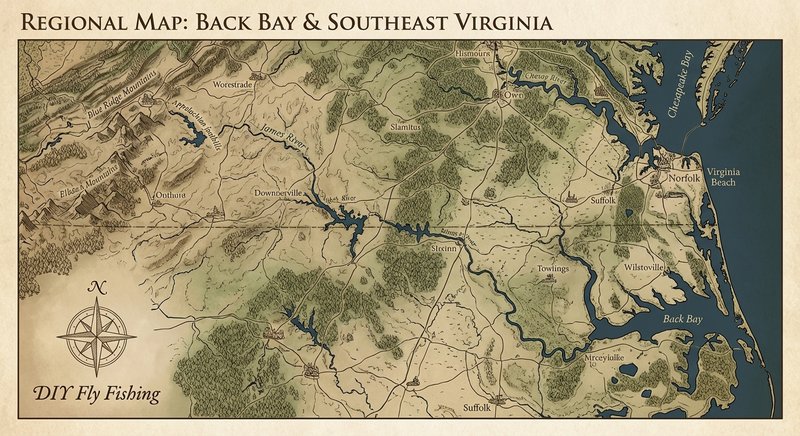
Back Bay
Fly fishing in Virginia · Intermediate · Best seasons: Spring, Summer, Fall
Target Species
Red Drum, Speckled Trout, Striped Bass
About This Water
Virginia Beach coastal bay with red drum and speckled trout. Wildlife refuge fishing.
Fishing Recommendations
Welcome to Back Bay, Virginia. As a guide, I can tell you that Back Bay is one of the most unique and storied fisheries on the Atlantic Coast. Historically world-famous for its largemouth bass, a shift in salinity and environment over the last two decades has transformed it into a premier destination for "Skinny Water" saltwater fly fishing.
Here is your comprehensive guide to fly fishing the flats and grass beds of Back Bay.
🎣 Location Overview
Back Bay is a large, shallow lagoon located in the southeastern corner of Virginia Beach, separated from the Atlantic Ocean by a narrow strip of barrier island (home to the Back Bay National Wildlife Refuge and False Cape State Park).
What makes this water special is its lack of lunar tides. Unlike the nearby Chesapeake Bay, the water level here is driven by wind tides. A strong North wind pushes water into the bay, while a South wind can suck the water out, exposing vast mudflats. The water is brackish, characterized by massive beds of Submerged Aquatic Vegetation (SAV) and an average depth of only 2 to 4 feet. For a fly angler, it offers a "low country" experience similar to South Carolina or Georgia, right in the heart of Virginia.
🐟 Target Species & Behavior
Red Drum (Puppy Drum)
In Back Bay, you are primarily targeting "Puppy Drum" (juveniles ranging from 15 to 28 inches). They are the kings of the flats here. They cruise the edges of the submerged grass looking for crabs and grass shrimp.
- Behavior: Look for "tailing" fish in the extreme shallows or "wakes" pushed by cruising fish. They are often found in small pods.
Speckled Trout
Specks are ambush predators that thrive in the slightly deeper "potholes" (sandy patches) within the grass beds.
- Behavior: They are light-sensitive. They hang on the edges of drop-offs or in the shadows of the grass. They feed aggressively on silversides, mullet, and shrimp.
Striped Bass (Rockfish)
While they inhabit the bay year-round, they are most active for fly anglers during the transitional months.
- Behavior: They tend to hold near structure—creek mouths, bridge pilings, or the few deeper channels. They are suckers for topwater action during low-light conditions.
📅 Best Times to Fish
- Optimal Seasons:
- Fall (September – November): This is the gold standard. The water clears up, the baitfish (mullet) are migrating, and the fish are feeding heavily for winter.
- Spring (Late April – June): As the water hits the 60°F mark, fish move back into the shallows from the deeper sounds.
- Best Time of Day: Early morning and late evening are paramount, especially for Speckled Trout and Striped Bass. However, for sight-fishing Red Drum, you want the sun high (10 AM – 2 PM) to cut through the tannin-stained water.
- The Wind Factor: This is the most important "time" to fish. A steady North or Northeast wind for 24 hours will "fill the bay," giving you access to the marsh edges where the big Reds like to hunt.
🪰 Recommended Flies & Techniques
Top Fly Patterns
- Gurgler (Size 2-4): White or Chartreuse. Unbeatable for Striped Bass and aggressive Drum in the morning.
- Kwan Fly / Spoon Fly (Size 4): Gold or Copper. These are essential for Red Drum; the vibration and flash help them find the fly in the stained water.
- Clouser Minnow (Size 2): Chartreuse/White or Pink/White. The go-to for Speckled Trout.
- EP Grass Shrimp: Tan or Clear. When the fish are spooky in the grass, a slow-sinking shrimp is the most natural presentation.
Effective Techniques
- Sight Casting: This is the pinnacle of Back Bay fishing. Use a 7-weight or 8-weight rod with a weight-forward floating line. You must be stealthy—pole your skiff or kayak slowly.
- Blind Casting the Edges: If the water is too turbid for sight fishing, focus on the "pockets" in the grass. Cast into the holes, let the fly sink for 2 seconds, and use a "strip-strip-pause" retrieve.
💡 Pro Tips & Local Knowledge
- The "Pothole" Secret: Use polarized sunglasses (amber or copper lenses work best in these waters). Look for lighter-colored circles in the dark grass. These are sandy potholes. Speckled Trout sit in these holes facing the current, waiting for bait to drift over.
- Kayak is King: Much of Back Bay is too shallow even for technical flats skiffs. A kayak or paddleboard allows you to reach the "interior" ponds within the marsh that see almost zero fishing pressure.
- Follow the Mullet: If you see "nervous water" or schools of small baitfish jumping, stay in that area. In Back Bay, if there is no bait visible, there are likely no predators.
- Focus South: The fishing generally improves as you move south toward the North Carolina line (Knotts Island area), where the salinity is often slightly higher and the grass is thicker.
⚠️ Important Information
Access
- Little Island Park: Located in Sandbridge. Excellent launch point for kayaks.
- Back Bay National Wildlife Refuge: Offers a ramp, but be aware of seasonal motor restrictions (electric motors only in certain areas to protect migratory birds).
- Horn Point: A popular spot for launching larger skiffs.
Regulations & Permits
- License: You will need a Virginia Saltwater Fishing License. Even though the water feels fresh, the target species are regulated under saltwater law.
- Size Limits: Virginia has strict "slot limits" for Red Drum (typically 18–26 inches) and Speckled Trout. Check the VMRC website for the most current regulations before keeping any fish.
Special Considerations
- Stingrays & Snakes: If wading, do the "Stingray Shuffle." Also, be mindful that Cottonmouths (Water Moccasins) are very common in the Back Bay marshes—watch your step when launching.
- Submerged Hazards: The bay is full of old duck blinds and submerged cypress knees. If running a motor, go slow until you know the "lanes."
Bug Hatches & Matching Flies
| Hatch | Type | Peak months | Time of day | Hook sizes | Matching flies |
|---|---|---|---|---|---|
| Giant Mayfly (Hex) Hexagenia limbata | mayfly | June, July | Dusk/Night | #6-10 | Hexagenia Spinner #6-8, Hexagenia Nymph #8-10 |
| Blue Damselfly Enallagma spp. | terrestrial | May, June, July | Mid-morning/Afternoon | #10-14 | Braided Butt Damselfly #10-12, Marabou Damsel Nymph #12-14 |
| Chironomid Midges Chironomidae | midge | March, April, October, November | All Day | #18-24 | Zebra Midge #18-22, Griffith's Gnat #20-24 |
| White Mayfly Ephoron leukon | mayfly | August, September | Evening/Dusk | #12-14 | White Wulff #12-14, Snowshoe Emerger #14 |
| Long-horned Caddis Oecetis spp. | caddis | June, July, August | Evening | #12-16 | Elk Hair Caddis (Tan) #14-16, Pupa Sedge #14 |
| Common Green Darner Anax junius | terrestrial | July, August, September | Afternoon | #4-8 | Blue Bottle Dragonfly #6-8, Dragonfly Nymph (Articulated) #4-8 |
| Meadow Grasshopper Conocephalus spp. | terrestrial | August, September | Afternoon | #8-12 | Dave's Hopper #8-12, Charlie Boy Hopper #10 |
| Flying Ants Formicidae | terrestrial | September, October | Afternoon | #16-20 | Cinnamon Ant #16-18, Black Foam Ant #18-20 |