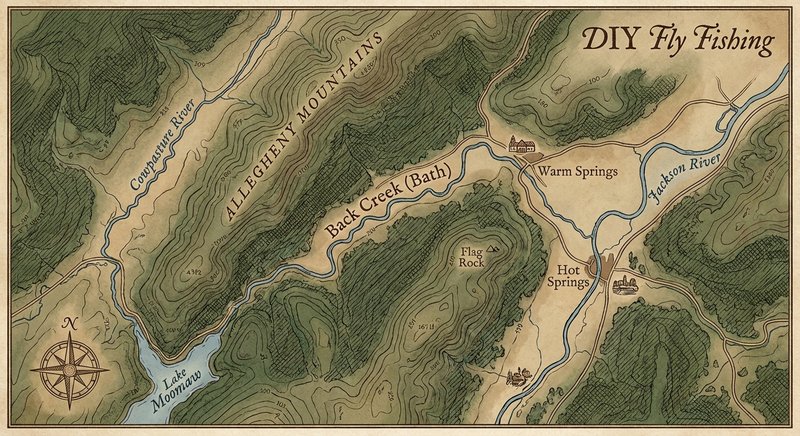
Back Creek (Bath)
Fly fishing in Virginia · Intermediate · Best seasons: Spring, Summer, Fall
Target Species
Brown Trout, Rainbow Trout
About This Water
Bath County stream with wild brown trout. Remote Allegheny Mountain waters.
Fishing Recommendations
Back Creek in Bath County, Virginia, is one of the Commonwealth’s most storied fly fishing destinations. Tucked away in the George Washington National Forest near the West Virginia border, it offers a classic Appalachian freestone experience with a unique limestone influence that keeps its waters productive and its fish healthy.
🎣 Location Overview
Back Creek is a medium-sized stream characterized by its diversity. It transitions from a tumbling mountain brook in its upper reaches to a more classic "pool-and-drop" freestone stream as it flows through the Hidden Valley section.
What makes Back Creek special is its scenic beauty and the "Special Regulation" section. Unlike some of Virginia’s smaller, choked-out laurel streams, Back Creek offers enough room for backcasts in most areas. The water is remarkably clear, running over a bed of cobble, ledge rock, and occasional deep silt-free pools. Anglers love it because it feels remote; once you hike a mile into the Hidden Valley, the sounds of the road disappear, leaving only the water and the trout.
🐟 Target Species & Behavior
- Rainbow Trout: These are the primary residents of the stocked and "Delayed Harvest" sections. They tend to hold in faster water—the "heads" of pools and the heavy riffles. They are opportunistic feeders but can become wary during low-water summer months.
- Brown Trout: Back Creek holds a surprising number of holdover and wild Brown Trout. These fish are more secretive, preferring the "tail-outs" of pools at dusk or the deep undercut banks and submerged woody debris.
- Behavior: In the spring, fish are aggressive. As the water warms in late summer, they move into oxygenated pocket water. Because of the limestone influence, the fish here grow slightly faster and are often "heartier" than those in pure freestone streams nearby.
📅 Best Times to Fish
- Optimal Seasons:
- Spring (March – June): This is the gold standard. The hatches are prolific, and water levels are usually perfect.
- Fall (Late September – November): The Brown Trout become aggressive as they prepare to spawn, and the foliage in Bath County is world-class.
- Best Time of Day:
- Spring/Fall: Mid-morning to late afternoon (when the water warms slightly).
- Summer: First light until 10:00 AM, and the "Magic Hour" (the last 60 minutes of daylight).
- Prime Conditions: A receding hydrograph after a light rain is perfect. Slight turbidity (stained water) helps mask your approach to the wary Browns.
🪰 Recommended Flies & Techniques
Top Fly Patterns
- Dry Flies:
- Spring: Quill Gordon (sz 12-14), March Brown (sz 12), and Elk Hair Caddis (sz 14-16).
- Summer: Hi-Vis Ant (sz 16), Beetles, and Dave’s Hopper (sz 10-12).
- Fall: Blue Winged Olives (sz 18-22).
- Nymphs:
- Pheasant Tail (sz 14-18), Prince Nymph (sz 12-14), and Sexy Walt’s Worm.
- Streamers:
- Olive or Black Wooly Buggers (sz 8-10) and the classic Black Ghost.
Effective Techniques
- Dry-Dropper: This is the most effective way to prospect Back Creek. Use a buoyant Elk Hair Caddis or Hopper as your indicator and hang a Pheasant Tail nymph 18-24 inches below it.
- Tight-Line Nymphing: In the riffles and pocket water, keeping your fly line off the water is essential to avoid drag caused by complex currents.
- Streamer Stripping: On overcast days, cast a Wooly Bugger toward the far bank and strip it back aggressively to trigger a reaction strike from a territorial Brown.
💡 Pro Tips & Local Knowledge
- The Hidden Valley Hike: Most people fish near the bridge. If you are willing to hike 20–30 minutes downstream into the Hidden Valley Gorge, the fishing pressure drops significantly and the size of the fish tends to increase.
- The "Stealth" Factor: The water in Bath County can be gin-clear. Wear earthy tones (greens/browns), stay low, and try not to "line" the fish (casting your fly line directly over their heads).
- Focus on the "Seams": Look for where fast water meets slow water. In Back Creek, trout sit exactly on that line to conserve energy while watching for food.
- The Pump Storage Factor: Be aware that the Dominion Back Creek Dam (Pumped Storage Project) is upstream. While the main fishing areas are well downstream, flow can be affected by the facility's operations. Always check the USGS gauges for "Back Creek near Sunrise, VA."
⚠️ Important Information
- Access: The primary access is via Hidden Valley Road (Route 621). There is a well-maintained parking area and a swinging bridge that provides access to the trail system.
- Regulations:
- Much of Back Creek is Special Regulation (Artificial Lures Only) or Delayed Harvest.
- Check the Virginia DWR (Department of Wildlife Resources) website before you go, as boundaries and season dates can change annually.
- Permits: You need a valid Virginia Freshwater Fishing License. If you are fishing during the "Stocked Trout" season (Oct 1 – June 15), you also need a Virginia Trout License.
- Cell Service: Expect zero cell service in the gorge. Download your maps for offline use and let someone know your "return-by" time.
Guide’s Final Word: Back Creek isn't just about the fish; it’s about the environment. It is one of the most "western-feeling" streams in Virginia. Take a 4-weight rod, a box of dry flies, and your camera. You won't regret it.
Bug Hatches & Matching Flies
| Hatch | Type | Peak months | Time of day | Hook sizes | Matching flies |
|---|---|---|---|---|---|
| Blue Winged Olive Baetis | mayfly | March, April, October, November | Mid-day/Afternoon | #18-22 | BWO Sparkle Dun #18-22, Pheasant Tail #18-20, RS2 #20-22 |
| Quill Gordon Epeorus pleuralis | mayfly | March, April | Mid-day | #12-14 | Quill Gordon #12-14, Hare's Ear #12-14 |
| Hendrickson Ephemerella subvaria | mayfly | April | Afternoon | #12-14 | Hendrickson Pink Lady #14, Red Quill #14, Hendrickson Wet Fly #12-14 |
| Sulphur Ephemerella invaria/dorothea | mayfly | May, June | Evening | #14-18 | Sulphur Parachute #14-18, Sulphur Cripple #16-18, Split Case Sulphur #16 |
| Tan Caddis Hydropsyche | caddis | May, June, July | Morning/Evening | #14-16 | Elk Hair Caddis #14-16, Holy Grail Caddis #14-16, LaFontaine's Deep Sparkle Pupa #14-16 |
| Golden Stonefly Acroneuria | stonefly | June, July | Afternoon/Evening | #8-12 | Golden Stimulator #8-12, Pat's Rubber Leg #8-12 |
| Little Black Stonefly Taeniopteryx | stonefly | February, March | Mid-day | #14-18 | Early Girl Stone #16, Zebra Midge #18-20 |
| Light Cahill Stenacron canadense | mayfly | June, July | Evening | #12-14 | Light Cahill #12-14, Gold Ribbed Hare's Ear #14 |
| Terrestrials (Ants/Beetles) Formicidae/Coleoptera | terrestrial | July, August, September | All Day | #12-18 | Parachute Ant #16-18, Foam Beetle #12-16 |