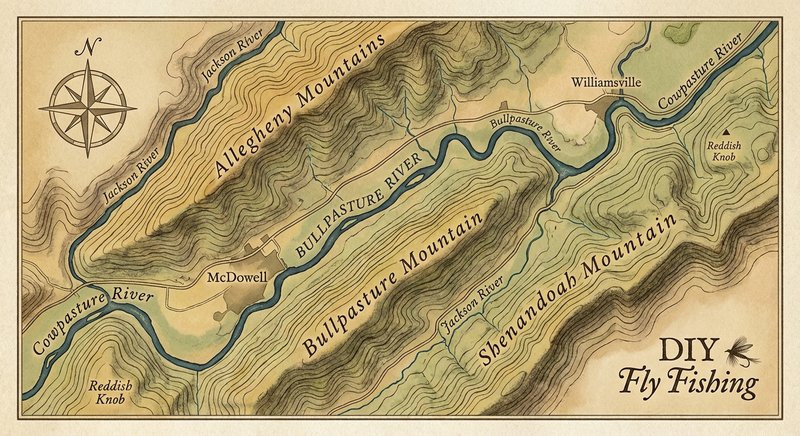
Bullpasture River
Fly fishing in Virginia · Intermediate · Best seasons: Spring, Summer, Fall
Target Species
Brown Trout, Rainbow Trout, Brook Trout
About This Water
Highland County stream with wild trout. Remote mountain fishing in beautiful valley.
Fishing Recommendations
The Bullpasture River in Highland County, Virginia, is often whispered about in fly shops as one of the state’s most scenic and productive "mountain limestone" streams. Flowing through the rugged mountains of the Alleghany Highlands, it offers a unique blend of classic freestone pocket water and limestone-enriched fertility.
Here is your comprehensive guide to fishing the Bullpasture.
🎣 Location Overview
The Bullpasture is a gem of the James River watershed. What makes it special is its geological "split personality." While it flows through a mountainous region, it is heavily influenced by karst (limestone) topography. This means the water is more alkaline and nutrient-rich than typical Appalachian freestones, leading to excellent bug life and faster fish growth.
The river is most famous for the Bullpasture Gorge, a breathtaking three-mile stretch where the river carves through high limestone cliffs. Outside of the gorge, the river meanders through pastoral valleys with classic riffle-run-pool sequences. It is primarily managed as a Delayed Harvest (DH) stream, ensuring high fish densities for much of the year.
🐟 Target Species & Behavior
- Rainbow Trout: These are the most abundant species, particularly in the stocked sections. They tend to hold in the faster oxygenated water at the heads of pools and in the middle of riffles. They are aggressive and prone to looking up for dry flies.
- Brown Trout: The "smart" residents of the Bullpasture. While many are stocked, some hold over year-to-year in the deep, cold holes of the Gorge. Look for them in undercut banks, beneath submerged logs, or at the very tail-outs of pools during low light.
- Brook Trout: While less common in the main stem during summer, you will find wild brookies in the higher reaches and the cold-water tributaries. In the fall, they may drop down into the main river to spawn.
📅 Best Times to Fish
- Spring (March – Early June): The Prime Window. This is when the Delayed Harvest regulations are in full effect. Water levels are usually optimal, and the major hatches (Quill Gordons, March Browns, and Sulphurs) occur.
- Summer (Late June – August): Focus exclusively on the Bullpasture Gorge. The valley sections can get too warm for trout health. Early morning and late evening sessions are mandatory. If the water exceeds 68°F, give the trout a break and head elsewhere.
- Fall (October – November): The "Second Season." The river is restocked for the DH season starting October 1st. The cooling water and spawning colors of the brook and brown trout make this a magical time.
- Time of Day: In Spring/Fall, 10:00 AM to 4:00 PM is best. In Summer, be on the water at dawn or during the "magic hour" at dusk.
🪰 Recommended Flies & Techniques
Top Fly Patterns
- Nymphs:
- Bead-head Pheasant Tail (#14-18): A staple for mimicking the river's various mayflies.
- Prince Nymph (#12-16): Excellent for the aggressive rainbows.
- Pat’s Rubber Legs (#8-12): Stoneflies are prevalent in the rocky Gorge.
- Dry Flies:
- Parachute Adams (#14-20): The ultimate "find out what's happening" fly.
- Elk Hair Caddis (#14-16): Tan or olive, especially in late spring evenings.
- Sulphur Parachute (#16-18): Critical for the late May/June hatches.
- Streamers:
- Woolly Bugger (#6-10) in Olive or Black: Strip these through deep holes in the Gorge to find holdover browns.
Techniques
- Indicator Nymphing: The most productive method for stocked fish. Use a two-fly rig (e.g., a Rubber Legs with a Pheasant Tail dropper).
- Euro Nymphing: The pocket water in the Gorge is world-class for tight-line nymphing. The ability to control your drift in the turbulent seams is a game-changer here.
- Dry-Dropper: Perfect for the summer months. Use a buoyant Stimulator as your "indicator" and hang a small zebra midge 18 inches below it.
💡 Pro Tips & Local Knowledge
- The Gorge Hike: Access to the best water requires a bit of a hike. Park at the VDWR parking area off Route 678 and follow the trail down. The further you walk from the parking lot, the better the fishing gets and the fewer people you'll see.
- Stealth Matters: Despite being a "stocked" river, the water is exceptionally clear. Long leaders (9ft–12ft) and 5x or 6x tippet are often necessary to avoid spooking fish in the slower pools.
- The Williamsville Stretch: The lower section near the confluence with the Cowpasture River stays slightly cooler and can hold some surprisingly large brown trout that move up from the larger river.
⚠️ Important Information
- Regulations: Large portions of the Bullpasture are Delayed Harvest. From October 1 through May 31, it is catch-and-release only, and you must use single-hook artificial lures/flies. Check the Virginia DWR website for the exact boundaries.
- Access: Much of the river flows through private land. Stick to the clearly marked VDWR public access points and the National Forest sections in the Gorge.
- Safety: The rocks in the Bullpasture are notoriously slick due to the limestone-driven algae. Studded wading boots and a wading staff are highly recommended, especially in the Gorge where the current is swift and the terrain is uneven.
- Permits: You need a Virginia Freshwater Fishing License and, if fishing during the DH season, a Trout License.
Bug Hatches & Matching Flies
| Hatch | Type | Peak months | Time of day | Hook sizes | Matching flies |
|---|---|---|---|---|---|
| Blue-Winged Olive (BWO) Baetis spp. | mayfly | March, April, September, October | Mid-day | #18-24 | RS2 #20-22, Parachute Adams #18-22, Pheasant Tail #18-20 |
| Quill Gordon Epeorus pleuralis | mayfly | March, April | Early Afternoon | #12-14 | Quill Gordon Dry #12-14, Gold Ribbed Hare's Ear #12-14 |
| Hendrickson Ephemerella subvaria | mayfly | April | Afternoon | #12-14 | Hendrickson Pink Lady #14, Red Quill #12-14, Pheasant Tail Nymph #12-14 |
| Grannom (Mother's Day Caddis) Brachycentrus spp. | caddis | April, May | Morning/Afternoon | #14-16 | Elk Hair Caddis (Dark) #14-16, Holy Grail #14-16, Peacock Caddis #16 |
| Sulphur Ephemerella invaria | mayfly | May, June | Evening | #14-18 | Sulphur Parachute #16-18, CDC Sulphur Emerger #16-18, Frenchie #16-18 |
| Yellow Sally Isoperla spp. | stonefly | May, June, July | Late Afternoon/Evening | #14-16 | Yellow Sally Stimulator #14-16, Little Yellow Stone Nymph #14-16 |
| Light Cahill Stenacron interpunctatum | mayfly | June, July | Evening | #12-14 | Light Cahill Dry #12-14, Cream Variant #14 |
| Terrestrials (Ants/Beetles) Formicidae / Coleoptera | terrestrial | July, August, September | All Day | #12-20 | Black Foam Beetle #14-18, Cinnamon Ant #16-20, Dave's Hopper #10-12 |
| Trico Tricorythodes spp. | mayfly | July, August, September | Early Morning | #22-26 | Trico Spinner #22-24, Zebra Midge #20-22 |