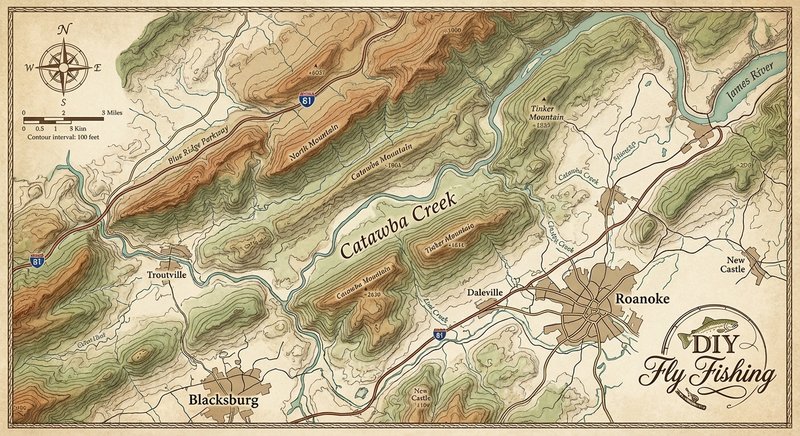
Catawba Creek
Fly fishing in Virginia · Beginner · Best seasons: Spring, Summer, Fall
Target Species
Rainbow Trout, Brown Trout
About This Water
Roanoke County stream with stocked trout. McAfee Knob hiking area.
Fishing Recommendations
Catawba Creek is one of Virginia’s "hidden gem" limestone-influenced streams. Located primarily in Roanoke and Botetourt counties, it offers a distinct experience compared to the rugged freestone mountain streams found nearby in the Blue Ridge. As a guide, I view Catawba as a "technical meadow stream"—it requires stealth, fine tippet, and a keen eye for reading slow-moving water.
🎣 Location Overview
Catawba Creek is a meandering lowland stream that eventually flows into the James River. What makes it special is its limestone influence. Unlike the acidic freestone streams of the high mountains, Catawba’s water is more alkaline, leading to high macroinvertebrate productivity.
The creek flows through pastoral valleys, alternating between slow, deep silt-bottomed pools and crunchy gravel riffles. It feels very much like a classic English chalk stream in sections, with undercut banks and overhanging sycamores. It is a "Put-and-Take" fishery managed by the Virginia Department of Wildlife Resources (DWR), but its thermal stability allows for decent holdover potential in the deeper, spring-fed holes.
🐟 Target Species & Behavior
- Rainbow Trout: These are the primary residents after stocking. They tend to congregate in the swifter water at the heads of pools or in the "tongue" of the current. They are opportunistic but become wary within a week of being stocked.
- Brown Trout: The "prize" of Catawba. The browns here love the undercut banks and the tangles of fallen timber. They are much more light-sensitive and predatory. To catch a holdover brown here, you’ll need to fish the low-light hours or deep under-structure.
- Behavior: Because the water is often clear and slow-moving, these fish are "spooky." If they see your shadow or a splashy cast, the pool is "put down" for an hour.
📅 Best Times to Fish
- Spring (March – May): The Prime Window. This coincides with the heaviest stocking and the most consistent insect hatches. April is legendary for the "Quill Gordon" and "March Brown" hatches.
- Summer (June – August): Focus on the early morning (6 AM – 10 AM). As water temperatures rise, the fish retreat to the deepest pools or the mouths of cold-water springs. Note: If water temps exceed 68°F, give the trout a break and target the creek’s smallmouth bass instead.
- Fall (October – November): A fantastic time for Brown Trout. As they prepare for their spawning cycle, they become aggressive. The changing leaves and crisp air make this the most scenic time to be on the water.
- Best Window: Overcast, drizzly days are best on Catawba. The lack of shadows gives the angler a massive advantage.
🪰 Recommended Flies & Techniques
Dry Flies
- Sulphurs (Size 14-18): Essential for late spring evenings.
- Elk Hair Caddis (Size 14-16): The go-to search pattern for riffles.
- Terrestrials: In Summer, a Size 14 Foam Ant or Size 12 Beetle dropped tight against the bank is deadly.
Nymphs (The Bread & Butter)
- Scuds & Sowbugs (Size 16-18): Because this is limestone-influenced water, these are present year-round. Gray or olive is best.
- Pheasant Tail (Size 16-20): Imitates various mayfly nymphs.
- Zebra Midge (Size 18-22): Necessary for those slow, glassy pools where the fish are "sip" feeding.
Streamers
- Woolly Bugger (Size 8-10, Black or Olive): Best after a rain when the water has a "tea" stain.
- Sculpin Patterns: Fished deep along the undercut banks to entice the larger browns.
Presentation Tip
Use a 9-foot to 12-foot leader tapering down to 5X or 6X fluorocarbon tippet. A standard 4-weight or 5-weight rod is perfect. Use a "reach cast" to prevent your fly line from drifting over the fish before the fly does.
💡 Pro Tips & Local Knowledge
- The Stealth Approach: This is not a creek for "power wading." Approach the bank on your knees if possible. Wear drab colors (olive or tan) to blend into the shoreline vegetation.
- Focus on the "Greenfield" Stretch: The public access near the Greenfield Recreation Park in Botetourt County is well-managed and provides excellent water.
- The "Drop-Off" Secret: Many anglers fish the middle of the pools. The veterans fish the "drop-off" where the shallow riffle meets the deep pool. Fish sit right on that ledge waiting for food to be delivered.
- Check the Gauge: If the James River is flooding, Catawba will likely be "blown out" (muddy and dangerous). Check local rainfall; if it’s been dry for a week, the creek will be gin-clear, requiring your finest tippet.
⚠️ Important Information
- Access: Much of Catawba Creek flows through private farmland. Always respect "Posted" signs. Public access is primarily at DWR-designated bridges and the Greenfield area.
- Regulations: This is generally managed as Stocked Trout Water. You are required to have:
- A valid Virginia State Fishing License.
- A Virginia Trout License (between Oct 1 and June 15).
- Creel Limits: Usually 6 trout per day with a 7-inch minimum, but always check the latest Virginia DWR Trout Guide as regulations can change annually.
- Wading Safety: The bottom can be slippery limestone bedrock or soft silt. Studded wading boots are highly recommended.
Guide’s Final Word: Catawba Creek rewards the patient angler. Don't rush from pool to pool. Pick a good run, stay low, and watch for the subtle "rings" of a rising fish. It’s some of the most rewarding technical fishing in the Commonwealth.
Bug Hatches & Matching Flies
| Hatch | Type | Peak months | Time of day | Hook sizes | Matching flies |
|---|---|---|---|---|---|
| Blue Winged Olive Baetis / Pseudocloeon | mayfly | March, April, October, November | Late Morning/Afternoon | #18-22 | RS2 #20-22, Parachute BWO #18-22, Pheasant Tail #18-20 |
| Quill Gordon Epeorus pleuralis | mayfly | March, April | Midday | #12-14 | Quill Gordon #12-14, Hare's Ear #12-14 |
| Hendrickson Ephemerella subvaria | mayfly | April | Afternoon | #12-14 | Hendrickson Parachute #14, Red Quill #12-14, Hendrickson Wet Fly #14 |
| Tan Caddis Hydropsyche | caddis | April, May, June | Evening | #14-18 | Elk Hair Caddis (Tan) #14-16, LaFontaine's Deep Sparkle Pupa #16, Holy Grail #14-16 |
| Sulfur Ephemerella invaria / dorothea | mayfly | May, June | Evening | #14-18 | Sulfur Parachute #16-18, Sulfur Cripple #16-18, Frenchie #16 |
| Yellow Sally Isoperla | stonefly | June, July | Afternoon/Evening | #14-16 | Yellow Sally Dry #14-16, Kaufmann's Mini Stone #14 |
| Light Cahill Stenacron interpunctatum | mayfly | June, July, August | Evening/Dusk | #12-14 | Light Cahill #12-14, Gold Ribbed Hare's Ear #14 |
| Terrestrials Formicidae / Coleoptera | terrestrial | July, August, September | All Day | #12-18 | Black Foam Beetle #14-16, Cinnamon Ant #16-18, Dave's Hopper #10-12 |