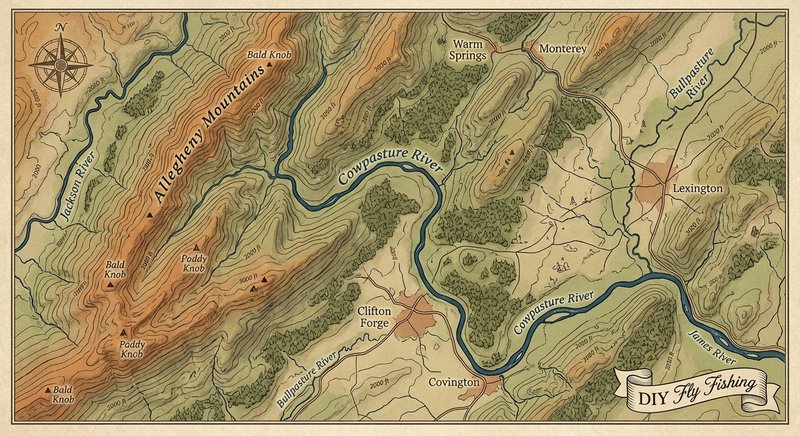
Cowpasture River
Fly fishing in Virginia · Intermediate · Best seasons: Spring, Summer, Fall
Target Species
Brown Trout, Rainbow Trout
About This Water
Highland and Bath County stream with wild trout. Scenic Allegheny Mountain fishing.
Fishing Recommendations
As an expert guide who has spent years roaming the Alleghany Highlands, I can tell you that the Cowpasture River is one of Virginia’s best-kept secrets. While its neighbor, the Jackson River, gets all the press, the Cowpasture offers a more serene, "old-school" fly fishing experience. It is a quintessential Appalachian freestone river flowing through a stunning limestone valley, giving it high water quality and a distinct character.
Here is your comprehensive guide to fly fishing the Cowpasture River for trout.
🎣 Location Overview
The Cowpasture River flows through Highland, Bath, and Alleghany counties before joining the Jackson to form the James River. What makes it special is its clarity and scenery. Because much of the river flows through the George Washington National Forest and large private farms, it remains remarkably clean.
The river is characterized by long, glassy pools, short riffles, and dramatic limestone cliffs. Unlike the tailwater section of the Jackson, the Cowpasture is a true freestone system. It is smaller and more intimate in its upper reaches, making it a favorite for anglers who value solitude and the classic "Blue Ridge" aesthetic.
🐟 Target Species & Behavior
While the lower Cowpasture is a premier Smallmouth Bass fishery, the Upper Cowpasture (Highland and northern Bath County) is the primary destination for trout.
- Rainbow Trout: These are the most common. They tend to hold in the faster oxygenated water at the heads of pools and in the middle of riffles. They are opportunistic and will often rise to a well-presented dry fly.
- Brown Trout: The "ghosts" of the Cowpasture. Browns are more likely to be found under undercut banks, beneath overhanging sycamore roots, or at the tail-outs of deep pools during low light.
- Behavior: Because the water is often crystal clear, these fish are extremely spooky. Long leaders and stealthy approaches are mandatory. In the summer, trout migrate toward "spring holes" where colder groundwater enters the river.
📅 Best Times to Fish
- Spring (March – June): Prime Time. This is when water levels are most consistent and the major hatches occur. April and May offer the most productive dry-fly fishing of the year.
- Summer (July – August): This is the most challenging time. The Cowpasture can get low and warm. Focus on the early morning (6:00 AM – 10:00 AM) and only fish the upper reaches where the water stays cool. If water temps exceed 68°F, please stop fishing for trout to prevent mortality.
- Fall (October – November): A fantastic time for Brown Trout as they become aggressive before spawning. The fall foliage in the Alleghany Highlands provides a world-class backdrop.
- Best Window: Overcast days are your best friend on this river. The lack of shadows helps hide your line and encourages fish to move out of deep cover.
🪰 Recommended Flies & Techniques
Top Fly Patterns
- Dry Flies:
- Adams (Classic or Parachute): #14-18 (Matches almost any grey mayfly).
- Elk Hair Caddis: #14-16 (Tan or Olive).
- Terrestrials (Summer): Foam Beetles, Ants, and Dave’s Hoppers.
- Nymphs:
- Pheasant Tail: #16-20 (The gold standard here).
- Hare’s Ear: #14-16.
- Prince Nymph: #14 (Effective in faster riffles).
- Streamers:
- Woolly Bugger: #8-12 (Olive or Black).
- Near Nuff Sculpin: #6-8.
Techniques
- Dry-Dropper: This is the most effective way to cover the Cowpasture. Use a buoyant Elk Hair Caddis with a small Pheasant Tail nymph suspended 18-24 inches below it.
- Sight Fishing: On sunny days, use high-quality polarized glasses. Slowly walk the banks and spot fish before you cast. If you can see them, they can see you—keep a low profile.
- Light Tackle: Use a 3-weight or 4-weight rod with a 9-foot to 12-foot leader tapered to 5X or 6X tippet.
💡 Pro Tips & Local Knowledge
- The Bullpasture Confluence: One of the most famous spots is where the Bullpasture River flows into the Cowpasture near Williamsville. The Bullpasture brings in colder water and is heavily stocked, often pushing fish down into the main stem of the Cowpasture.
- The "Slow Crawl": When fishing streamers in the deep pools for Browns, don't strip aggressively. Use a slow, rhythmic "crawl" along the bottom to mimic a crayfish or a lethargic sculpin.
- Watch the Gauges: The Cowpasture can drop very quickly. Check the USGS gauge at Williamsville. If it’s below 60 cfs, the fishing gets "technical" (very spooky fish). If it's above 300 cfs, it may be too turbid for dry flies.
⚠️ Important Information
- Access: Much of the Cowpasture flows through private land. However, there are several public access points within the George Washington National Forest and at VDGIF boat ramps. Always respect "Posted" signs.
- Regulations: Parts of the river and its tributaries are "Stocked Trout Waters," which require a baseline freshwater license PLUS a trout conservation stamp (between Oct 1 and June 15). Check the Virginia DWR website for the most current regulations.
- Wading Safety: The riverbed is composed of limestone ledges and "river snot" (algae-covered rocks). Felt-soled boots or studs are highly recommended to avoid a soaking.
- Leave No Trace: This is a pristine environment. Please pack out all spent tippet and trash to keep the Cowpasture beautiful.
Bug Hatches & Matching Flies
| Hatch | Type | Peak months | Time of day | Hook sizes | Matching flies |
|---|---|---|---|---|---|
| Blue-Winged Olive Baetis / Pseudocloeon | mayfly | March, April, October, November | Midday | #18-22 | RS2 #20-22, Parachute BWO #18-20, Pheasant Tail Nymph #18-22 |
| Quill Gordon Epeorus pleuralis | mayfly | March, April | Early Afternoon | #12-14 | Quill Gordon Dry #12-14, Gold Ribbed Hare's Ear #12-14 |
| Hendrickson Ephemerella subvaria | mayfly | April | Afternoon | #12-14 | Red Quill #12-14, Hendrickson Nymph #12-14, Hendrickson Emerger #14 |
| Sulphur Ephemerella invaria / dorothea | mayfly | May, June | Evening | #14-18 | Comparative Dun #14-16, Sulphur Parachute #16-18, Pheasant Tail #16-18 |
| Tan Caddis Hydropsyche | caddis | April, May, June | Late Afternoon/Evening | #14-16 | Elk Hair Caddis #14-16, Holy Grail #14-16, Peeking Caddis #14 |
| Golden Stonefly Acroneuria | stonefly | June, July | Morning/Evening | #6-10 | Pat's Rubber Legs #6-10, Golden Stimulator #8-10 |
| March Brown Maccaffertium vicarium | mayfly | May | Afternoon | #10-12 | March Brown Wet #10-12, March Brown American #10-12 |
| Light Cahill Stenonema / Stenacron | mayfly | June, July | Evening/Dusk | #12-14 | Light Cahill #12-14, Cream Midges #20-22 |
| Terrestrials Formicidae / Coleoptera | terrestrial | July, August, September | Midday | #12-18 | Cinnamon Ant #16-18, Black Foam Beetle #14-16, Dave's Hopper #10-12 |
| Zebra Midge Chironomidae | midge | January, February, March, December | All Day | #18-24 | Zebra Midge #18-22, Griffith's Gnat #20-22 |