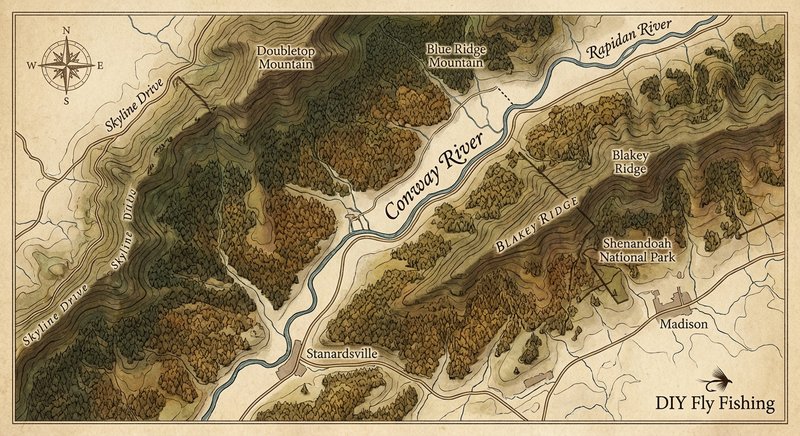
Conway River
Fly fishing in Virginia · Intermediate · Best seasons: Spring, Summer, Fall
Target Species
Brook Trout
About This Water
Greene County stream with native brook trout. Shenandoah National Park drainage.
Fishing Recommendations
The Conway River is one of the hidden gems of the Blue Ridge Mountains. Forming the border between Greene and Madison counties, it is a high-gradient, freestone sanctuary for Virginia’s state fish: the Southern Appalachian Brook Trout. While its neighbor, the Rapidan River, gets more national headlines, the Conway offers a more rugged, intimate, and often more rewarding experience for the angler willing to hike.
🎣 Location Overview
The Conway River is the quintessential "blue line" mountain stream. Characterized by steep gradients, massive moss-covered boulders, and dense rhododendron canopies, it offers classic pocket-water fishing.
What makes the Conway special is its wildness. Much of the fishable water lies within the Rapidan Wildlife Management Area (WMA) and the Shenandoah National Park (SNP). The water is crystal clear and remains cold even in the summer heat due to the heavy forest cover and high elevation of its headwaters. Anglers love it because it requires "mountain goat" agility and precise casting; it is a place where you earn every fish you land.
🐟 Target Species & Behavior
The Native Brook Trout (Salvelinus fontinalis) is the star of the show here. You won't find stocked fish in the upper reaches; these are wild, colorful, and aggressive specimens.
- Size: Most fish are in the 5–8 inch range, but a "Conway King" can reach 10–12 inches.
- Behavior: These fish are opportunistic but incredibly spooky. Because the water is so clear, they can see an angler from a distance. They hold in the "cushion" in front of rocks, in the deep plunge pools below waterfalls, and in the tail-outs of pools during low light.
- Diet: Their diet consists mainly of aquatic insects (Mayflies, Caddis, Stoneflies), terrestrial insects (Ants, Beetles), and the occasional small crawfish or minnow.
📅 Best Times to Fish
- Spring (Late March – May): Prime Time. This is the window for major hatches (Quill Gordons, March Browns). Water levels are usually ideal.
- Summer (June – August): Great fishing, provided you stay high in the drainage. The canopy keeps the water cool. Focus on terrestrial patterns.
- Fall (September – October): Beautiful scenery and active fish preparing for the spawn. This is when the Brookies display their most vibrant orange and red spawning colors.
- Time of Day: In the spring, midday is best as the water warms. In summer, early morning and late evening are crucial to avoid the brightest sun.
🪰 Recommended Flies & Techniques
Top Fly Patterns
- Dry Flies:
- Mr. Rapidan (Size 14-16): The local gold standard. It mimics many things and is highly buoyant.
- Royal Wulff or Elk Hair Caddis (Size 16-18): High visibility is key in broken water.
- Parachute Adams: Perfect for the flatter, slower pools.
- Terrestrials (Summer):
- Black Ants (Size 18-20): Often the most effective fly on the river.
- Foam Beetles: Great for "splatting" near overhanging banks.
- Nymphs:
- Pheasant Tail or Hare’s Ear (Size 16-18): Standard fare for deeper plunge pools.
- Prince Nymph: Effective when the water is slightly high or off-color.
Techniques & Presentation
- The "Bow and Arrow" Cast: The rhododendrons are thick. You will often find yourself in spots where a traditional backcast is impossible. Master this trick cast to reach fish under low-hanging branches.
- High Sticking: Use a short line and keep your rod tip high to minimize drag. In the turbulent pocket water, even a few inches of fly line on the water will cause the fly to drag unnaturally.
- Stealth: Always fish upstream. Brook trout face into the current; if you approach from behind, you have a much better chance of not being spotted. Wear drab colors (greens/browns) to blend into the forest.
💡 Pro Tips & Local Knowledge
- The "Sneak Attack": Before you even reach the water's edge, stop 5–10 feet back. Observe the tail of the pool. Often, the most active fish are sitting in very shallow water at the back of the pool and will bolt upstream—spooking the rest of the fish—if you stomp right up to the bank.
- Focus on the Seams: Look for where fast water meets slow water. That "seam" is the conveyor belt of food.
- Keep Moving: Don't spend 30 minutes in one pool. Give a pool 5–10 good casts; if you don't get a rise, move up to the next one. These fish are aggressive—if they are there and hungry, they usually strike quickly.
- The Devil's Ditch: Look for the confluence where the Devil’s Ditch enters the Conway. This area offers some of the most rugged but productive water in the system.
⚠️ Important Information
- Access: Access is primarily via Route 667 (Conway River Road). The road eventually becomes gravel and enters the Rapidan WMA. High-clearance vehicles are highly recommended, as the road can be rough and includes several small fords/stream crossings.
- Regulations:
- The Conway is generally Catch and Release Only (check current DWR/SNP signs for specific boundary changes).
- Single-hook, artificial lures only. No bait is permitted.
- Permits: You need a valid Virginia Freshwater Fishing License. If you cross into the Shenandoah National Park boundary, you must adhere to Park-specific regulations (which are generally aligned with the wild trout rules).
- Safety: This is bear country. While they usually avoid humans, be aware of your surroundings. Cell service is non-existent in the canyon, so tell someone where you are going and when you expect to return. Be cautious of slippery rocks—felt-soled boots or studs are a lifesaver here.
Bug Hatches & Matching Flies
| Hatch | Type | Peak months | Time of day | Hook sizes | Matching flies |
|---|---|---|---|---|---|
| Quill Gordon Epeorus pleuralis | mayfly | March, April | Mid-day | #12-14 | Quill Gordon Dry #12-14, Hare's Ear #12-14 |
| Blue Winged Olive Baetis spp. | mayfly | March, April, October, November | Mid-day/Afternoon | #18-22 | Parachute BWO #18-22, Pheasant Tail #18-20 |
| March Brown Maccaffertium vicarium | mayfly | May | Afternoon | #10-14 | March Brown Dry #12-14, Gold Ribbed Hare's Ear #10-12 |
| Sulfur Ephemerella invaria/dorothea | mayfly | May, June | Evening | #14-18 | Sulfur Parachute #14-16, Sulfur Emerger #16 |
| Yellow Sally Isoperla spp. | stonefly | June, July | Afternoon/Evening | #14-16 | Yellow Stimulator #14-16, Little Yellow Stone #14-16 |
| Tan Caddis Hydropsyche spp. | caddis | May, June, September | Morning/Evening | #14-18 | Elk Hair Caddis #14-18, LaFontaine Sparkle Pupa #16 |
| Black Ant Formicidae | terrestrial | July, August, September | All Day | #16-20 | Black Foam Ant #16-18, Cinnamon Ant #18 |
| Light Cahill Stenacron interpunctatum | mayfly | June, July | Evening | #12-16 | Light Cahill #12-16, Cream Variant #14 |