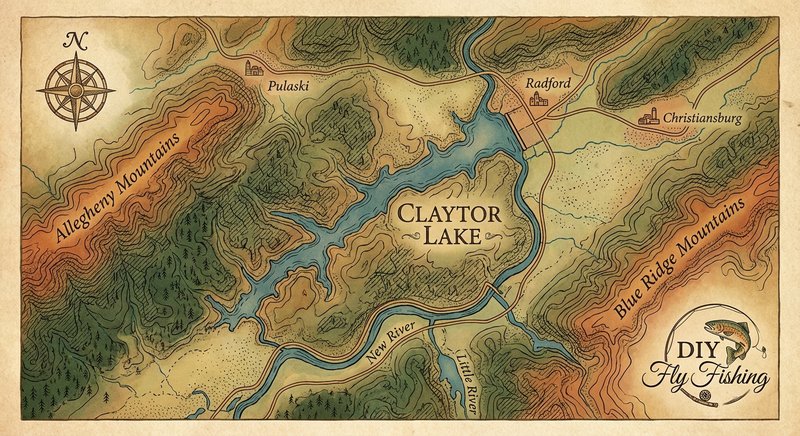
Claytor Lake
Fly fishing in Virginia · Intermediate · Best seasons: Spring, Summer, Fall
Target Species
Striped Bass, Largemouth Bass, Walleye
About This Water
Pulaski County reservoir with excellent bass fishing. Striped bass and walleye too.
Fishing Recommendations
Welcome to the "New River Jewel." As your guide, I’m excited to break down Claytor Lake. While many Virginia anglers head to the coast for Stripers or the mountains for Trout, Claytor Lake offers a unique, deep-water reservoir experience nestled in the Blue Ridge Highlands. It is a challenging but rewarding "big water" fly fishing destination.
🎣 Location Overview
Claytor Lake is a 4,500-acre impoundment of the New River in Pulaski County, Virginia. Unlike the shallow, murky reservoirs found elsewhere, Claytor is characterized by its dramatic depth (up to 115 feet), remarkably clear water, and steep, rocky shorelines.
What makes it special for the fly angler is the "river-to-lake" transition. The upper end of the lake retains riverine characteristics with significant current, while the lower end near the dam is a classic deep-water fjord-like environment. The lake is famous for its forage base—specifically Alewives and Gizzard Shad—which allows predators to grow large and powerful.
🐟 Target Species & Behavior
Striped Bass (Stripers)
These are the kings of Claytor. They are landlocked and rely heavily on schooling baitfish.
- Behavior: They are nomadic. In the spring, they push "up-river" toward the Allisonia area. In summer, they retreat to the thermocline (usually 20–30 feet deep).
- Feeding: They focus almost exclusively on Alewives. Look for "blitzes" on the surface during low light, though they often hold deep near submerged points.
Largemouth Bass
Claytor has a healthy population of Largemouths, though they share the habitat with hard-fighting Smallmouths.
- Behavior: They hold tight to the thousands of private docks, fallen timber, and the scattered weed beds in the back of coves (like Peak Creek).
- Feeding: They target bluegill, crawfish, and shad.
Walleye
Claytor is one of Virginia’s premier Walleye destinations.
- Behavior: These are "light-sensitive" fish. During the day, they sit in 20+ feet of water near rocky drop-offs.
- The "Run": In early spring (Feb-March), they migrate out of the lake and into the New River section to spawn, which is the prime window for fly anglers.
📅 Best Times to Fish
- Spring (March – May): Prime Time. This is when the Walleye run occurs in the upper New River section (Allisonia). Stripers also move shallow and can be caught on large streamers in the upper third of the lake.
- Summer (June – August): Focus on night fishing or "Golden Hour." The water clarity makes daytime fishing tough. Stripers will be deep; you’ll need heavy sinking lines. Bass will be under docks during the day.
- Fall (September – November): The "Fall Feed." As water temperatures drop, shad move into the shallows of the coves. Stripers and Bass follow them. This is the best time for surface action.
Best Times of Day:
- Stripers/Walleye: 4:00 AM to 8:00 AM and 7:00 PM to Midnight.
- Bass: Overcast days are your best friend on this clear water.
🪰 Recommended Flies & Techniques
For Striped Bass
- Patterns: Cowen’s Shad, Game Changers (white/silver), and heavy Clouser Minnows (chartreuse/white).
- Technique: Use a 9wt or 10wt rod with a 300–400 grain integrated sinking line. You must get the fly down to the 15–25 foot range unless you see them busting bait on top. Use a "strip-strip-pause" retrieve to mimic a wounded shad.
For Largemouth Bass
- Patterns: BoogleBugs (poppers) for early morning, and Murdich Minnows or Kinky Muddlers for sub-surface.
- Technique: Accuracy is key. Use an 8wt rod to skip flies under docks or tight to "overhanging" rock faces. If the bite is slow, a crawfish pattern bounced down a rocky point is lethal.
For Walleye
- Patterns: Bunny Leeches (purple, black, or white) and heavy-eyed Clousers.
- Technique: You must stay on the bottom. Use a 6wt or 7wt with a sink-tip line. In the spring river run, swing the fly across the current like you are fishing for Steelhead, keeping it just ticking the rocks.
💡 Pro Tips & Local Knowledge
- The "Allisonia" Run: If you are here in March, head to the Allisonia boat ramp. Move upstream into the New River. This is where the Walleye and Stripers congregate to spawn. It is the most "fly-friendly" water in the system.
- Fish the Lights: Many docks have underwater "green lights" or bright overhead lights. On summer nights, these act as fish magnets. Cast a small white streamer (size 2-4) into the shadow line of the light for explosive Striper and Bass action.
- Watch the Gulls: In the fall and winter, seagulls are your best fish finders. If they are diving, the Stripers have pushed the Alewives to the surface.
- The Wind Factor: Claytor is a "wind tunnel" lake. A light chop is good for Bass fishing as it breaks up the surface visibility, but heavy winds make fly casting from a boat dangerous. Always check the forecast for the New River Valley.
⚠️ Important Information
- Access: Claytor Lake State Park is the primary access point with excellent ramps and bank access. Allisonia (Upper Lake) and Peak Creek (Pulaski side) are also vital access points.
- Regulations: A valid Virginia Freshwater Fishing License is required. There are specific size and creel limits for Stripers and Walleye that change seasonally—check the Virginia DWR website before you head out.
- Safety: This is a deep lake with heavy recreational boat traffic (jet skis/wakeboards) in the summer. If you are in a kayak or small boat, stay alert and fly fish the coves to stay out of the main channel wakes.
- Clean/Drain/Dry: Claytor has issues with invasive species (like Zebra Mussels nearby). Ensure your gear is cleaned to prevent spreading invasives to the New River.
Guide’s Final Word: Claytor is a "quality over quantity" lake. You might cast 500 times for one Striper, but when that 15-pounder hits your fly in the dark, you'll understand why we love this water. Tight lines!
Bug Hatches & Matching Flies
| Hatch | Type | Peak months | Time of day | Hook sizes | Matching flies |
|---|---|---|---|---|---|
| White Fly Ephoron leukon | mayfly | August, September | Evening/Night | #12-14 | White Wulff #12-14, Ephoron Emerger #14, White Miller Nymph #14 |
| Dobsonfly (Hellgrammite) Corydalus cornutus | stonefly | June, July, August | All Day | #2-8 | Murray's Hellgrammite #4-8, Bitch Creek Nymph #6-10, Clouser Minnow (Black) #2-6 |
| Giant Michigan Mayfly Hexagenia limbata | mayfly | June, July | Evening/Dusk | #6-10 | Hexagenia Spinner #6-8, Hex Nymph #8-10, Yellow Humpy #10 |
| Tan Caddis Hydropsyche | caddis | May, June, September | Morning/Evening | #14-18 | Elk Hair Caddis (Tan) #14-16, LaFontaine's Deep Sparkle Pupa #16, Peeking Caddis #14-16 |
| Light Cahill Stenacron interpunctatum | mayfly | June, July | Evening | #12-14 | Light Cahill Dry #12-14, Gold Ribbed Hare's Ear #12-14 |
| Blue-Winged Olive Baetis | mayfly | April, October, November | Afternoon | #18-22 | BWO Parachute #18-20, RS2 (Olive) #20-22, Pheasant Tail Nymph #18-20 |
| Cicada Magicicada / Tibicen | terrestrial | July, August | All Day | #4-8 | Rainy's Grand Slam Cicada #6-8, Project Cicada #6-8 |
| Midges Chironomidae | midge | March, April, December | Morning | #18-24 | Zebra Midge #18-22, Griffith's Gnat #20-22, Chironomid Pupa #18-20 |