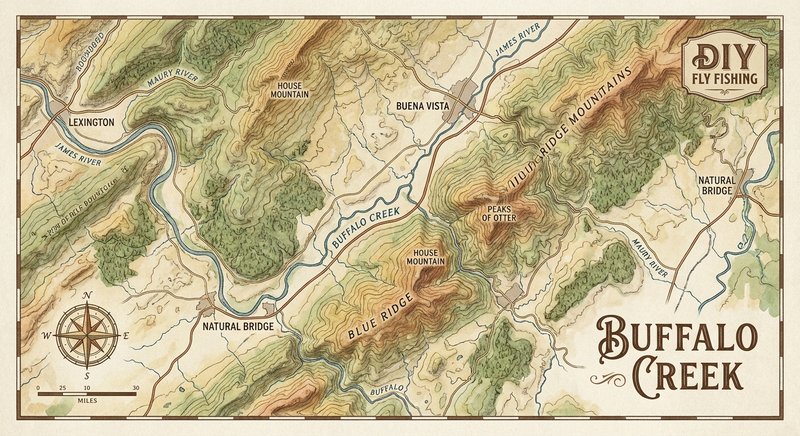
Buffalo Creek
Fly fishing in Virginia · Beginner · Best seasons: Spring, Summer, Fall
Target Species
Brown Trout, Rainbow Trout
About This Water
Rockbridge County stream with wild trout. Scenic mountain fishing.
Fishing Recommendations
As an expert guide who has spent significant time in the Blue Ridge region, I can tell you that Buffalo Creek near Lexington, Virginia, is one of the crown jewels of the Shenandoah Valley. Specifically, the "Special Regulation" section is a bucket-list destination for any serious trout angler visiting the Commonwealth.
Here is your comprehensive guide to fishing Buffalo Creek.
🎣 Location Overview
Buffalo Creek is a classic limestone spring creek located in Rockbridge County. Unlike the tumbling freestone mountain streams found in the nearby Blue Ridge Mountains, Buffalo Creek meanders through pastoral farmland and limestone shelf rock.
What makes it special is its limestone influence. The water is nutrient-rich, alkaline, and stays cooler than most valley streams during the summer. This creates a prolific environment for aquatic insects and crustaceans, leading to trout that grow faster and larger than their mountain cousins. Anglers love it because it offers a "Western-style" spring creek experience in the heart of Virginia—complete with tricky currents, clear water, and wary fish.
🐟 Target Species & Behavior
The primary targets here are Brown Trout and Rainbow Trout.
- Brown Trout: These are the "kings" of Buffalo Creek. They are notorious for hiding under the deep limestone ledges and undercut banks. They are highly predatory and can reach impressive sizes (18"+). They are most active during low light or when the water has a bit of "stain" after a rain.
- Rainbow Trout: These fish tend to hold in the swifter riffles and at the heads of the pools. They are generally more opportunistic than the browns and will rise more readily to a well-presented dry fly.
- Feeding Behavior: Because this is a limestone stream, the fish rely heavily on scuds (freshwater shrimp) and sowbugs. If you aren't seeing a hatch, they are almost certainly feeding on the bottom on these high-protein crustaceans.
📅 Best Times to Fish
Optimal Seasons
- Spring (March – June): This is the prime window. The water levels are usually perfect, and the major hatches (Quill Gordons, March Browns, and Sulphurs) occur.
- Fall (Late September – November): This is the best time for trophy Brown Trout. As the water cools and the fish prepare to spawn, they become more aggressive and territorial.
- Summer (July – August): While many VA streams get too hot, Buffalo Creek’s springs keep it fishable, but you must fish early in the morning or late in the evening.
Best Times of Day
- Morning/Evening: In the clear water of a spring creek, bright midday sun is your enemy. The fish will tuck under ledges and become dormant.
- Overcast Days: A cloudy day on Buffalo Creek is a gift. It brings the big browns out from under the rocks and makes the fish less "spooky."
🪰 Recommended Flies & Techniques
Top Fly Patterns
- Nymphs/Crustaceans:
- Ray Charles or Grey Scud (Size 14-18) – Essential for limestone waters.
- Pheasant Tail Nymph (Size 16-20).
- Zebra Midge (Size 18-22) in black or red.
- Dry Flies:
- Sulphur Parachute (Size 16-18) – The most famous hatch on the creek.
- Elk Hair Caddis (Size 14-16) – Great for the riffles.
- Terrestrials: Beetle and Ant patterns in late summer.
- Streamers:
- Black or Olive Wooly Bugger (Size 8-12).
- Sculpin patterns (the trout love the native sculpins found in the limestone crevices).
Techniques & Presentation
- The "High-Stick" Nymph: Because the current can be complex with different speeds, use a tight-line nymphing technique to avoid drag.
- Down-and-Across Streamers: Cast toward the undercut banks on the opposite side, let the streamer sink, and strip it back aggressively to trigger a reaction from a big Brown.
- Long Leaders: Use 9ft to 12ft leaders tapered to 5X or 6X. These fish are highly pressured and will bolt if they see a thick fly line landing over their heads.
💡 Pro Tips & Local Knowledge
- The "Creep and Peep": The banks of Buffalo Creek are often high. If you walk right up to the edge, the trout will see your silhouette against the sky and vanish. Stay low, wear drab clothing, and kneel when approaching a pool.
- Focus on the Ledges: Buffalo Creek is full of "shelf rock." The fish aren't always in the deepest part of the hole; they are often tucked under the rock shelves in just a few inches of water.
- The "Sulphur" Window: From May through June, the Sulphur hatch can be world-class. It usually happens in the last hour of daylight. Be on the water and ready at 7:30 PM.
⚠️ Important Information
Access
The most famous stretch is the Delayed Harvest (DH) section and the Special Regulation section. Much of Buffalo Creek flows through private land; however, there is excellent public access provided by the Virginia Department of Wildlife Resources (DWR) via the Buffalo Creek "Special Regulation" area.
- Note: Always respect "Posted" signs. Landowners are gracious enough to allow access in certain spots; don't ruin it for others.
Regulations
- Special Regulation Area: Usually requires the use of single-hook artificial lures only.
- Size/Creel Limits: Check the current VA DWR trout regulations, as this creek often has a "Catch and Release only" period or strict size limits (e.g., no fish under 16 inches may be kept).
- Permit: You need a valid Virginia State Fishing License AND a Trout License.
Special Considerations
- Wading: The limestone rock can be incredibly slick—slicker than mountain granite. Felt-soled boots or studs are highly recommended to avoid a fall.
- Cows: This is farm country. You may encounter cattle near the banks. Give them a wide berth, and be careful where you step!
Bug Hatches & Matching Flies
| Hatch | Type | Peak months | Time of day | Hook sizes | Matching flies |
|---|---|---|---|---|---|
| Blue Winged Olive Baetis | mayfly | March, April, October, November | Late Morning/Afternoon | #18-22 | BWO Sparkle Dun #18-20, Pheasant Tail Nymph #18-22, RS2 #20-22 |
| Sulphur Ephemerella invaria/dorothea | mayfly | May, June | Evening | #14-18 | Sulphur Parachute #16-18, Sulphur CDC Spinner #14-18, Sulphur Cripple #16 |
| Grannom Caddis Brachycentrus | caddis | April | Morning/Afternoon | #12-16 | Elk Hair Caddis (Dark) #14-16, Peacock Caddis #14-16, Deep Sparkle Pupa #14-16 |
| Trico Tricorythodes | mayfly | July, August, September | Early Morning | #22-26 | Trico Spinner #22-26, Trico Parachute #22-24 |
| Tan Caddis Hydropsyche | caddis | May, June, July | Evening | #14-18 | LaFontaine Sparkle Pupa #14-16, Tan Elk Hair Caddis #14-18, Holy Grail #14-16 |
| Terrestrials (Beetles/Ants) Coleoptera/Formicidae | terrestrial | June, July, August, September | All Day | #12-20 | Black Foam Beetle #14-18, Cinnamon Ant #16-20, Dave's Hopper #10-14 |
| Zebra Midge Chironomidae | midge | January, February, March | All Day | #18-24 | Zebra Midge (Red/Black) #18-22, Griffith's Gnat #18-22, Mercury Midge #20-24 |
| Light Cahill Stenacron interpunctatum | mayfly | June, July | Evening | #12-14 | Light Cahill #12-14, Cream Usual #14 |