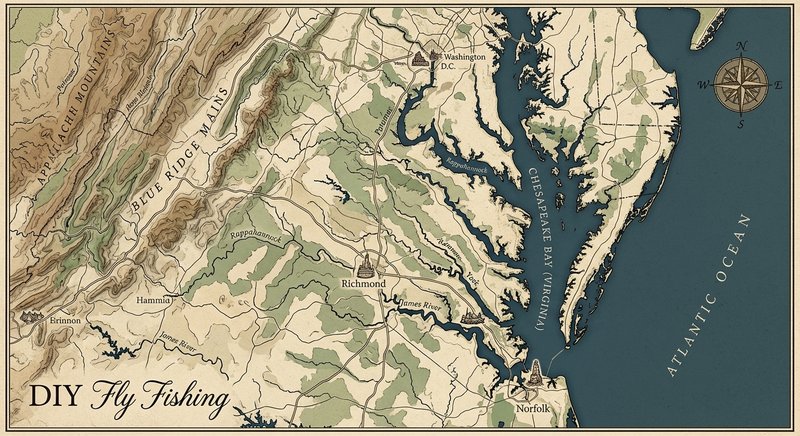
Chesapeake Bay (Virginia)
Fly fishing in Virginia · Intermediate · Best seasons: Spring, Summer, Fall
Target Species
Striped Bass, Red Drum, Speckled Trout
About This Water
World-famous estuary with striped bass, red drum, and speckled trout. Year-round fishing.
Fishing Recommendations
Welcome to the "Main Salmon of the East." The Virginia portion of the Chesapeake Bay is a world-class fly fishing destination, offering a mix of vast salt marshes, shallow grass flats, and massive concrete structures. Whether you are stalking Red Drum in the skinny water of the Eastern Shore or dredging for "Rockfish" (Striped Bass) around the bridge tunnels, this water demands versatility and respect for the tides.
🎣 Location Overview
The Virginia Chesapeake Bay is the lower third of the nation’s largest estuary. It is a complex ecosystem where the Atlantic Ocean meets the influx of several major rivers (James, York, Rappahannock, and Potomac).
What makes it special is the diversity of habitat. To the east lies the Eastern Shore, a wilderness of salt marshes and seaside flats. To the west are the Middle Peninsula and Northern Neck, characterized by sandy points and rip-rap. In the center is the Chesapeake Bay Bridge-Tunnel (CBBT), a 17-mile man-made reef that acts as a magnet for every migratory species on the coast. The water is generally brackish to salty, ranging from crystal clear on the flats to "tannin-stained" near the river mouths.
🐟 Target Species & Behavior
Striped Bass (Local name: Rockfish)
- Behavior: Highly migratory and structure-oriented. They love current.
- Holding Spots: Bridge pilings, rip-rap jetties, shadow lines at night, and under "working birds" in open water.
- Diet: Menhaden (bunker), bay anchovies, silversides, and blue crabs.
Red Drum (Redfish)
- Behavior: Two distinct fisheries exist here. "Puppy Drum" (15–25 inches) inhabit the grass flats and marshes. "Bull Reds" (40+ inches) roam the shoals and open water in the spring and fall.
- Holding Spots: Shallow flats, oyster bars, and "guts" in the marsh.
- Diet: Primarily crabs and shrimp in the shallows; large menhaden in open water.
Speckled Trout
- Behavior: Ambush predators that prefer clean water and grass. They are sensitive to temperature and very "spooky."
- Holding Spots: Lush seagrass beds (Eelgrass), "potholes" (sandy depressions in grass), and creek mouths during a falling tide.
- Diet: Glass minnows, shrimp, and small mullet.
📅 Best Times to Fish
- Spring (April – Early June): The "Wake Up." Bull Reds arrive on the shoals (May is peak). Stripers move out of the rivers after spawning.
- Summer (Late June – August): Best for Red Drum in the shallows. Speckled trout are active early morning/late evening. Night fishing the CBBT lights becomes the primary Striper game to avoid the heat.
- Fall (September – November): The "Golden Era." This is the fall blitz. Stripers and Specks gorge themselves for winter. Bull Reds reappear on the surface.
- Prime Windows: Always fish the moving tide. The two hours before and after high tide are generally most productive for flats, while the "ebb" (falling) tide is best for creek mouths.
🪰 Recommended Flies & Techniques
Top Fly Patterns
- Clouser Minnow: The undisputed king of the Bay. Chartreuse/White or Olive/White. Heavy eyes to get deep in the current.
- Lefty’s Deceiver: Essential for mimicking larger menhaden. White/Blue or White/Chartreuse.
- Gurgler: For heart-stopping topwater strikes from Stripers and Specks in low light.
- Kwan Fly / Spoon Fly: Specifically for Red Drum on the flats to mimic crabs and shrimp.
- Half and Half: A hybrid between a Clouser and a Deceiver—perfect for Bull Reds.
Techniques & Presentation
- The Strip-Set: Never "trout set" (lift the rod). When you feel a strike, pull the line hard with your stripping hand to set the hook in the tough mouths of these salt species.
- Dredging: Use a 250–400 grain sinking line to get flies down to the base of bridge pilings or deep channel edges where Stripers hold.
- Sight Casting: On the Eastern Shore flats, move slowly and look for "v-wakes" or the bronze flash of a Red Drum. Cast 2 feet in front of the fish's nose.
💡 Pro Tips & Local Knowledge
- Follow the Birds: If you see Gannets or Gulls diving, there is bait. If there is bait, there are predators. Approach the school from upwind, cut your motor, and drift into casting range. Never drive through the middle of the school.
- The "CBBT" Lights: If you have a boat, fishing the "shadow lines" of the Bridge-Tunnel at night is legendary. Stripers sit just inside the dark water and dart into the light to grab bait.
- Pink is the Secret: While chartreuse is the standard, local guides know that Pink/White is often the most effective color for Speckled Trout in Virginia waters.
- The Wind Factor: The Chesapeake is shallow and can get "choppy" fast. A 15-knot wind from the North can make the Bay dangerous for small skiffs. Always check the marine forecast, not just the land forecast.
⚠️ Important Information
Access
- Wade Fishing: Limited but possible at First Landing State Park (Virginia Beach), Kiptopeke State Park (Eastern Shore), and Grandview Nature Preserve (Hampton).
- Boat/Kayak: This is primarily a boat/kayak fishery. Public ramps are plentiful, but "Lynnhaven Inlet" and "Kiptopeke" are the most popular for fly anglers.
Regulations & Permits
- License: A Virginia Saltwater Fishing License is required.
- Size Limits: Regulations for Striped Bass (Rockfish) change frequently in Virginia due to conservation efforts. Always check the VMRC (Virginia Marine Resources Commission) website before heading out.
- Release: Speckled trout are fragile; if you plan to release them, keep them in the water. Their scales and "slime coat" are easily damaged.
Gear Recommendation
- Rods: 8-weight for general use; 10-weight for Bull Reds and heavy sinking lines.
- Reels: Saltwater-sealed drags are non-negotiable. The salt here is corrosive.
- Leader: 16lb–20lb fluorocarbon for most applications. If targeting large Stripers around structure, use a 30lb bite tippet.
Bug Hatches & Matching Flies
| Hatch | Type | Peak months | Time of day | Hook sizes | Matching flies |
|---|---|---|---|---|---|
| Giant Mayfly Hexagenia limbata | mayfly | June, July | Evening/Night | #6-10 | Hexagenia Spinner #6-8, Burrowing Mayfly Nymph #8-10 |
| Salt Marsh Midge Chironomidae | midge | April, May, September, October | Morning/Evening | #18-24 | Zebra Midge #18-22, Griffith's Gnat #20-24 |
| White Miller Ephoron leukon | mayfly | August | Evening | #12-14 | White Wulff #12-14, Snowshoe Mayfly #14 |
| Cinnamon Caddis Hydropsyche | caddis | May, June | Evening | #14-16 | Elk Hair Caddis (Tan) #14-16, Pupa Emerger #16 |
| Coastal Grasshopper Melanoplus | terrestrial | July, August, September | Afternoon | #8-12 | Dave's Hopper #8-12, Rainy's Foam Hopper #10 |
| Flying Ant Formicidae | terrestrial | August, September | Afternoon | #16-20 | Black Foam Ant #16-18, Cinnamon Ant #16-20 |
| Japanese Beetle Popillia japonica | terrestrial | June, July | All Day | #12-14 | Foam Beetle #12-14 |
| Trico Tricorythodes | mayfly | July, August, September | Morning | #20-24 | Trico Spinner #22-24, RS2 #20-22 |