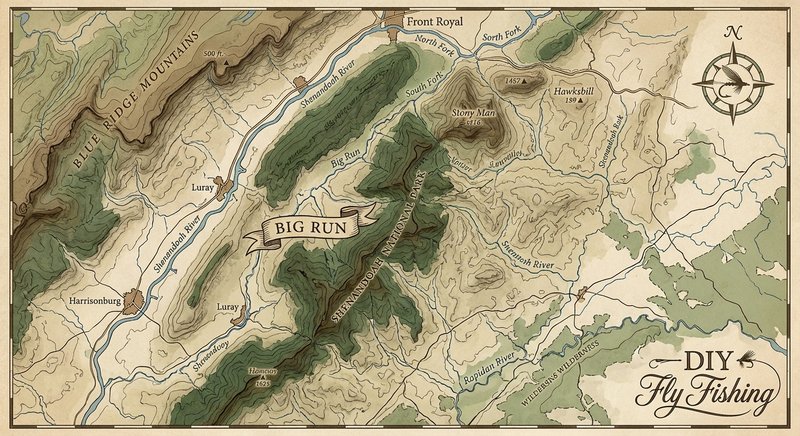
Big Run
Fly fishing in Virginia · Advanced · Best seasons: Spring, Summer, Fall
Target Species
Brook Trout
About This Water
Shenandoah National Park stream with native brook trout. Remote wilderness fishing.
Fishing Recommendations
Welcome to one of the crown jewels of the Mid-Atlantic. As a guide, when people ask for the quintessential Appalachian "Blue Lining" experience, Big Run in the Shenandoah National Park (SNP) is always at the top of my list.
Located in the South District of the park, Big Run is the largest watershed in the Shenandoah National Park. It is a wild, rugged, and remote drainage that offers some of the finest native Brook Trout fishing in the Eastern United States.
🎣 Location Overview
Big Run is unique because of its scale and its "upside-down" nature. Unlike many mountain streams that you fish from the bottom up, most anglers access Big Run from the Skyline Drive, meaning you hike down into the canyon to fish and must save enough energy for the strenuous hike back up at the end of the day.
The water is crystal clear, flowing over a bed of ancient quartzite and sandstone boulders. It features classic pool-and-drop morphology: plunge pools, long glides, and technical pocket water. What makes it special is the sense of isolation; once you get two or three miles away from the trailhead, you are in a true wilderness setting where the only sounds are the water and the wind.
🐟 Target Species & Behavior
The star of the show here is the Salvelinus fontinalis—the Native Brook Trout. These are not stocked fish; they are wild, colorful, and surprisingly aggressive.
- Size: Expect fish in the 5–8 inch range. A 10-inch fish is a "trophy" in these high-gradient headwaters.
- Behavior: They are opportunistic feeders because nutrients are scarce in freestone mountain streams. However, they are incredibly "spooky." If they see your shadow or feel the vibration of a heavy footstep, they will dart under a rock and won't come out for an hour.
- Holding Water: Look for the "bubble line" (foam or bubbles carrying insects). They sit at the head of pools waiting for food to drop in, or in the tail-outs during low light.
📅 Best Times to Fish
- Spring (Late March – Early June): Prime Time. This is when the water levels are stable and the major hatches (Quill Gordons, March Browns, and Hendricksons) occur. The fish are hungry after a long winter and will rise readily.
- Summer (June – August): Great fishing, but requires a stealthy approach. Water levels can get low and clear. Focus on the deeper pools and the shaded sections of the canyon.
- Fall (September – October): A magical time. The Brookies are in their spawning colors (vibrant oranges and reds). Terrestrial fishing is at its peak. Note: Please avoid stepping on "redds" (spawning nests) in late October/November.
- Best Window: 10:00 AM to 4:00 PM in the Spring; Early morning and late evening in the heat of Summer.
🪰 Recommended Flies & Techniques
In Big Run, you don't need a thousand fly patterns, but you do need a delicate presentation.
Top Fly Patterns
- Dry Flies:
- Royal Wulff or Royal Coachman (High visibility is key in broken water).
- Elk Hair Caddis (Tan or Olive, sizes 14–18).
- Parachute Adams (The ultimate generalist).
- Humpty or Stimulator (Great for flotation in heavy pocket water).
- Terrestrials (Summer/Fall):
- Black Ants (Size 16–20) — If the fishing is tough, go to an ant.
- Green Weenies (A local Shenandoah staple).
- Foam Beetles or Small Hoppers.
- Nymphs:
- Pheasant Tail (Size 16–18).
- Gold-Ribbed Hare's Ear.
Techniques
- Dry-Dropper: This is the most effective way to cover Big Run. Use a buoyant dry fly (like a Stimulator) and hang a small Pheasant Tail nymph 12–18 inches below it.
- The "Sneak": Stay low. I often recommend fishing from your knees to keep your silhouette off the horizon.
- Short Casts: Most of your casts will be under 20 feet. Accuracy and mending to avoid drag are more important than distance.
💡 Pro Tips & Local Knowledge
- Go Deep: The further you hike down from the Skyline Drive (via the Big Run Loop or Rockytop Trail), the better the fishing gets. The "Portal" area, where the stream narrows into a canyon, holds some of the best water.
- Watch the Water Temp: If the water gets above 68°F in the peak of summer, stop fishing. Brook trout are sensitive to heat, and catching them in warm water can be fatal for the fish.
- Gear Selection: Use a short rod (7' to 8') rated for a 2-weight or 3-weight line. A 9-foot rod is often too long for the overhanging mountain laurel and rhododendron.
- The "Shadow" Rule: Never let your shadow fall over the pool you are about to fish. Always approach from downstream and cast upstream.
⚠️ Important Information
- Access: Access is primarily via the Big Run Overlook (Mile 81.2) or Dundo Flats (Mile 83.7) on the Skyline Drive. Be prepared for a 2–4 mile hike with significant elevation change.
- Regulations:
- Single-hook, artificial lures only. No bait is permitted.
- Catch and Release is highly encouraged to protect these native gems, though SNP does have specific harvest regulations (usually 9-inch minimum, but check current park flyers at the entrance station).
- Permits: You must have a valid Virginia State Fishing License. If you are keeping a vehicle in the park, you will need a National Park Pass or pay the entrance fee.
- Safety: This is bear and rattlesnake country. Carry bear spray, stay hydrated, and tell someone your itinerary. Cell service is non-existent in the bottom of the Big Run canyon.
Tight lines, and enjoy the solitude of the Blue Ridge!
Bug Hatches & Matching Flies
| Hatch | Type | Peak months | Time of day | Hook sizes | Matching flies |
|---|---|---|---|---|---|
| Quill Gordon Epeorus pleuralis | mayfly | March, April | Mid-day | #12-14 | Quill Gordon Dry #12-14, Quill Gordon Wet Fly #12-14 |
| Blue Quill Paraleptophlebia adoptiva | mayfly | April | Late morning/Afternoon | #16-18 | Blue Quill Dry #16-18, Pheasant Tail Nymph #16-20 |
| March Brown Maccaffertium vicarium | mayfly | May | Afternoon | #10-14 | March Brown American #10-12, Hare's Ear Nymph #10-14 |
| Sulphur Ephemerella dorothea | mayfly | May, June | Evening | #14-18 | Sulphur Parachute #14-18, Sulphur Emerger #16-18 |
| Yellow Sally Isoperla spp. | stonefly | June, July | Late afternoon/Evening | #14-16 | Yellow Sally Dry #14-16, Iron Lotus #16 |
| Cinnamon Caddis Hydropsyche | caddis | May, June, September | Evening | #14-16 | Elk Hair Caddis (Tan) #14-16, Pupa (Tan) #14-16 |
| Light Cahill Stenacron interpunctatum | mayfly | June, July | Evening/Dusk | #12-14 | Light Cahill Dry #12-14, Gold Ribbed Hare's Ear #12-14 |
| Black Ant Formicidae | terrestrial | July, August, September | All day | #16-20 | Cinnamon or Black Foam Ant #16-20, Flying Ant #18 |
| Green Drake Ephemera guttulata | mayfly | Late May, Early June | Late Afternoon/Evening | #8-10 | Green Drake Paradox #8-10, Coffin Fly #10 |