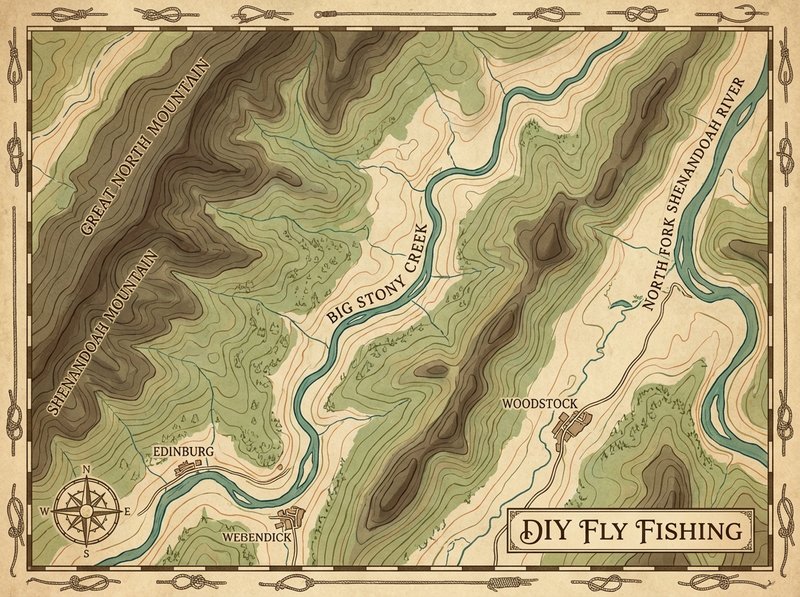
Big Stony Creek
Fly fishing in Virginia · Intermediate · Best seasons: Spring, Summer, Fall
Target Species
Brown Trout, Rainbow Trout
About This Water
Giles County stream with wild trout. Cascades waterfall area.
Fishing Recommendations
Welcome to the heart of the Shenandoah Valley. Big Stony Creek in Shenandoah County is one of Virginia’s most storied trout streams. Flowing through the George Washington National Forest near Edinburg, it offers a quintessential Appalachian fly fishing experience. It is a freestone stream with a slight limestone influence, providing better mineral content and bug life than many of the more sterile mountain runs in the region.
Here is your comprehensive guide to fishing Big Stony Creek.
🎣 Location Overview
Big Stony Creek is a medium-sized freestone stream that drains the eastern slopes of Great North Mountain. What makes it special is its diversity: it transitions from a high-gradient mountain stream in its upper reaches to a broader, ledge-filled valley stream in its lower reaches.
The stream is famous for its Delayed Harvest (DH) section, which runs for approximately 3 miles from the downstream boundary of the George Washington National Forest to the Route 675 bridge. This section provides high-quality catch-and-release fishing through the cooler months. Above the DH section, the water becomes a "Wild Trout" stream, where the canopy tightens and the fish become smaller but much more wary.
🐟 Target Species & Behavior
- Rainbow Trout: These are the primary residents of the Delayed Harvest section. They tend to hold in the faster riffles and at the heads of deep pools. They are aggressive and often respond well to colorful attractors and flashy nymphs.
- Brown Trout: You will find both stocked holdovers and wild browns. The wild fish are primarily in the upper reaches. Browns here are notorious for hugging the undercut banks and hiding beneath the large "lunker" logs and boulders. They are more light-sensitive and become most active during low-light hours or when the water is slightly stained after a rain.
📅 Best Times to Fish
- Spring (March – May): The Gold Standard. This is when the major hatches occur. Water levels are usually optimal. April is arguably the best month of the year for dry fly action.
- Summer (June – August): Focus on the upper reaches where the canopy provides shade and keeps water temperatures cooler. Early mornings are essential. If water temps exceed 68°F, give the fish a break and head elsewhere.
- Fall (October – November): The start of the Delayed Harvest season (October 1st) brings fresh stockings and aggressive fish. The changing foliage makes this the most scenic time to fish.
- Optimal Windows:
- Spring: 11:00 AM – 4:00 PM (Waiting for the water to warm slightly).
- Summer: Dawn until 10:30 AM.
- Fall: Late afternoon as the sun dips behind the mountain.
🪰 Recommended Flies & Techniques
Top Fly Patterns
- Dry Flies:
- Spring: Quill Gordon (#12-14), March Brown (#12), and Sulphurs (#14-16) in May.
- Summer: Elk Hair Caddis (#14-18), Royal Wulff (#14), and Black Ants or Beetles (#16-18).
- Fall: Blue Winged Olives (#18-22) and Stimulators (#12).
- Nymphs:
- Pheasant Tail (#14-18) and Gold-Ribbed Hare’s Ear.
- Prince Nymphs (the "hot bead" version is deadly in the DH section).
- Pat’s Rubber Legs (Black/Tan) for higher water.
- Streamers:
- Woolly Buggers (Olive or Black) #8-10.
- Sculpin patterns (the stream has a high natural sculpin population).
Techniques
- Tight-Line Nymphing: In the pocket water and riffles, a European-style or tight-line approach is highly effective to navigate the complex currents.
- Dry-Dropper: This is the "go-to" for Big Stony. Use a buoyant Stimulator or Hopper as your indicator and hang a small Pheasant Tail 18 inches below it.
- The "Slow Swing": In the deeper pools of the DH section, swinging a small streamer or a weighted nymph through the tail-out can often entice a strike from a neutral fish.
💡 Pro Tips & Local Knowledge
- Work the "Lunkers": The Virginia Department of Wildlife Resources (DWR) has installed various wood structures (Lunker structures) in the DH section. These are magnetizing for large Brown trout. Always cast a few inches past these logs and let your fly drift deep along the edge.
- Stealth is Mandatory: The water in Big Stony can be crystal clear. Wear earthy tones (camo/olive/tan) and avoid "shining" the pool with your fly rod. If you see the fish, they have likely already seen you.
- Long Leaders: For dry fly fishing, use a 9-foot to 12-foot 5X leader. The extra length helps prevent drag in the swirling mountain currents.
- The "Edinburg Gap" Secret: If the lower DH section is crowded, hike further upstream from the forest boundary. The crowds thin out significantly, and while the fish are smaller, they are beautiful, wild-acting specimens.
⚠️ Important Information
- Access: Most fishing occurs along Route 675 (Wolf Gap Road). There are numerous pull-offs marked with "Public Fishing" signs.
- Regulations:
- Delayed Harvest Section: From October 1 through May 31, fishing is strictly Catch and Release only, and you must use Single-Hook Artificial Lures. No bait is allowed during this time.
- Licensing: You need a standard Virginia Freshwater Fishing License plus a Trout License. If you are in the National Forest, a National Forest Permit is also required.
- Safety: The rocks in Big Stony are exceptionally slick due to a fine layer of silt and algae. Studded wading boots and a wading staff are highly recommended.
- Cell Service: Be prepared to lose cell service once you turn onto Route 675. Download your maps for offline use before you leave Edinburg.
Guide's Final Word: Big Stony is a "technical freestone." It rewards the angler who slows down, watches the water for 10 minutes before casting, and prioritizes a drag-free drift over a long cast. Tight lines!
Bug Hatches & Matching Flies
| Hatch | Type | Peak months | Time of day | Hook sizes | Matching flies |
|---|---|---|---|---|---|
| Blue-Winged Olive (BWO) Baetis tricaudatus | mayfly | March, April, October, November | Afternoon | #18-22 | RS2 #18-22, Parachute Adams #18-22, Pheasant Tail #18-20 |
| Quill Gordon Epeorus pleuralis | mayfly | March, April | Mid-day | #12-14 | Quill Gordon #12-14, Gold Ribbed Hare's Ear #12-14 |
| Hendrickson Ephemerella subvaria | mayfly | April, May | Afternoon | #12-14 | Red Quill #12-14, Hendrickson Emerger #12-14 |
| March Brown Maccaffertium vicarium | mayfly | May | Afternoon | #10-12 | March Brown #10-12, Hare's Ear Nymph #10-12 |
| Sulphur Ephemerella invaria | mayfly | May, June | Evening | #14-16 | Sulphur Parachute #14-16, Sulphur CDC Emerger #14-16 |
| Yellow Sally Isoperla spp. | stonefly | June, July | Afternoon/Evening | #14-16 | Yellow Sally #14-16, Little Yellow Sloan #14-16 |
| Green Sedge Rhyacophila | caddis | April, May, June | Morning/Evening | #12-16 | Green Weenie #12-14, Elk Hair Caddis #14-16 |
| Light Cahill Stenocron interpunctatum | mayfly | June, July | Evening | #12-14 | Light Cahill #12-14 |
| Giant Black Stonefly Pteronarcys dorsata | stonefly | April, May | All Day (Nymphs) | #4-8 | Pat's Rubber Legs #4-8, Black Stimulator #8-10 |
| Terrestrials Formicidae / Coleoptera | terrestrial | July, August, September | All Day | #12-18 | Black Foam Beetle #14-16, Cinnamon Ant #16-18 |