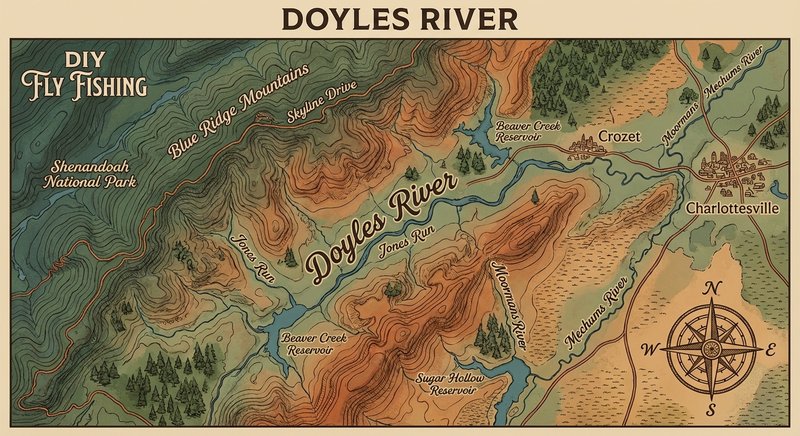
Doyles River
Fly fishing in Virginia · Advanced · Best seasons: Spring, Summer, Fall
Target Species
Brook Trout
About This Water
Shenandoah National Park stream with native brook trout. Scenic waterfall hike access.
Fishing Recommendations
The Doyles River is one of the crown jewels of the South District of Shenandoah National Park. For the fly angler seeking the quintessential Blue Ridge mountain experience, the Doyles offers a perfect blend of rugged scenery, classic plunge-pool pocket water, and a healthy population of wild, native Southern Appalachian Brook Trout.
🎣 Location Overview
The Doyles River is a high-gradient freestone stream that drains the eastern slope of the Blue Ridge Mountains. It is characterized by its dramatic drops—most notably the Upper and Lower Doyles River Falls—and its crystalline water.
What makes the Doyles special is its remoteness and physical character. Because it requires a hike down from Skyline Drive, it sees slightly less pressure than roadside streams. The water is highly oxygenated by constant waterfalls and boulder gardens, creating a "staircase" of deep, emerald-green pools and bubbly riffles. Anglers love it because it rewards stealth and accurate casting in a pristine, primordial forest setting.
🐟 Target Species & Behavior
The primary (and usually only) target here is the Wild Brook Trout.
- Behavior: These are "opportunistic feeders." In a nutrient-poor mountain environment, they cannot afford to be too picky, but they are incredibly spook-oriented. If they see your shadow or feel the vibration of a heavy footstep, the pool is "done" for thirty minutes.
- Holding Patterns: Brookies in the Doyles hang in the "bubble line" (the current carrying food into a pool) or tucked tightly against the shadows of large granite boulders. In the summer, they move to the most highly oxygenated water—right at the base of the falls or in the fastest riffles.
- Size: Expect fish in the 5–8 inch range, with a "trophy" being anything over 10 inches.
📅 Best Times to Fish
- Spring (March – May): The Golden Window. This is when the hatches are most prolific and water levels are optimal. Early spring (March) can be cold, but by April, the fish are aggressive.
- Summer (June – August): Great fishing, but requires a stealthy approach. Water levels can drop, making the fish nervous. Focus on the deeper plunge pools and the shaded "canyons" of the river.
- Fall (September – October): A magical time. The Brook Trout take on their spawning colors (vibrant oranges and reds). Be mindful of low water and avoid stepping on "redds" (spawning nests) in late October.
- Time of Day: During Spring/Fall, mid-day is excellent as the water warms. In the heat of Summer, the first three hours of daylight are most productive.
🪰 Recommended Flies & Techniques
Top Fly Patterns
- Dry Flies:
- Royal Wulff or Humpy (Size 14-16): High visibility and great flotation in rough water.
- Parachute Adams (Size 16-18): The ultimate generalist.
- Elk Hair Caddis (Size 14-16): Mimics the prolific caddis hatches of the SNP.
- Terrestrials (Summer): Foam Beetles, Ants (Cinnamon or Black), and Dave’s Hoppers.
- Nymphs:
- Pheasant Tail (Size 16-18): Classic dropper.
- Bead-head Prince Nymph: For getting deep in the plunge pools.
Techniques
- Dry-Dropper Rig: This is the "bread and butter" on the Doyles. Use a high-floating dry fly (like a Wulff) and hang a small unweighted Pheasant Tail nymph 12–18 inches below it.
- The "Bow and Arrow" Cast: The canopy is tight. You will rarely make a traditional overhead cast. Master the roll cast and the bow-and-arrow cast to get your fly under overhanging rhododendrons.
- Upstream Approach: Always fish moving upstream so you are approaching the fish from behind their field of vision.
💡 Pro Tips & Local Knowledge
- The "One and Done" Rule: In these small pools, you usually get one or two good drifts before the fish are alerted. If you don't get a strike quickly, move to the next pocket.
- Stay Out of the Water: The Doyles is small enough that you can fish most of it while standing on the bank or on dry boulders. Wading into the middle of a pool will send every trout into hiding.
- Focus on the "Tail-outs": While everyone casts for the head of the pool, the biggest fish often sit at the very end (tail-out) of a pool in the evening to sip spent insects.
- The "Lower" Secret: Many people stop at the Upper Falls. If you have the lungs for it, hike down past the Lower Falls toward the park boundary. The water levels out slightly and you'll find some larger, undercut banks that hold bigger fish.
⚠️ Important Information
- Access: Park at the Doyles River Parking Area (Milepost 81.1 on Skyline Drive). The trail is steep—you will drop about 1,000 feet in elevation on the way down, which means a strenuous hike back up.
- Regulations:
- National Park Entrance Fee: Required to enter Skyline Drive.
- License: A valid Virginia Freshwater Fishing License is required.
- Gear: Single-point, barbless hooks only. No organic bait (artificial lures/flies only).
- Catch & Release: While the park allows keeping some fish, highly recommended to practice 100% catch and release on the Doyles to preserve this fragile native fishery.
- Safety: This is black bear and timber rattlesnake country. Be aware of your surroundings, especially when stepping over logs or rocks. Cell service is non-existent in the canyon.
Bug Hatches & Matching Flies
| Hatch | Type | Peak months | Time of day | Hook sizes | Matching flies |
|---|---|---|---|---|---|
| Quill Gordon Epeorus pleuralis | mayfly | March, April | Afternoon | #12-14 | Quill Gordon Dry #12-14, Quill Gordon Nymph #12-14 |
| Blue Winged Olive Baetis | mayfly | March, April, October, November | Midday | #18-22 | Blue Winged Olive #18-22, Pheasant Tail Nymph #18-20 |
| American March Brown Maccaffertium vicarium | mayfly | May | Afternoon | #10-14 | March Brown Dry #10-12, Hare's Ear Nymph #10-14 |
| Sulphur Ephemerella invaria | mayfly | May, June | Evening | #14-18 | Sulphur Parachute #14-16, Sulphur Emerger #16-18 |
| Yellow Sally Isoperla | stonefly | May, June, July | Afternoon/Evening | #14-16 | Yellow Sally Dry #14-16, Little Yellow Stone Nymph #14-16 |
| Cinnamon Caddis Hydropsyche | caddis | May, June, August, September | Evening | #14-18 | Elk Hair Caddis (Tan/Cinnamon) #14-18, Soft Hackle Hare's Ear #14-16 |
| Light Cahill Stenacron interpunctatum | mayfly | June, July | Evening | #12-16 | Light Cahill #12-16 |
| Terrestrials Formicidae / Coleoptera | terrestrial | July, August, September | All Day | #12-18 | Black Foam Ant #16-18, Crowe Beetle #14-16, Green Weenie #12-14 |