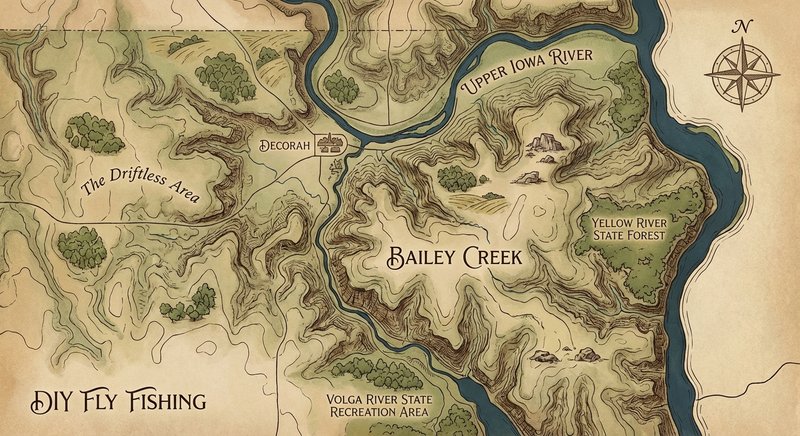
Bailey Creek
Fly fishing in Iowa · intermediate · Best seasons: spring, summer, fall
Target Species
Brown Trout
About This Water
Delaware County stream with wild trout. Driftless Area spring creek character.
Fishing Recommendations
As an expert guide familiar with the "Driftless Area" style of fishing, Bailey Creek in Franklin County, Iowa, is a unique and rewarding destination. Unlike the rocky, high-gradient streams of the Northeast or West, Bailey Creek is a spring-fed prairie stream. It offers a classic "English chalk stream" feel—meandering through meadows with deep undercut banks and lush aquatic vegetation.
Here is your comprehensive guide to fly fishing Bailey Creek.
🎣 Location Overview
Bailey Creek is located near Sheffield in North Central Iowa. It is a vital part of Iowa’s trout program because it represents one of the few successful trout fisheries outside the traditional Northeast Iowa Driftless region.
What makes Bailey Creek special is its spring-fed nature. The cool water temperatures remain stable throughout the year, allowing Brown Trout to not only survive but thrive. The stream is characterized by its slow, glassy glides, sharp bends, and deep pools carved into the soft prairie soil. Anglers love it because it requires stealth and technical precision; it is a "stalker’s" creek where a well-placed cast is more important than a long one.
🐟 Target Species & Behavior
The primary target here is the Brown Trout.
- Behavior: These fish are notoriously wary. Because the water is often clear and the surface is smooth, they are easily spooked by shadows or heavy footsteps on the bank.
- Holding Spots: Look for them tucked tight against undercut banks, hovering near the edges of submerged weed beds (Elodea and Water Cress), or sitting at the very head of deep pools where the current enters.
- Feeding: They are opportunistic but can be selective during a hatch. They feed heavily on scuds (freshwater shrimp) and sowbugs year-round, which provides the protein needed for their impressive growth rates.
📅 Best Times to Fish
Bailey Creek is a three-season fishery that rewards different approaches throughout the year.
- Spring (April – Early June): This is the prime window. Water levels are usually stable, and the first major hatches occur.
- Prime Window: Mid-day (11:00 AM – 3:00 PM) as the water warms slightly.
- Summer (Late June – August): The vegetation becomes thick, making the "lanes" of open water smaller. This is Terrestrial Season.
- Prime Window: Early morning or late evening to avoid the heat. Overcast days are gold.
- Fall (September – October): Brown Trout become aggressive as they prepare for the spawn. This is the best time to find the largest fish in the system.
- Prime Window: Late afternoon. The low sun angle helps mask your approach.
🪰 Recommended Flies & Techniques
Top Fly Patterns
- Nymphs:
- Ray Charles (Grey or Tan): A legendary scud/sowbug pattern for this region. Size 16-18.
- Flashback Pheasant Tail: Size 18-20.
- Zebra Midge: Red or Black, size 20.
- Dry Flies:
- Blue Winged Olive (BWO): Vital for cloudy spring/fall days. Size 18-22.
- Trico: Late summer mornings. Size 22-24.
- Hippie Stomper or Foam Beetle: For summer terrestrials.
- Streamers:
- Black or Olive Woolly Bugger: Size 8-10. Best used in high water or low light.
Techniques & Presentation
- The "Stealth" Approach: Stay low. If you can see the fish, they have likely already seen you. Crawl if you have to.
- Tight-Line Nymphing: Because the current is slow, traditional indicators can sometimes spook fish. Using a light "Euro" style setup or a very small yarn indicator is preferred.
- The "Dink and Link": Use a high-visibility dry fly (like a Hopper) with a small scud dropped 18 inches below it.
💡 Pro Tips & Local Knowledge
- The "Vibrations" Rule: The banks of Bailey Creek are often "peaty" and soft. If you stomp on the bank, the vibrations travel through the soil and into the water, alerting every trout in the pool. Walk softly several feet back from the edge.
- Focus on the Bends: Every sharp turn in the creek creates a "scour hole." The biggest Browns sit at the deepest part of these holes, often underneath the roots of bank-side grasses.
- Watch the Weeds: In mid-summer, the "lanes" between weed beds act like natural funnels. Drift your fly right down the center of these green alleys.
- Light Tippet: You will rarely need anything heavier than 5X or 6X fluorocarbon. These fish are leader-shy due to the clarity of the spring water.
⚠️ Important Information
- Access: Much of Bailey Creek runs through private land, but there are significant stretches managed by the Iowa DNR (specifically the Bailey Creek Wildlife Area). Always look for "Public Hunting/Fishing" signs.
- Regulations:
- A valid Iowa Fishing License and Trout Fee are required.
- Be sure to check current DNR regulations, as some areas may have specific lure restrictions (though most of Bailey is open to general trout regulations).
- Special Considerations:
- The stream is small. If you see another angler's vehicle at an access point, it is common etiquette to move to a different stretch to avoid "crowding" the water.
- Watch for wild parsnip in the summer—it can cause nasty skin burns if you brush against it in shorts. Long pants are highly recommended.
Guide’s Final Word: Bailey Creek isn't about high numbers; it’s about the quality of the hunt. Slow down, observe the water for five minutes before casting, and enjoy the serenity of a true Iowa prairie gem.
Bug Hatches & Matching Flies
| Hatch | Type | Peak months | Time of day | Hook sizes | Matching flies |
|---|---|---|---|---|---|
| Blue Winged Olive Baetis tricaudatus | mayfly | March, April, September, October | Late Morning/Afternoon | #18-22 | RS2 #20-22, BWO Sparkle Dun #18-20, Pheasant Tail Nymph #18-20 |
| Grannom Caddis Brachycentrus | caddis | April, May | Afternoon/Evening | #14-16 | Elk Hair Caddis #14-16, LaFontaine's Deep Pupa #14-16, Peacock Caddis #16 |
| Sulfur Ephemerella invaria | mayfly | May, June | Evening | #14-18 | Sulfur Parachute #16-18, CDC Sulfur Emerger #16-18, Hare's Ear Nymph #14-16 |
| Trico Tricorythodes | mayfly | July, August, September | Early Morning | #20-24 | Trico Spinner #22-24, Griffith's Gnat #20-22, Zeebra Midge #20-22 |
| Terrestrials (Grasshoppers/Ants) | terrestrial | July, August, September | Late Morning/Afternoon | #10-18 | Dave's Hopper #10-12, Black Foam Ant #16-18, Beetle Bailey #14-16 |
| Little Black Stonefly Capniidae | stonefly | February, March | Midday | #16-20 | Early Brown Stone #16-18, Prince Nymph #16-18, Black Zebra Midge #18-20 |
| Light Cahill Maccaffertium | mayfly | June, July | Evening | #12-14 | Light Cahill #14, Gold Ribbed Hare's Ear #12-14, Light Cahill Emerger #14 |
| Chironomids (Midges) Chironomidae | midge | January, February, March, December | All Day | #18-26 | Zebra Midge #18-22, Griffith's Gnat #20-22, Mercury Midge #20-24 |