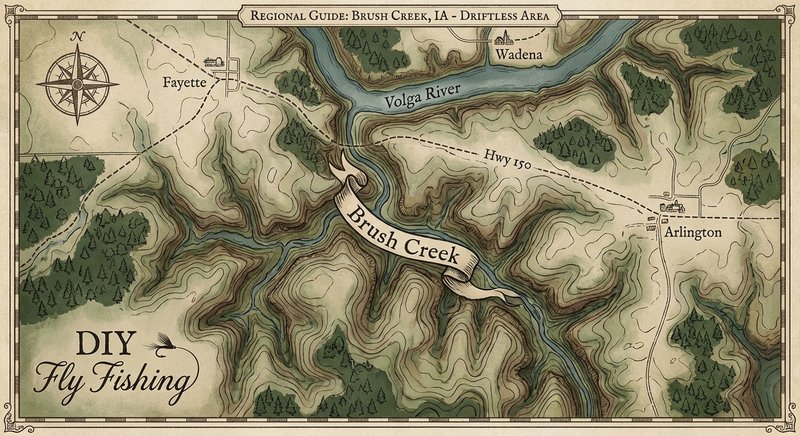
Brush Creek
Fly fishing in Iowa · intermediate · Best seasons: spring, summer, fall
Target Species
Brown Trout
About This Water
Fayette County tributary with wild brown trout. Quality Driftless spring creek.
Fishing Recommendations
Welcome to the heart of the Iowa Driftless Area. As your guide, I’m excited to walk you through one of the region's most rugged and rewarding gems: Brush Creek.
Located primarily in Fayette County near the town of Arlington, Brush Creek is a classic limestone spring creek that offers a more "wild" experience than many of the more manicured streams in the state.
🎣 Location Overview
Brush Creek is a cornerstone of the Brush Creek Canyon State Preserve. Unlike the flat, agricultural landscapes many associate with Iowa, this area is defined by steep limestone bluffs, deep narrow valleys, and dense hardwood forests.
The water is cold, clear, and highly alkaline, thanks to the limestone springs that feed it. This chemistry creates a "food factory," producing incredible densities of aquatic insects and crustaceans. The creek itself is characterized by sharp bends, deep undercut banks, and sections of plunging riffles. It feels more like a mountain stream in the Appalachians than a Midwestern creek, making it a favorite for anglers who prefer a bit of a hike and a "secluded" atmosphere.
🐟 Target Species & Behavior
The primary draw here is the Brown Trout. While Iowa’s DNR does stock portions of the creek, Brush Creek is famous for its wild, naturally reproducing Brown Trout.
- Behavior: These fish are notoriously "spooky." The water is crystal clear, and the browns are highly sensitive to shadows and bank vibrations.
- Holding Spots: Look for them tucked deep under "Lunker Structures" (man-made wooden cribs), beneath overhanging root balls, or at the very tail-ends of deep pools during low light.
- Feeding: They are opportunistic but wary. Younger fish focus on midges and scuds, while the "trophy" browns (which can reach 16–20 inches here) transition to a diet of crayfish, sculpins, and even smaller trout.
📅 Best Times to Fish
Brush Creek is a year-round fishery due to the constant spring temperatures, but for the best experience:
- Spring (March – May): This is the prime window for hatches. As the water warms slightly, the fish become very active. Watch for the Blue-Winged Olive (BWO) hatches on overcast, drizzly days.
- Summer (June – August): The "Terrestrial Season." This is when the creek gets "brushy." While the vegetation is thick, the fishing is electric. This is the time for hoppers, ants, and beetles.
- Fall (September – October): The most beautiful time in the canyon. Brown trout become aggressive and territorial as they prepare for the spawn. This is your best chance to land a large fish on a streamer.
- Prime Window: Low-light periods are essential. Be on the water at the "crack of dawn" or the last hour of legal light. If it’s a bright, blue-bird day, the fishing will be tough.
🪰 Recommended Flies & Techniques
Top Fly Patterns
- Nymphs:
- Ray Charles or Scud patterns (Pink or Orange, size 14-18) — These are staples in the Driftless.
- Pheasant Tail Jig (Size 16-20) — Essential for mimicking the natural mayfly larvae.
- Dries:
- Elk Hair Caddis (Size 14-16) — Great for skating across riffles.
- Parachute Adams (Size 18-22) — The ultimate "searching" pattern.
- Hi-Vis Ant or Chubby Chernobyl (Size 12-14) — For summer terrestrial action.
- Streamers:
- Woolly Buggers (Black or Olive, size 8-10) — Work these deep along the undercut banks.
Effective Techniques
- European Nymphing: Because the creek is narrow and has varied currents, a tight-line or Euro-nymphing setup is incredibly effective for getting small flies down into the deep pockets without drag.
- Stealth Approach: You must stay low. I often recommend my clients literally crawl to the bank on their knees. If you can see the fish, they have likely already seen you.
- The "Reach Cast": Given the winding nature of the creek, mastering the reach cast will help you manage complex micro-currents and prevent your fly from dragging prematurely.
💡 Pro Tips & Local Knowledge
- The Canyon Hike: Most people fish near the road bridges. To find the better fish, park at the Brush Creek Canyon State Preserve entrance and hike down into the gorge. The further you get from the parking lot, the more "uneducated" and larger the fish become.
- Check the USGS Gauges: Brush Creek can "blow out" (become chocolate milk) after a heavy rain due to agricultural runoff upstream. If the water has a slight "stain" (greenish-tea color), the fishing is actually better because the fish feel more secure.
- The "Pink Squirrel": This is a legendary Driftless fly (created by John Bethke). It's a gold-beaded nymph with a pink chenille collar. If nothing else is working, tie on a Pink Squirrel.
⚠️ Important Information
- Access: Much of the creek runs through the State Preserve, which is public. However, outside the preserve, most of the land is private. In Iowa, you must have permission to fish on private land, and the landowner owns the stream bed. Always look for "Iowa Trout Program" signs which indicate public fishing easements.
- Regulations:
- An Iowa Fishing License and a Trout Fee are required.
- Be sure to check current DNR regulations; some sections may have specific "catch and release only" rules or "artificial lures only" restrictions.
- Safety: The canyon is steep and can be slippery. Wear wading boots with felt or studs. Cell service is spotty to non-existent once you drop into the canyon.
Guide’s Final Word: Brush Creek isn't for the angler who wants an easy walk. It’s for the one who wants to earn their fish in one of the most beautiful settings the Midwest has to offer. Bring a 3-weight or 4-weight rod, stay low, and enjoy the silence of the canyon.
Bug Hatches & Matching Flies
| Hatch | Type | Peak months | Time of day | Hook sizes | Matching flies |
|---|---|---|---|---|---|
| Blue-Winged Olive Baetis | mayfly | April, May, September, October | Late Morning/Afternoon | #18-22 | BWO Sparkle Dun #18-20, RS2 #20-22, Pheasant Tail Nymph #18-20 |
| Grannom Caddis Brachycentrus | caddis | April, May | Late Morning/Afternoon | #14-16 | Elk Hair Caddis (Olive) #14-16, LaFontaine's Deep Sparkle Pupa #14-16, Peacock Caddis #16 |
| Sulphur Ephemerella invaria/dorothea | mayfly | May, June | Evening | #14-18 | Sulphur Parachute #16-18, CDC Sulphur Emerger #16, Hare's Ear Nymph #14-16 |
| Trico Tricorythodes | mayfly | July, August, September | Early Morning | #20-24 | Trico Spinner #22-24, Drowned Trico Spinner #20-22, Griffith's Gnat #20-22 |
| Scud Gammarus | crustacean | All Year | All Day | #12-18 | Ray Charles #14-18, Pink Scud #12-16, Orange Scud #14-16 |
| Midges Chironomidae | midge | January, February, March | Mid-day | #18-24 | Zebra Midge #18-22, Morgan's Midge #20-22, Palomino Midge #20 |
| Terrestrials Orthoptera/Formicidae | terrestrial | July, August, September | Late Morning/Afternoon | #10-16 | Morrish Hopper #10-12, Black Foam Ant #14-18, Hi-Viz Foam Beetle #12-16 |
| Light Cahill Stenacron interpunctatum | mayfly | June, July | Evening | #12-14 | Light Cahill Parachute #12-14, Gold Ribbed Hare's Ear #12-14 |