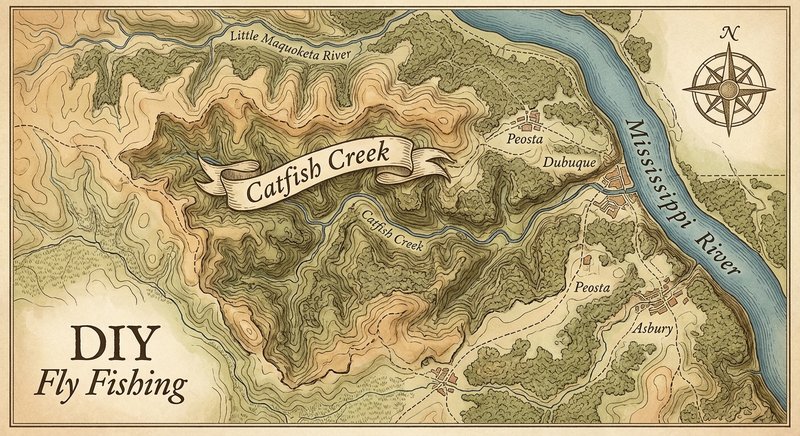
Catfish Creek
Fly fishing in Iowa · beginner · Best seasons: spring, fall
Target Species
Rainbow Trout
About This Water
Dubuque County stream with state park access. Stocked trout near Mines of Spain.
Fishing Recommendations
Welcome to the Driftless Area of Iowa. As a guide, I can tell you that Catfish Creek, specifically the section running through Swiss Valley Park and the Mines of Spain near Dubuque, is a hidden gem of the Midwest.
While many anglers head to the famous streams of Northeast Iowa, Catfish Creek offers a unique "spring creek" experience with cold-water characteristics that support a thriving trout population in a stunning limestone valley.
🎣 Location Overview
Catfish Creek is a classic limestone spring-fed stream. The primary trout water is the South Fork of Catfish Creek, which flows through the Swiss Valley Nature Preserve. What makes this area special is its "Driftless" topography—steep limestone bluffs, deep valleys, and cold water that stays at a relatively consistent temperature year-round.
The stream is characterized by a mix of shallow riffles, undercut banks, and deep "blue holes" carved into the limestone. It is a "Put-and-Grow" and "Put-and-Take" fishery managed by the Iowa DNR. The water clarity can be exceptional during dry spells, making for challenging but rewarding sight-fishing opportunities.
🐟 Target Species & Behavior
The primary target here is Rainbow Trout, though you will occasionally encounter Brown Trout.
- Rainbow Trout: These fish are actively stocked but quickly become "stream-wise." They tend to hold in the faster water at the heads of pools or tucked tightly against the limestone rock faces.
- Behavior: In Catfish Creek, trout are highly opportunistic. Because it is a fertile limestone stream, there is a massive biomass of scuds, sowbugs, and midges.
- Feeding: They are wary. Because the creek is relatively small and clear, these fish are sensitive to shadows and heavy wading. They feed heavily on sub-surface nymphs but will rise during the consistent midge and blue-winged olive hatches.
📅 Best Times to Fish
While the stream is open year-round, timing is everything.
- Spring (March – May): This is the prime window. As the ground thaws, the "early season" midges and Blue-Winged Olives (BWOs) bring fish to the surface. The water levels are usually stable, and the fish are hungry after the winter.
- Fall (September – November): My personal favorite. The crowds thin out, the autumn colors in the valley are spectacular, and the trout become aggressive as temperatures drop. Terrestrials (hoppers/ants) remain effective late into the season.
- Time of Day: During the spring, mid-day (11 AM – 3 PM) is best as the water warms slightly. In the fall, early morning and late evening are most productive.
- Prime Conditions: Overcast days are a gift on Catfish Creek. The low light keeps the trout from feeling exposed in the clear water, leading to much more aggressive feeding.
🪰 Recommended Flies & Techniques
Top Fly Patterns
- Nymphs:
- Ray Charles (Grey or Tan, size 16-18): A local Driftless staple representing the abundant sowbugs.
- Zebra Midge (Black or Red, size 18-22): Essential year-round.
- Pheasant Tail Nymph (size 16-20): Classic BWO imitation.
- Dry Flies:
- Elk Hair Caddis (size 16-18): Great for the riffles.
- Parachute Adams (size 18-22): The ultimate "searching" pattern for this creek.
- Streamers:
- Black or Olive Wooly Bugger (size 10-12): Use these in the deeper holes near the bridge abutments or fallen timber.
Techniques
- Tight-Line Nymphing: Because the creek is narrow, a long leader and a "Euro-style" or tight-line approach allows you to probe the deep pockets without your fly line spooking the fish.
- Dry-Dropper: This is the most effective way to cover Catfish Creek. Use a buoyant Hopper or Caddis on top and a small Scud or Midge 18 inches below it.
- Stealth Approach: This is a small stream. Do not walk right up to the bank. Stay low, dress in earthy tones, and cast from a distance.
💡 Pro Tips & Local Knowledge
- The "Swiss Valley" Stretch: Focus your energy on the water within the Swiss Valley Nature Preserve. The DNR stocks this heavily, and the habitat improvements (lunker structures) are world-class.
- Look for the "Bubbles": In the slow-moving pools, trout often sit in the "bubble line" where the current brings food directly to them. If you see foam, there’s likely a fish underneath it.
- The Mines of Spain: If the trout fishing is slow in the South Fork, head to the Mines of Spain section. While less "trouty," you can find Smallmouth Bass and even the occasional Northern Pike near the confluence with the Mississippi River.
- After the Rain: If the water is slightly stained (the color of weak tea) after a light rain, switch to a San Juan Worm or a bright Pink Squirrel nymph. The fish lose their wariness and feed aggressively.
⚠️ Important Information
- Regulations: You must have a valid Iowa Fishing License and a Trout Fee (Trout Stamp) to fish Catfish Creek.
- Access: Access is excellent. Swiss Valley Park has well-maintained trails that run parallel to the creek.
- Gear: A 3-weight or 4-weight fly rod (7'6" to 8'6") is perfect. Avoid heavy 6-weights as they are overkill for these waters and can lead to sloppy presentations.
- Wading: The bottom can be slippery limestone and "mucky" in spots. Felt soles or studs are recommended, but move slowly to avoid sending vibrations through the water.
- Catch & Release: While some sections allow harvest, practicing catch and release helps maintain the quality of this fragile spring creek ecosystem.
Tight lines, and enjoy one of Iowa's finest cold-water treasures!
Bug Hatches & Matching Flies
| Hatch | Type | Peak months | Time of day | Hook sizes | Matching flies |
|---|---|---|---|---|---|
| Blue Winged Olive Baetis | mayfly | April, May, September, October | Mid-day | #18-22 | RS2 #18-22, Parachute BWO #18-22, Pheasant Tail Nymph #18-20 |
| Grannom Caddis Brachycentrus | caddis | April, May | Afternoon/Evening | #14-16 | Elk Hair Caddis (Olive) #14-16, LaFontaine's Deep Sparkle Pupa #14-16, Holy Grail #14-16 |
| Sulfur Ephemerella invaria/rotunda | mayfly | May, June | Evening | #14-18 | Sparkle Dun #14-18, Sulfur Parachute #16-18, Hare's Ear Nymph #14-16 |
| Scud Gammarus | crustacean | Year-round | All Day | #12-18 | Ray Charles #14-18, Pink Scud #12-16, Sowbug #14-18 |
| Trico Tricorythodes | mayfly | July, August, September | Morning | #20-24 | Trico Spinner #20-24, Sunken Trico Spinner #22-24 |
| Cranefly Tipulidae | other | August, September | Afternoon/Evening | #10-14 | Daddy Long Legs #10-12, Killer Bug #12-14 |
| Midges Chironomidae | midge | January, February, March, December | All Day | #18-24 | Zebra Midge #18-22, Griffith's Gnat #18-22, Top Secret Midge #20-24 |
| Terrestrials Formicidae/Gryllidae | terrestrial | July, August | Mid-day/Afternoon | #12-16 | Chernobyl Ant #12-14, Black Foam Beetle #14-16, Cinnamon Ant #16-18 |