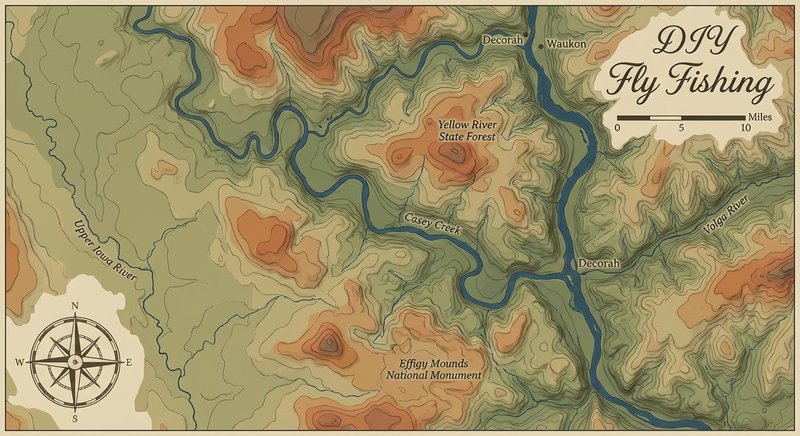
Casey Creek
Fly fishing in Iowa · intermediate · Best seasons: spring, summer, fall
Target Species
Brown Trout
About This Water
Dubuque County stream with wild trout. Limited public access.
Fishing Recommendations
As an expert guide, I have a duty to clarify a quick geographic detail first: While there is a Casey Creek in Adair County, Iowa, it is a warm-water stream primarily home to catfish and chubs. However, for an angler targeting Brown Trout in Iowa, you are almost certainly looking for the legendary streams of the Driftless Area in Northeast Iowa.
The "holy grail" for Brown Trout in this region—and the stream most fly anglers are referring to when they look for technical, spring-fed water—is Canoe Creek (specifically the West Canoe and North Canoe stretches in Winneshiek County).
Here is the comprehensive guide for targeting Brown Trout in the premier cold-water streams of Northeast Iowa.
🎣 Location Overview
The Driftless Area of Iowa is a geological anomaly. Unlike the rest of the flat Midwest, this region escaped the last glaciation, leaving behind deep limestone valleys and hundreds of cold, crystal-clear spring-fed streams.
Canoe Creek and its neighbors (like French Creek and Waterloo Creek) are the crown jewels. These streams are characterized by "limestone creek" behavior: high alkalinity, prolific insect life, and steady 50–60 degree water temperatures year-round. These waters are narrow, often choked with bankside vegetation, and feature deep undercut banks and limestone ledges where massive Brown Trout hide.
🐟 Target Species & Behavior
Species: Wild and stocked Brown Trout (Salmo trutta).
- Behavior: Iowa Browns are notoriously "spooky." Because the water is often gin-clear and shallow, these fish are highly sensitive to shadows and vibration.
- Holding Spots: They hug the "dark water"—underneath overhanging grassy banks, behind large limestone boulders, or in the deep "buckets" at the tail-outs of riffles.
- Feeding: They are opportunistic but sophisticated. They transition from tiny midges in the winter to massive "hoppers" in the late summer, and they become highly piscivorous (fish-eating) once they exceed 14 inches.
📅 Best Times to Fish
- Spring (April – June): This is prime time. The "Mother’s Day Caddis" hatch and the arrival of Blue Winged Olives (BWO) create frantic surface activity.
- Summer (July – August): While many trout streams across the US shut down due to heat, Iowa’s springs keep these waters cold. This is Terrestrial Season. Fishing grasshopper patterns against the tall meadow grass is the most exciting way to catch large Browns.
- Fall (September – October): Brown Trout become aggressive as they prepare for the spawn. Their colors darken, and they will strike large streamers to defend territory.
- Time of Day: Early morning (first light) and the "golden hour" before sunset are essential for dry fly success. On overcast, drizzly days, the fishing can be spectacular all day long.
🪰 Recommended Flies & Techniques
Top Fly Patterns
- Nymphs:
- Frenchies or Pheasant Tails (Size 14–18) – The bread and butter of Iowa trout.
- Zebra Midges (Size 18–22) in black or red.
- Scuds (Size 14–16) in gray or olive – These are the primary food source in limestone springs.
- Dry Flies:
- Elk Hair Caddis (Size 14–16).
- Hi-Vis Parachute Adams (Size 16–20).
- Dave’s Hopper or Pink Pookie (Size 8–12) for summer terrestrials.
- Streamers:
- Black or Olive Woolly Buggers (Size 8–10).
- White Belly Mehems or Small Muddler Minnows.
Techniques
- The "Stealth Approach": You must stay low. Often, I recommend my clients literal "knee-crawl" to the bank. If you can see the fish, they have likely already seen you.
- European Nymphing: Because the streams are narrow with complex currents, a tight-line/Euro nymphing setup is incredibly effective at reaching the bottom of deep holes without drag.
- Downstream Dry Fly: On glassy pools, casting slightly downstream and letting the fly drift to the fish first (before the leader) can prevent spooking wary Browns.
💡 Pro Tips & Local Knowledge
- Focus on the "Bends": In Iowa streams, the outside bend of a creek almost always has an undercut bank carved by the current. A Brown Trout is almost certainly sitting in that dark shadow.
- The "Hopp-and-Drop": During the summer, tie a 2-foot piece of 5X fluorocarbon to the bend of a large Hopper fly and attach a small weighted nymph. The hopper acts as your indicator and a meat-and-potatoes meal.
- The Mud Factor: If the water is slightly stained after a rain (the color of weak tea), don't go home. This is the best time to throw large, dark streamers. The trout lose their inhibitions in murky water.
⚠️ Important Information
- Access: Much of the fishing is on private land through DNR Easements. Look for the green and white "Trout Stream" signs. Always respect fences and stay within the mowed or signed corridors.
- Regulations: Iowa has specific "Trout Fee" requirements on your fishing license. Many streams are Catch and Release Only or have artificial-lure-only restrictions (like parts of French Creek). Check the Iowa DNR Trout Map before you head out.
- Gear: A 7.5' to 9' rod in a 3-weight or 4-weight is perfect. You rarely need to cast more than 20–30 feet; accuracy and delicacy are far more important than distance.
- Safety: Watch for wild parsnip along the banks in summer—it can cause nasty chemical burns on your skin. Wear long pants even when it's hot.
Bug Hatches & Matching Flies
| Hatch | Type | Peak months | Time of day | Hook sizes | Matching flies |
|---|---|---|---|---|---|
| Blue-Winged Olive Baetis tricaudatus | mayfly | April, May, September, October | Afternoon | #18-22 | RS2 #20-22, BWO Sparkle Dun #18-20, Pheasant Tail #18-20 |
| Trico Tricorythodes spp. | mayfly | July, August, September | Morning | #20-24 | Trico Spinner #20-24, Trico Emerger #22, Zebra Midge #20-22 |
| Spotted Sedge Hydropsyche | caddis | May, June, July | Evening | #14-18 | Elk Hair Caddis #14-16, LaFontaine's Deep Sparkle Pupa #16, Peacock Caddis #16-18 |
| Light Cahill Stenacron interpunctatum | mayfly | June, July | Evening | #12-14 | Light Cahill #12-14, Gold Ribbed Hare's Ear #12-14 |
| Midges Chironomidae | midge | January, February, March, November, December | All Day | #18-24 | Griffith's Gnat #18-22, Mercury Midge #20-22, Top Secret Midge #20-24 |
| Grasshoppers Orthoptera | terrestrial | July, August, September | Afternoon | #8-12 | Dave's Hopper #10-12, Morrish Hopper #8-10, Joe's Hopper #12 |
| Ants and Beetles Formicidae / Coleoptera | terrestrial | June, July, August | All Day | #14-18 | Black Foam Ant #16-18, Chernobyl Ant #12-14, Crowe Beetle #14-16 |
| Crane Fly Tipulidae | terrestrial | August, September | Morning/Evening | #10-14 | Daddy Long Legs #12, Crane Fly Larva #10-12 |