Big Spring Creek
Fly fishing in Iowa · intermediate · Best seasons: spring, summer, fall
Target Species
Rainbow Trout, Brown Trout
About This Water
Clayton County stream fed by Iowa's largest spring. Consistent cold water flows.
Fishing Recommendations
Welcome to the Driftless Area of Iowa. As a guide who has spent years roaming the limestone coulees of the Midwest, I can tell you that Big Spring Creek in Clayton County is a crown jewel of the region.
Connected to the largest cold-water spring in Iowa, this creek is a unique fishery. Because it is home to a major state trout hatchery, the fish densities here can be staggering, but don’t let that fool you—the "holdover" fish are some of the most sophisticated and selective trout you will find in the state.
🎣 Location Overview
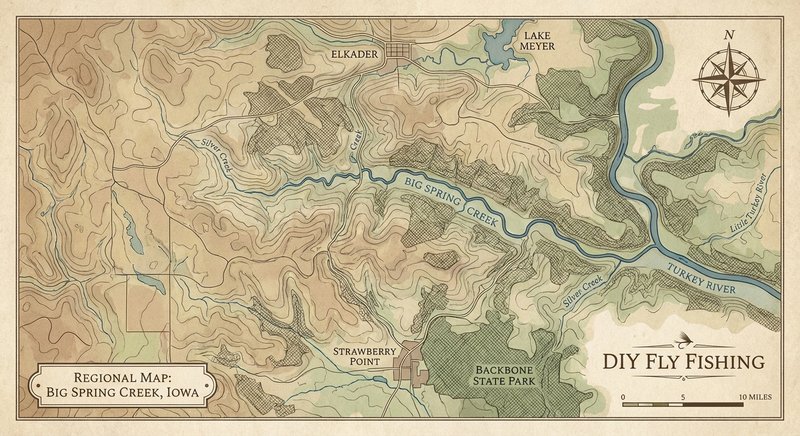
Big Spring Creek is a classic limestone spring stream located near Elkader, Iowa. The water emerges from a massive subterranean cave system at the Big Spring Hatchery at a constant volume and temperature (roughly 48–52°F year-round).
What makes it special:
- Thermal Stability: It never freezes in the winter and stays cold in the blistering Iowa summer, providing a 365-day growing season.
- Bio-Density: The limestone-rich water is an engine for aquatic life. The creek is carpeted in elodea and watercress, which harbor massive populations of scuds, sowbugs, and midges.
- The Setting: You are fishing in the heart of the "Driftless"—a region missed by the last glaciers—characterized by steep limestone bluffs and narrow, winding valleys.
🐟 Target Species & Behavior
- Rainbow Trout: Because of the hatchery's proximity, Rainbows are the most numerous. You will find "stockies" near the access points, but the older holdovers develop deep colors and incredible power. They tend to hold in the faster riffles and near the heads of pools.
- Brown Trout: The creek also holds a beautiful population of Brown trout, including some surprisingly large "wild" fish that have moved up from the Turkey River. Browns are much more cover-oriented, hugging the undercut banks and hiding beneath the thick mats of aquatic vegetation.
Behavioral Note: These fish see a lot of flies. They are "educated." They will often move several feet to inspect a fly, only to reject it if the drift isn't perfect or the tippet is too thick.
📅 Best Times to Fish
- Spring (April – June): This is the prime window for hatches. The Blue-Winged Olives (BWO) and Grannom Caddis bring fish to the surface.
- Summer (July – August): While other streams warm up, Big Spring stays cold. This is Terrestrial Season. Look for "Hopper-Dropper" opportunities along the tall grass banks.
- Fall (September – November): My personal favorite. The Brown trout become aggressive as they prepare for the spawn. The colors of the Driftless bluffs are spectacular, and the crowds thin out.
- Time of Day: During mid-summer, early mornings are best to beat the heat. In the shoulder seasons, wait for the water to "warm" slightly in the afternoon to trigger insect activity.
🪰 Recommended Flies & Techniques
Top Fly Patterns
- Scuds & Sowbugs (#16–20): These are the "bread and butter" of Big Spring. Gray, olive, or tan. If you aren't catching fish, put on a scud.
- Pheasant Tail Nymph (#18–22): Specifically the "Flashback" version to mimic the small mayflies common here.
- Zebra Midge (#18–22): Red or Black with a silver bead. Essential for the deep, slow winter and early spring pools.
- Chubby Chernobyl / Hippie Stomper (#12–14): Great for summer terrestrials.
- RS2 or WD-40 (#20–22): Perfect for the picky fish feeding just below the surface during a BWO hatch.
Effective Techniques
- Sight Nymphing: The water is often crystal clear. Instead of using a bobber (strike indicator), watch the fish. If you see the white of their mouth or a sudden turn, set the hook.
- The "Vegetation Drag": Fish will often sit in small pockets surrounded by weeds. You must use a high-rod "Euro" style or "Short-line" nymphing technique to keep your line off the weeds.
- Dry-Dropper: A buoyant dry fly with a small weighted scud 18 inches below it is the most effective way to cover the riffles.
💡 Pro Tips & Local Knowledge
- The "Hatchery Run": The stretch immediately below the hatchery outflow has the highest concentration of fish, but they are the most pressured. For a better experience, hike downstream toward the confluence with the Turkey River. The fish there are more "wild" in character.
- Tippet Management: I cannot stress this enough: Use 6X or 7X fluorocarbon. These fish are tippet-shy. If you use 4X, you will likely get looks but no takes.
- Stealth is Key: Because the water is clear and the creek isn't wide, the fish will see you before you see them. Wear earthy colors (no white hats!) and crawl into position if you have to.
- The Turkey River Connection: After a heavy rain, Big Spring Creek often clears up faster than the main Turkey River. If the river is blown out, Big Spring is your "Plan B" that often becomes "Plan A."
⚠️ Important Information
- Access: Much of the land around Big Spring is a mix of state-owned land (Big Spring Wildlife Management Area) and private property. Always look for "Iowa DNR Trout Program" signs. Respect all fences and gates.
- Regulations:
- A valid Iowa Fishing License AND a Trout Fee are required.
- There are specific segments that may have "Catch and Release Only" or "Artificial Lures Only" regulations—always check the latest Iowa DNR Trout Map before your first cast.
- Wading: The bottom can be very silty in spots and incredibly slippery on the limestone ledges. Felt soles or studs are highly recommended.
- Clean Your Gear: To prevent the spread of invasive species like New Zealand Mudsnails, please dry your waders completely or spray them with a diluted bleach solution before moving to another watershed.
Final Guide Advice: Take a moment to look at the spring itself near the hatchery. It’s a geological marvel that pumps out millions of gallons of water a day. Respect the resource, barbless hooks are preferred, and enjoy some of the best technical spring creek fishing in the United States.
Bug Hatches & Matching Flies
| Hatch | Type | Peak months | Time of day | Hook sizes | Matching flies |
|---|---|---|---|---|---|
| Midges Chironomidae | midge | January, February, March, December | All Day | #18-24 | Zebra Midge #18-22, Griffith's Gnat #20-24, Smoke Jumper #20-22 |
| Blue Winged Olive Baetis spp. | mayfly | March, April, September, October | Mid-day/Afternoon | #18-22 | RS2 #20-22, Parachute Adams #18-22, Pheasant Tail Nymph #18-20 |
| Trico Tricorythodes spp. | mayfly | July, August, September | Morning | #20-26 | Trico Spinner #22-24, Trico Drowned Spinner #22-24 |
| Grannom Caddis Brachycentrus | caddis | April, May | Afternoon/Evening | #14-16 | Elk Hair Caddis (Dark) #14-16, LaFontaine's Deep Sparkle Pupa #14-16 |
| Sulfur Ephemerella invaria/dorothea | mayfly | May, June | Evening | #14-18 | Sulfur Parachute #16-18, Sulfur Emerger #16-18 |
| Spotted Sedge Hydropsyche | caddis | June, July, August | Evening | #14-18 | Soft Hackle Hare's Ear #14-16, X-Caddis #16-18 |
| Terrestrials (Ants and Beetles) Formicidae/Coleoptera | terrestrial | July, August, September | All Day | #12-20 | Cinnamon Ant #16-18, Black Foam Beetle #14-16 |
| Little Brown Stonefly Nemoura/Amphinemura | stonefly | March, April | Afternoon | #14-16 | Early Brown Stone #14-16, Copper John #14-18 |