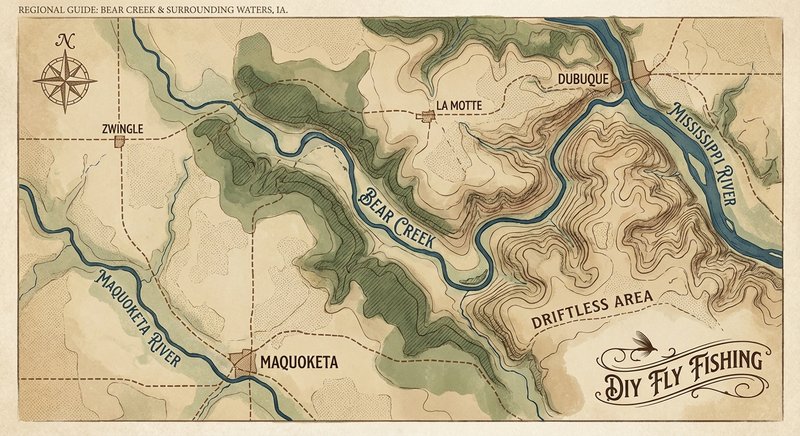
Bear Creek
Fly fishing in Iowa · intermediate · Best seasons: spring, summer, fall
Target Species
Brown Trout
About This Water
Fayette County stream with wild trout. Driftless Area spring creek character.
Fishing Recommendations
Bear Creek, located in the scenic Driftless Area of Northeast Iowa (primarily in Winneshiek and Fayette Counties), is widely considered one of the crown jewels of Iowa trout fishing. It consists of two primary branches—North Bear and South Bear—which converge to form a premier cold-water fishery that rivals any stream in the Midwest.
As a guide, I view Bear Creek as the quintessential "technical" limestone spring stream. It offers a perfect blend of accessibility and challenge, making it a must-visit for any serious brown trout angler.
🎣 Location Overview
Bear Creek is a spring-fed limestone stream characterized by its crystal-clear water, meandering bends, and lush valley setting. Unlike many Midwestern streams that turn muddy after a light rain, the Bear Creek system (especially North Bear) tends to clear up relatively quickly due to its robust spring flow.
What makes this water special is the habitat improvement work. The Iowa DNR and Trout Unlimited have spent decades installing lunker structures (artificial undercut banks), narrowing the channel to increase flow, and stabilizing banks. This has created a "brown trout factory" with deep holding pools, fast riffles, and plenty of overhead cover.
🐟 Target Species & Behavior
The star of the show here is the Brown Trout.
- Behavior: These fish are notoriously wary. Because the water is often gin-clear, Bear Creek browns have excellent vision. They are "lie-dominant," meaning they will pick a prime spot—usually an undercut bank or a shaded pocket—and stay there.
- Feeding: They are opportunistic but selective. In the spring and fall, they focus on aquatic insects. In the heat of summer, they shift their gaze toward the banks for terrestrials. Large "trophy" browns in this system are known to be piscivorous, feeding on sculpins and smaller trout under the cover of low light.
- Wild vs. Stocked: While the DNR stocks rainbows and some browns, Bear Creek has a significant population of wild, stream-bred brown trout. These wild fish are darker, more vibrant, and significantly harder to fool.
📅 Best Times to Fish
Optimal Seasons
- Spring (April - June): This is the prime window for hatches. As the valley greens up, the insects wake up.
- Summer (July - August): High sun makes fishing tough during the day, but this is the "Golden Age" of terrestrial fishing.
- Fall (September - October): My personal favorite. The brown trout become aggressive as they prepare for the spawn. The colors of the fish and the autumn leaves are spectacular.
Prime Windows
- The "Trico" Morning: In late summer, get to the water at sunrise. The Trico (tiny mayfly) hatch can bring every fish in the stream to the surface.
- Evening Rise: During May and June, the last hour of light is magic for caddis activity.
- Overcast Days: If it’s drizzling or cloudy, the big browns lose their inhibitions and move out of the undercut banks into the open.
🪰 Recommended Flies & Techniques
Top Fly Patterns
- Nymphs:
- Pink Squirrel: An Iowa original. It works year-round.
- Scuds (Orange or Olive): The primary protein source in limestone streams.
- Zebra Midge (Size 18-22): Essential for winter and early spring.
- Dry Flies:
- Elk Hair Caddis (Size 14-16): A staple for skittering across riffles.
- Hippie Stomper: An excellent high-visibility terrestrial/attractor.
- BWO (Blue Winged Olive): Critical for those drizzly spring and fall days.
- Streamers:
- Black or Olive Wooly Bugger: Strip these deep along the lunker structures.
Techniques & Presentation
- The Stealth Approach: This is the most important tip. Do not wade if you don't have to. Stay on the bank, keep a low profile (kneel!), and cast from a distance. If you splash into the water, every brown trout within 30 feet will tuck under a rock.
- Euro Nymphing: Given the deep pockets and current seams, tactical nymphing (high-sticking) is incredibly effective here.
- Long Leaders: Use a 9ft to 12ft leader tapered to 5X or 6X fluorocarbon. The clarity of the water demands thin tippets.
💡 Pro Tips & Local Knowledge
- North vs. South Bear: North Bear is generally more popular and has more public access. If North Bear is crowded, head to South Bear—it’s slightly smaller and more intimate, often holding very large fish in surprisingly small pools.
- The "Highlandville" Factor: The tiny town of Highlandville is the epicenter. Stop by the Highlandville General Store for the latest report; they are the gatekeepers of local knowledge.
- Fish the "Skinny" Water: Most anglers skip the shallow riffles to get to the deep pools. On North Bear, big browns will often sit in 6 inches of bubbly water at the head of a pool to intercept food. Don't overlook the shallow water!
- Terrestrial "Plop": In August, when using grasshopper patterns, don't be afraid to let the fly land with a "splat." This mimics a grasshopper falling off the bank and triggers a predatory strike.
⚠️ Important Information
Access
- Access is excellent. There are numerous marked DNR parking lots and easements.
- Most of North Bear is within the North Bear Creek Wildlife Management Area.
Regulations
- License: You need a valid Iowa Fishing License and a Trout Fee.
- Regulations: While much of the stream allows for bait and keep (check current DNR signage), many fly anglers practice strictly catch-and-release to preserve the wild brown population.
- Limits: The standard limit is 5 trout per day, but be sure to check the specific section you are fishing, as regulations can change near bridges or specific property lines.
Special Considerations
- Cell Service: Virtually non-existent in the Bear Creek valley. Download your maps for offline use before you leave Decorah or Waukon.
- Waders: Breathable waders are best. In the heat of summer, wet wading is comfortable, but watch out for stinging nettles on the banks—they are brutal in Iowa!
Bug Hatches & Matching Flies
| Hatch | Type | Peak months | Time of day | Hook sizes | Matching flies |
|---|---|---|---|---|---|
| Blue-Winged Olive (BWO) Baetis tricaudatus | mayfly | March, April, October, November | Late Morning/Afternoon | #18-22 | RS2 #18-22, Parachute BWO #18-22, WD-40 #20-22 |
| Grannom Caddis Brachycentrus | caddis | April, May | Afternoon/Evening | #14-16 | Elk Hair Caddis (Olive) #14-16, Pupa-Leek #14-16, Peacock Caddis Larva #14-16 |
| Sulfur / Pale Morning Dun Ephemerella invaria/dorothea | mayfly | May, June | Late Afternoon/Evening | #14-18 | Sulfur Parachute #16-18, Pheasant Tail #16-18, Sulfur Emerger #16-18 |
| Tan Caddis Hydropsyche | caddis | May, June, July, August | Evening | #14-18 | Gold Ribbed Hare's Ear #14-16, X-Caddis #14-18, Holy Grail Caddis #14-16 |
| Trico Tricorythodes | mayfly | July, August, September | Morning | #20-24 | Trico Spinner #20-24, Sunken Trico Spinner #22-24, Griffith's Gnat #20-22 |
| Terrestrials Formicidae / Coleoptera | terrestrial | July, August, September | All Day | #12-18 | Black Foam Ant #16-18, Cinnamon Ant #14-16, Hi-Vis Foam Beetle #12-16 |
| Midges Chironomidae | midge | January, February, March, December | Late Morning | #20-26 | Zebra Midge #20-24, Top Secret Midge #22-24, Morgan's Midge #22-24 |
| Little Black Stonefly Capniidae | stonefly | February, March | Afternoon | #16-18 | Prince Nymph #16-18, Black Stonefly Dry #16-18, Black Copper John #16-18 |