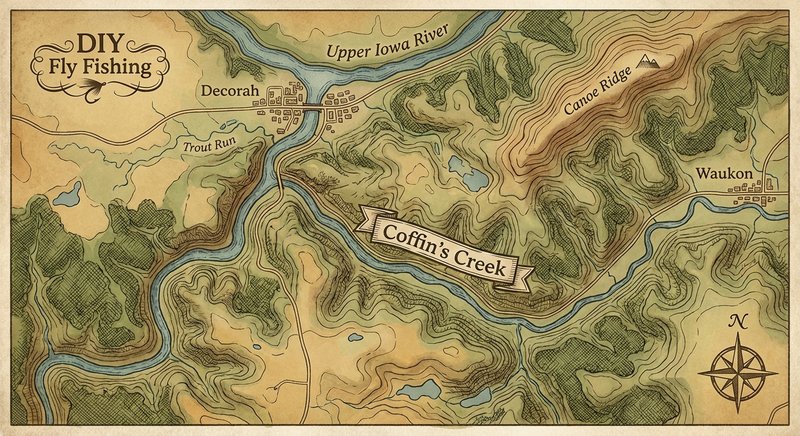
Coffin's Creek
Fly fishing in Iowa · beginner · Best seasons: spring, fall
Target Species
Rainbow Trout
About This Water
Delaware County stream with stocked trout. Easy access fishing area.
Fishing Recommendations
As an expert guide familiar with the hidden gems of the Driftless Area, I can tell you that Coffin’s Creek in Clayton County, Iowa, is one of those "blink-and-you’ll-miss-it" treasures. While larger rivers like the Upper Iowa or the Maquoketa get the glory, Coffin’s Creek offers an intimate, technical, and rewarding experience for the fly angler who appreciates small-stream stealth.
Here is your comprehensive guide to fly fishing Coffin’s Creek.
🎣 Location Overview
Coffin’s Creek is a cold-water tributary located near the town of Strawberry Point in northeast Iowa. It is part of the legendary Driftless Area, a region bypassed by the last glaciers, leaving behind steep limestone bluffs and spring-fed streams.
What makes Coffin’s Creek special is its size and character. It is a narrow, meandering stream characterized by deep undercut banks, limestone outcroppings, and classic riffle-pool-run sequences. Because it is smaller than many neighboring streams, it remains relatively protected from heavy wind, but it requires a delicate touch. It feels like a "secret" spot, often providing a sense of solitude that is hard to find on more famous waters.
🐟 Target Species & Behavior
While the stream holds a surprising population of wild Brown Trout, it is primarily managed and loved for its Rainbow Trout.
- Behavior: The Rainbows here are often a mix of stocked fish and holdovers. Stocked fish tend to congregate in the deeper, slower pools immediately after a release. However, holdover Rainbows become "stream smart" quickly, moving into the heads of pools and behind submerged boulders to intercept forage.
- Holding Patterns: Look for fish in the "seams" where fast water meets slow water. In Coffin’s Creek, the undercut banks are prime real estate. If you don't see fish rising, they are almost certainly tucked under the grassy overhangs.
- Feeding: They are opportunistic feeders. In the spring, they focus on aquatic insects (midges and mayflies). By fall, they shift their attention to terrestrials and high-protein meals like leeches and sculpins to prepare for winter.
📅 Best Times to Fish
Optimal Seasons
- Spring (April – June): This is prime time. The water temperatures are rising, stimulating insect activity. This coincides with the Iowa DNR’s spring stocking schedule, ensuring high fish density.
- Fall (September – November): This is my favorite time for Coffin’s Creek. The foliage is spectacular, the crowds vanish, and the fish become aggressive. Low, clear water in the fall requires the most skill but offers the highest reward.
Best Times of Day
- Spring: Mid-morning to late afternoon. You want the sun to warm the water just enough to trigger a hatch (usually around 11:00 AM).
- Fall: Early morning or "the golden hour" before sunset.
Prime Conditions
Look for a "falling and clearing" barometer. After a light rain, the water gets a slight "stain" (tea color). This is the best time to fish, as it masks your presence and emboldens the trout to leave their overhead cover.
🪰 Recommended Flies & Techniques
Top Fly Patterns
- Nymphs:
- Pheasant Tail (Size 16-20) – The gold standard for Iowa.
- Zebra Midge (Size 18-22) – Essential for spring mornings.
- Pink Squirrel (Size 14-16) – A Driftless Area staple; the flashy dubbing works wonders on stocked Rainbows.
- Dry Flies:
- Elk Hair Caddis (Size 14-18) – Great for skating over riffles.
- Blue Winged Olive (BWO) (Size 18-22) – Vital for overcast spring/fall days.
- Hippie Stomper (Size 14) – A fantastic attractor/terrestrial for fall.
- Streamers:
- Black or Olive Woolly Bugger (Size 10-12) – Drag these through the deep holes.
Effective Techniques
- Tight-Line Nymphing: Because the creek is narrow, a long rod (9ft 3wt or 4wt) allows you to "dap" nymphs into pockets without casting much line, avoiding the tall bank grass.
- Dry-Dropper: This is the most effective way to cover Coffin’s Creek. Use a buoyant dry fly (like a Chubby Chernobyl) with a small nymph tied 18 inches below it.
- The "Stealth" Approach: On a creek this small, if you can see the fish, they have already seen you. Fish upstream, stay low, and wear earthy colors.
💡 Pro Tips & Local Knowledge
- The "One-Cast" Rule: In small water like Coffin’s, your first cast is your best chance. Spend more time observing the water and less time casting. If you "line" a pool (cast your fly line over the fish), move on to the next bend; they won't bite for another hour.
- Focus on the Bends: Coffin’s Creek is very twisty. The outside of every bend usually has a deep scour hole. These are the "hotels" where the biggest Rainbows live.
- Light Tippet: The water is often crystal clear. I recommend using 6X fluorocarbon tippet. It’s invisible to the fish and helps your small flies move naturally.
- Casting Challenges: Expect overhanging willow branches and tall reed canary grass. Master the roll cast and the sidearm cast before you get here.
⚠️ Important Information
Access
Coffin’s Creek has limited public access compared to some of the larger parks. Check the Iowa DNR Trout Map (available online or as a PDF) to identify the specific public easements. Do not trespass on private land without explicit permission; Iowa landowners are generally friendly but value their privacy.
Regulations & Permits
- Trout Fee: You must have a valid Iowa Fishing License and have paid the Trout Fee to fish Coffin’s Creek.
- Limits: Check current DNR regulations for daily bag limits. While many anglers practice catch-and-release to preserve the fishery, keeping a few stocked Rainbows for the pan is permitted in most stretches.
Special Considerations
- Wading: The bottom can be a mix of limestone rock and soft silt. Be careful in the siltier sections to avoid getting stuck.
- Gear: A 7’6” to 9’ fly rod in a 3-weight or 4-weight is perfect. Anything heavier is overkill and will make delicate presentations difficult.
Guide’s Final Word: Coffin’s Creek isn't about catching the biggest fish in the state; it’s about the technical challenge of small-stream fly fishing in a beautiful, quiet setting. Slow down, stay low, and enjoy the rhythm of the Driftless. Tight lines!
Bug Hatches & Matching Flies
| Hatch | Type | Peak months | Time of day | Hook sizes | Matching flies |
|---|---|---|---|---|---|
| Blue-Winged Olive Baetis | mayfly | April, May, September, October | Midday | #18-22 | RS2 #18-22, Parachute BWO #18-20, Pheasant Tail Nymph #18-20 |
| Grannom Caddis Brachycentrus | caddis | April, May | Afternoon/Evening | #14-16 | Elk Hair Caddis #14-16, Peacock Caddis Larva #14-16, Holy Grail #14-16 |
| Sulphur Ephemerella invaria/dorothea | mayfly | May, June | Evening | #14-18 | Sparkle Dun #14-18, Sulphur Parachute #16-18, Hare's Ear Nymph #14-16 |
| Trico Tricorythodes | mayfly | July, August, September | Morning | #20-24 | Trico Spinner #20-24, Griffith's Gnat #20-22, Zebra Midge #20-22 |
| Cinnamon Caddis Hydropsyche | caddis | June, July, August | Evening | #14-18 | Tan Elk Hair Caddis #14-18, Iris Caddis #16-18, Soft Hackle Hare's Ear #14-16 |
| Scud Gammarus | terrestrial | April, May, June, July, August, September, October | All Day | #12-18 | Pink Scud #12-16, Orange Scud #14-18, Ray Charles #14-18 |
| Terrestrials (Ants and Beetles) Formicidae/Coleoptera | terrestrial | July, August, September | Afternoon | #12-18 | Black Foam Ant #14-18, Crowe Beetle #12-16, Chernobyl Ant #10-14 |
| Midges Chironomidae | midge | January, February, March | Midday | #18-24 | Zebra Midge #18-22, Palomino Midge #20-24, WD-40 #20-22 |