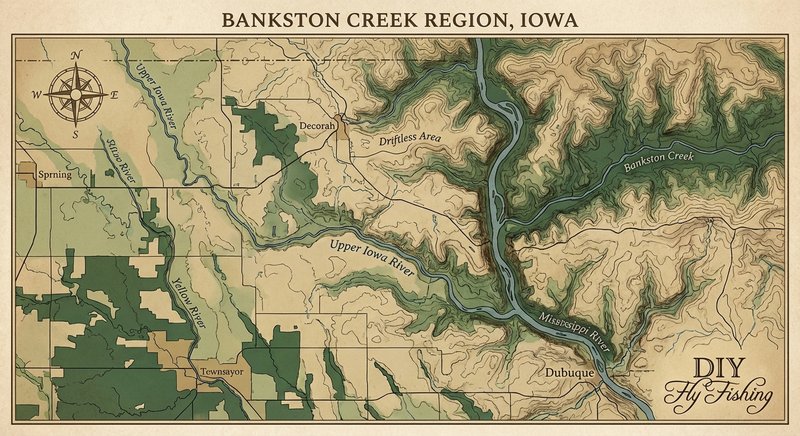
Bankston Creek
Fly fishing in Iowa · beginner · Best seasons: spring, fall
Target Species
Rainbow Trout
About This Water
Dubuque County stream with stocked trout. State forest provides access.
Fishing Recommendations
As an expert guide familiar with the hidden gems of the Iowa Driftless Area, I can tell you that Bankston Creek is one of those quintessential "small water" experiences that rewards the patient, stealthy angler. Located in Dubuque County, it offers a classic limestone spring creek environment that feels worlds away from the surrounding cornfields.
Here is your comprehensive guide to fly fishing Bankston Creek.
🎣 Location Overview
Bankston Creek is a cold-water tributary located within Bankston Park, managed by the Dubuque County Conservation Board. What makes this water special is its classic "Driftless" character: it is a narrow, meandering limestone stream with deep undercut banks, riffles, and plunges.
While Iowa isn't the first place people think of for trout, the limestone geology here provides a steady flow of cold, nutrient-rich water. Anglers love Bankston because it is intimate. You aren't launching 60-foot casts here; you are hunting fish in tight quarters, navigating overhanging brush, and enjoying a setting that feels incredibly private and rugged.
🐟 Target Species & Behavior
The primary draw here is the Rainbow Trout, which are regularly stocked by the Iowa DNR. However, the creek also supports Brook Trout, some of which are wild or the result of fingerling stocking programs.
- Rainbows: Generally found in the swifter water at the heads of pools or tucked right against the undercut banks. They tend to be opportunistic feeders but can become "creek smart" a few days after a stocking truck visits.
- Brookies: Look for these in the coldest, most shaded pockets. They are often smaller but exceptionally beautiful.
- Behavior: Because the water is clear and the creek is narrow, these fish are extremely spooky. If they see your shadow or feel the vibration of a heavy footstep on the bank, the pool is "done" for the next hour.
📅 Best Times to Fish
Optimal Seasons
- Spring (April – Early June): This is the prime window. Water levels are usually stable, and the first major insect hatches (Blue Winged Olives and Caddis) bring fish to the surface.
- Fall (September – November): As temperatures drop, the fish become aggressive again. This is also when the Brook Trout take on their brilliant spawning colors.
Best Times of Day
- Early Morning: From dawn until the sun hits the water.
- Late Afternoon/Dusk: Especially in the spring and fall when the "evening rise" occurs.
- Overcast Days: This is a "guide’s secret." Cloud cover masks your silhouette and encourages trout to move out from under the banks to feed.
🪰 Recommended Flies & Techniques
Top Fly Patterns
- Nymphs:
- Bead-head Pheasant Tail (#16-20): The gold standard for Driftless streams.
- Zebra Midge (#18-22): Essential for technical, clear-water days.
- Pink Squirrel (#14-16): A legendary Driftless pattern developed in neighboring Wisconsin; it works wonders on Iowa Rainbows.
- Dry Flies:
- Elk Hair Caddis (#14-18): Great for skittering across riffles.
- Parachute Adams (#16-20): The perfect generalist imitation.
- Streamers:
- Woolly Bugger (Olive or Black, #10-12): Best used after a rain when the water has a slight "tea" stain.
Techniques & Presentation
- The "Bow and Arrow" Cast: Because of the tight brush, you will often find yourself unable to backcast. Learn this technique to flick flies into tight pockets.
- Tight-Line Nymphing: In the deeper holes, use a weighted nymph with a small strike indicator (or no indicator at all) to get down fast.
- Stealth Approach: Always fish upstream. Approach the bank on your knees if possible. If you can see the fish, they have likely already seen you.
💡 Pro Tips & Local Knowledge
- Work the Undercuts: The biggest fish in Bankston Creek are almost always under the bank. Drift your nymph as close to the grass edge as possible. If you aren't occasionally losing flies to the roots, you aren't fishing deep enough.
- The "One-Cast" Rule: In a creek this small, your first cast is your best chance. Don't "warm up" with bad casts; make the first one count.
- Post-Rain Strategy: Bankston can get muddy after a heavy Iowa downpour. However, as it starts to clear (the "tannin" stage), the fishing can be legendary with small black streamers.
⚠️ Important Information
Access
Access is primarily through Bankston Park, located off Bankston Park Road. There is a parking area near the creek. Be mindful of property boundaries; while the park offers public access, much of the surrounding land is private. Always respect "No Trespassing" signs.
Regulations & Permits
- License: You must have a valid Iowa Fishing License AND a legal Trout Fee (Trout Stamp).
- Limits: Check current Iowa DNR regulations for daily bag limits. Many Driftless anglers practice Catch and Release to preserve the quality of these small fisheries.
- Tackle: While some areas allow bait, fly anglers prefer barbless hooks to ensure a safe release for the fish.
Special Considerations
- Gear: Use a short rod. A 7’6” or 8’0” 3-weight or 4-weight is perfect. A 9-foot rod is often too long and will get caught in the overhead canopy.
- Footwear: Felt soles or studs are recommended, as the limestone rocks can be incredibly slick.
Guide’s Final Word: Bankston Creek isn't about the size of the fish; it's about the technical challenge of the hunt. Slow down, stay low, and enjoy the beauty of Iowa's Driftless region. Tight lines!
Bug Hatches & Matching Flies
| Hatch | Type | Peak months | Time of day | Hook sizes | Matching flies |
|---|---|---|---|---|---|
| Blue-Winged Olive Baetis | mayfly | April, May, September, October | Mid-day/Afternoon | #18-22 | RS2 #20-22, BWO Parachute #18-22, Pheasant Tail #18-20 |
| Grannom Caddis Brachycentrus | caddis | April, May | Afternoon/Evening | #14-16 | Elk Hair Caddis #14-16, Peacock Caddis #14-16, LaFontaine's Deep Sparkle Pupa #14-16 |
| Trico Tricorythodes | mayfly | July, August, September | Early Morning | #20-24 | Trico Spinner #22-24, Griffith's Gnat #20-22, Trico Nymph #22-24 |
| Light Cahill Maccaffertium | mayfly | June, July | Evening | #12-14 | Light Cahill Dry #12-14, Gold Ribbed Hare's Ear #12-14 |
| Crane Fly Tipulidae | terrestrial | May, June, August, September | Afternoon/Evening | #10-14 | Crane Fly Adult #10-12, Walt's Worm #12-14 |
| Terrestrials (Ants & Beetles) Formicidae/Coleoptera | terrestrial | July, August, September | All Day | #14-18 | Black Foam Ant #16-18, Cinnamon Ant #14-16, Foam Beetle #14-16 |
| Zebra Midge Chironomidae | midge | January, February, March, December | Mid-day | #18-24 | Zebra Midge #18-22, Morgan's Midge #20-22 |
| Freshwater Shrimp (Scud) Gammarus | crustacean | April, May, June, October | All Day | #12-16 | Ray Charles #14-16, Pink Scud #12-16, Rainbow Warrior #16-18 |