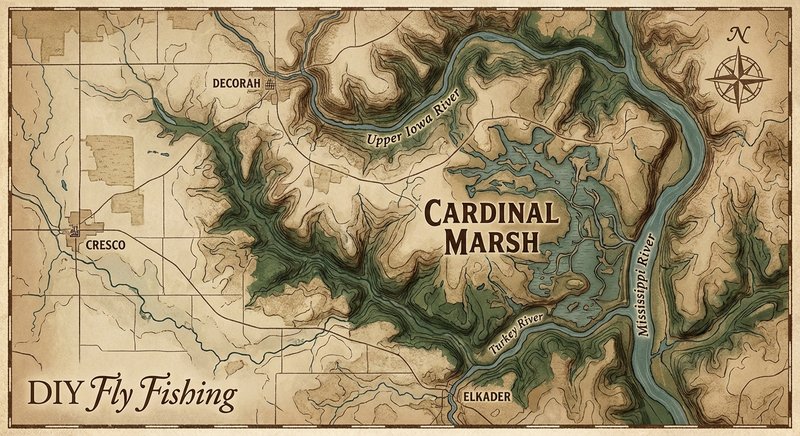
Cardinal Marsh
Fly fishing in Iowa · intermediate · Best seasons: spring, summer, fall
Target Species
Brown Trout
About This Water
Winneshiek County wildlife area with spring creek. Wild trout with waterfowl.
Fishing Recommendations
Welcome to the Driftless Area of Northeast Iowa. As your guide, I’m excited to walk you through a bit of a hidden gem. While many anglers flock to the famous streams in Decorah, Cardinal Marsh Wildlife Management Area (WMA) and the associated stretches of Canoe Creek offer a unique, quieter experience for the dedicated fly fisher.
Here is your comprehensive guide to fly fishing for Brown Trout at Cardinal Marsh.
🎣 Location Overview
Cardinal Marsh is a sprawling 1,100-acre wildlife complex located in Winneshiek County, about 10 miles northwest of Decorah. While the name "Marsh" suggests stagnant water, the area is bisected by the North Branch of Canoe Creek.
What makes this area special is the transition of habitats. You’ll find classic Driftless limestone spring-fed water meandering through prairie grasses and wetland edges. Unlike the high-walled limestone bluffs found elsewhere in the region, the terrain here is more open and meadow-like. The water is generally cold, clear, and rich in nutrients, creating a "bug factory" that supports a healthy population of wary Brown Trout.
🐟 Target Species & Behavior
The primary target here is the Brown Trout. While the Iowa DNR stocks these waters, the "wild" feel of the marsh allows many fish to hold over, becoming savvy and selective.
- Behavior: These Browns are notorious for "living in the shadows." They hug the deep undercut banks and hide beneath the overhanging prairie grasses.
- Feeding: They are highly opportunistic. Because the marsh environment is rich in crustaceans, their primary diet consists of scuds and sowbugs. During hatch cycles, they will move to the heads of pools to sip duns, and in late summer, they become "hopper-focused" as insects fall from the tall bank grasses.
📅 Best Times to Fish
Optimal Seasons
- Spring (April – May): This is prime time for aquatic insect hatches. As the water warms, the fish become extremely active. Look for Blue Winged Olive (BWO) hatches on overcast days.
- Summer (June – August): The most exciting time for terrestrial lovers. However, you must fish early morning (dawn to 10 AM) or late evening to avoid the midday heat and spooking fish in low, clear water.
- Fall (September – October): The "Pre-Spawn" window. Brown trout become aggressive and territorial. Their colors deepen, and they are more likely to chase large streamers.
Prime Windows
- The "Cloudy Day" Advantage: In this open meadow environment, bright sun is your enemy. Overcast skies provide the "cover" Brown Trout need to feel comfortable feeding in shallow riffles.
🪰 Recommended Flies & Techniques
Top Fly Patterns
- Nymphs:
- Ray Charles or Pink Scud (Size 14-18): A staple in Iowa spring creeks.
- Pheasant Tail (Size 16-20): Mimicking the prolific mayfly nymphs.
- Zebra Midge (Size 18-22): Essential for those tough, mid-day lulls.
- Dry Flies:
- Elk Hair Caddis (Size 14-16): Great for searching riffles.
- Parachute Adams (Size 16-20): The ultimate "catch-all" during a hatch.
- Hippie Stomper or Fat Albert (Size 12-14): Perfect for the summer terrestrial bite.
- Streamers:
- Woolly Bugger (Black or Olive, Size 8-10): Swing these through deep holes near the undercut banks.
Techniques & Presentation
- The "Grass Hopper" Drop: In summer, cast your terrestrial pattern so it lands with a noticeable splat right against the grass bank. This mimics a grasshopper falling in and often triggers an immediate reaction strike.
- Stealth Nymphing: Use a light indicator or "Euro-style" tight-line technique. The water is often shallow; a heavy indicator hitting the surface will send fish darting for cover.
- The Reach Cast: Because the stream meanders tightly, mastering the reach cast will help you achieve a drag-free drift across various current seams.
💡 Pro Tips & Local Knowledge
- The "Knee-Crawl" Approach: Because there is very little overhead canopy (trees) at Cardinal Marsh, the fish can see you from a long way off. Experienced guides here often fish from their knees to keep a low profile against the horizon.
- Focus on the Bends: In a marsh-stream environment, the deepest water and the best "holding" logs are always on the outside bends. Don't waste too much time in the long, sandy straightaways.
- Vibration Matters: The banks are soft and peaty. If you heavy-foot your way down the bank, the trout will feel the vibrations through the water before you ever see them. Walk softly.
⚠️ Important Information
- Access: Access is excellent via the Cardinal Marsh WMA parking lots off Madison Rd and 330th St. Be prepared to hike; the best fishing is often a 15-minute walk from the gravel lots.
- Regulations: You must have a valid Iowa Fishing License and a Trout Fee (trout stamp).
- Catch & Release: While some areas allow harvesting, I highly recommend Catch and Release for Brown Trout in this system to maintain the quality of the holdover population.
- Safety Hazard: Wild Parsnip is common in the tall grasses of the marsh during summer. Its sap causes severe skin burns when exposed to sunlight. Wear long pants and sleeves even if it's hot!
- Gear: A 7.5' to 9' 4-weight rod is the perfect tool for this water. Use 5X or 6X fluorocarbon tippet for nymphing, as these fish can be leader-shy in the clear spring water.
Tight lines, and enjoy the solitude of the marsh!
Bug Hatches & Matching Flies
| Hatch | Type | Peak months | Time of day | Hook sizes | Matching flies |
|---|---|---|---|---|---|
| Midges Chironomidae | midge | March, April, October, November | All Day | #18-24 | Zebra Midge #18-22, Griffith's Gnat #20-22 |
| Speckled Dun Callibaetis | mayfly | June, July, August | Late Morning | #12-16 | Callibaetis Spinner #14-16, Hare's Ear Nymph #12-16 |
| Blue-Winged Olive Baetis | mayfly | April, May, September, October | Afternoon | #18-22 | BWO Sparkle Dun #18-20, Pheasant Tail #18-22 |
| Damselfly Enallagma | terrestrial | June, July, August | All Day | #10-14 | Marabou Damsel #10-12, Adult Damsel #12-14 |
| Spotted Sedge Hydropsyche | caddis | May, June, July | Evening | #14-18 | Elk Hair Caddis #14-16, LaFontaine's Emerger #16-18 |
| Tricos Tricorythodes | mayfly | July, August, September | Early Morning | #20-24 | Trico Spinner #22-24, RS2 #20-22 |
| Grasshoppers Melanoplus | terrestrial | August, September | Mid-day | #8-12 | Joe's Hopper #8-12, Dave's Hopper #10-12 |
| Water Boatmen Corixidae | terrestrial | April, October | All Day | #14-18 | Water Boatman #14-16, Backswimmer #14-16 |
| Black Ants Formicidae | terrestrial | July, August | Afternoon | #16-20 | Cinnamon Ant #16-18, Black Foam Ant #16-20 |