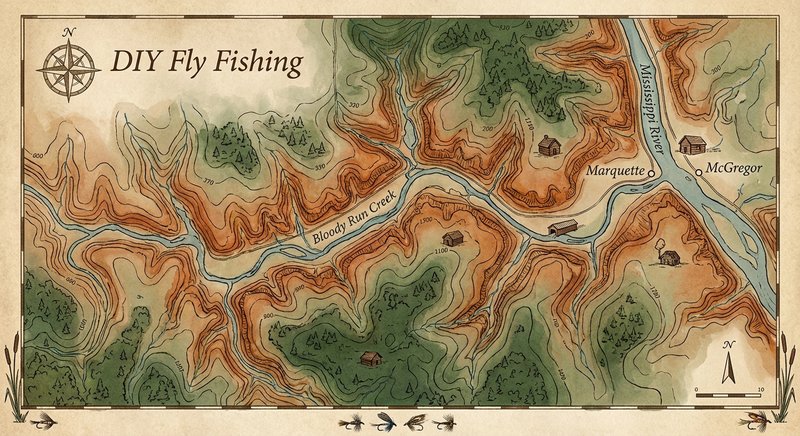
Bloody Run Creek
Fly fishing in Iowa · intermediate · Best seasons: spring, summer, fall
Target Species
Brown Trout, Rainbow Trout
About This Water
Clayton County stream with historic significance. Wild brown trout in scenic valley.
Fishing Recommendations
Welcome to the heart of the Iowa Driftless. As your guide, I’m excited to walk you through Bloody Run Creek, arguably one of the most iconic and scenic trout streams in the Hawkeye State. Located in Clayton County near Marquette, this stream offers a true "mountain-style" fly fishing experience in the middle of the Midwest.
🎣 Location Overview
Bloody Run Creek is a premier limestone spring-fed stream that carves through deep valleys and limestone bluffs before emptying into the Mississippi River. It is a "category 1" trout stream, meaning it has excellent water quality and a high capacity for natural reproduction.
What makes Bloody Run special is its diversity of water. You’ll find everything from fast-moving riffles and deep undercut banks to long, glassy pools that demand a stealthy approach. The scenery is rugged, with the Canadian Pacific Railway flanking the stream, giving it a classic, secluded feel. Unlike many Iowa streams that meander through flat pastures, Bloody Run feels "big," with significant elevation changes and high limestone walls.
🐟 Target Species & Behavior
- Brown Trout: The "kings" of Bloody Run. There is a robust population of wild, stream-bred Browns. They are notoriously wary and highly selective. They hold tightly to undercut banks, submerged logs, and the deep shadows of the limestone cliffs.
- Rainbow Trout: These are primarily stocked by the Iowa DNR to supplement the fishery. They tend to be less cautious than the wild browns and are often found in the swifter water at the heads of pools or in the main current of deep runs.
Feeding Behavior: These fish are opportunistic but sophisticated. Because it is a fertile limestone stream, there is a massive biomass of scuds, sowbugs, and crane fly larvae. During hatches, they will move into the "feeding lanes" in the riffles, but during the bright sun of midday, they retreat to the deepest cover available.
📅 Best Times to Fish
Optimal Seasons
- Spring (April – June): This is the "Golden Era" on Bloody Run. Water levels are usually stable (barring heavy spring rains), and the major hatches (Blue Winged Olives and Caddis) begin in earnest.
- Summer (July – August): While other streams warm up, Bloody Run stays cool due to heavy spring influence. This is prime Terrestrial Season.
- Fall (September – November): My personal favorite. The Brown trout become aggressive as they prepare to spawn. The fall colors in the Driftless are world-class.
Best Times of Day
- Early Morning/Late Evening: Essential for targeting large Browns. The "crepuscular" window is when the big fish leave their rocky haunts to hunt.
- Overcast Days: A cloudy day on Bloody Run is worth three sunny ones. The lack of shadows makes the fish feel secure and significantly improves the dry fly fishing.
🪰 Recommended Flies & Techniques
Top Fly Patterns
- Nymphs:
- The Scud/Sowbug (Size 14-18): Pink, gray, or olive. This is the "bread and butter" of the Driftless.
- Pheasant Tail (Size 16-20): Classic for a reason; mimics the small mayflies common here.
- Prince Nymph (Size 14-16): Great as an attractor in faster riffles.
- Dry Flies:
- Elk Hair Caddis (Size 14-18): Tan or olive. Excellent for the pocket water.
- BWO (Size 18-22): Necessary for those drizzly spring and fall days.
- Hippie Stomper or Foam Beetles: For the summer terrestrial bite.
- Streamers:
- Black or Olive Wooly Buggers (Size 6-10): Strip these through the deep holes or under the railroad bridges.
Effective Techniques
- European Nymphing: Given the depth of some of the pools and the speed of the runs, a tight-line/Euro setup is incredibly effective here to get flies down to the "strike zone" quickly.
- Dry-Dropper: A high-visibility dry fly with a small scud dropped 18-24 inches below is the most efficient way to prospect the stream in summer.
- Stealth Approach: The water can be crystal clear. Keep a low profile, wear earthy tones, and avoid "lining" the fish (throwing your fly line directly over their heads).
💡 Pro Tips & Local Knowledge
- The "Railroad" Strategy: Much of the best water is accessible along the railroad tracks. However, be extremely careful. The tracks are active. Always stay off the ties and give trains a wide berth. The vibration of a train will often "shut down" the fishing for 15 minutes, but it can also shake insects into the water—be ready to fish immediately after a train passes.
- The County Park vs. WMA: The Bloody Run County Park (lower section) is heavily stocked and great for beginners. If you want a more "wild" experience and larger fish, head upstream into the Wildlife Management Area (WMA) where the terrain gets tougher and the fish get smarter.
- The "Big Brown" Secret: If you want a trophy Brown, fish a large articulated streamer during a light rain. The slight turbidity in the water gives the big predators the confidence to strike.
⚠️ Important Information
- Access: Much of Bloody Run is public within the County Park and the WMA. However, always respect "Private Property" signs where the stream leaves public land.
- Regulations:
- A valid Iowa Fishing License AND a Trout Fee are required.
- Check the current Iowa DNR fishing regulations, as some sections may have specific lure or harvest restrictions (though much of Bloody Run allows for keeping a limit, many fly anglers practice 100% Catch & Release to preserve the wild population).
- Safety: The banks can be steep and the rocks slippery (limestone is like ice when wet). Felt-soled boots or studs are highly recommended. Watch for stinging nettles and wild parsnip in the summer—wear long pants even if it's hot!
Tight lines, and enjoy the beauty of Clayton County!
Bug Hatches & Matching Flies
| Hatch | Type | Peak months | Time of day | Hook sizes | Matching flies |
|---|---|---|---|---|---|
| Blue-Winged Olive Baetis spp. | mayfly | March, April, September, October | Late Morning/Afternoon | #18-22 | RS2 #18-22, Parachute Adams #18-22, Pheasant Tail #18-20 |
| Grannom Caddis Brachycentrus | caddis | April, May | Late Morning/Afternoon | #14-16 | Elk Hair Caddis (Olive/Tan) #14-16, Deep Sparkle Pupa #14-16, Caddis Larva #14-16 |
| Sulphur Ephemerella invaria/dorothea | mayfly | May, June | Evening | #14-18 | Sulphur Parachute #14-18, CDC Emerger #16-18, Rusty Spinner #14-18 |
| Trico Tricorythodes | mayfly | July, August, September | Early Morning | #20-24 | Trico Spinner #20-24, Drowned Trico #22-24, Zebra Midge (Black) #20-22 |
| Cinnamon Caddis Hydropsyche | caddis | June, July, August | Evening | #14-18 | Iris Caddis #14-16, X-Caddis #16-18, Hydropsyche Larva #14-16 |
| Midges Chironomidae | midge | January, February, March, December | Midday | #18-26 | Griffith's Gnat #18-24, Zebra Midge #18-22, Top Secret Midge #20-24 |
| Terrestrials Formicidae / Coleoptera | terrestrial | July, August, September | All Day | #12-18 | Black Foam Ant #16-18, Hippie Stomper #14-16, Coffee's Sparkle Beetle #14-16 |
| Light Cahill Stenonema/Stenacron | mayfly | June, July | Evening | #12-14 | Light Cahill #12-14, Gold Ribbed Hare's Ear #12-14, Cahill Emerger #14 |