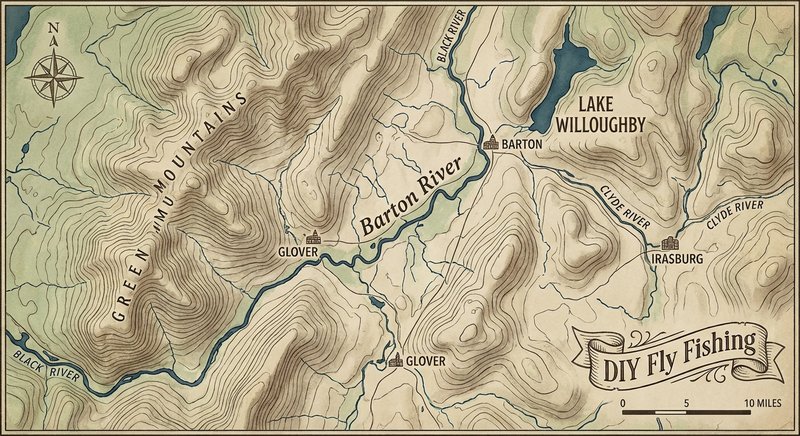
Barton River
Fly fishing in Vermont · Beginner · Best seasons: Spring, Summer, Fall
Target Species
Rainbow Trout, Brown Trout
About This Water
Northeast Kingdom stream connecting Crystal Lake to Lake Memphremagog. Rainbow and brown trout.
Fishing Recommendations
The Barton River is one of the crown jewels of Vermont’s "Northeast Kingdom" (NEK). Unlike many other Vermont rivers that flow south or west toward the Connecticut River or Lake Champlain, the Barton flows north into Lake Memphremagog. This unique geography makes it one of the premier "lake-run" fisheries in the Eastern United States.
🎣 Location Overview
The Barton River originates from the outflow of Crystal Lake in the village of Barton and winds its way approximately 22 miles north to Lake Memphremagog. It is a river of two characters:
- The Upper River: Characterized by classic freestone features, pocket water, and riffles. It feels like a traditional mountain stream.
- The Lower River: As it approaches the Coventry "flats," the river slows, deepens, and meanders through marshland.
What makes the Barton special is its connection to Lake Memphremagog. It serves as a vital spawning highway for massive lake-dwelling fish, offering anglers a rare opportunity to hook "Steelhead-style" Rainbows and trophy Brown Trout in a relatively small river setting.
🐟 Target Species & Behavior
Rainbow Trout
- Behavior: The Barton is famous for its wild, lake-run Rainbows. These fish spend most of their lives in the deep, cold waters of Memphremagog and enter the river in the spring (for spawning) and sometimes in the fall.
- Holdings: Look for them in deep pools and behind large boulders where they rest during their upstream migration. In the spring, they are often found in the faster, gravel-bottomed oxygenated water.
Brown Trout
- Behavior: There is a mix of resident "homebody" Browns and large lake-run migratory Browns. The lake-run fish enter the system primarily in the fall.
- Holdings: Browns are notorious for hugging undercut banks and hiding under log jams in the slower, siltier sections of the lower river near Coventry.
Bonus Species
You will also encounter Landlocked Atlantic Salmon (primarily in the fall) and occasional Brook Trout in the colder, upper tributaries.
📅 Best Times to Fish
Spring (Mid-April – June)
- The Prime Window: This is the peak for lake-run Rainbows. As soon as the ice breaks and the spring runoff begins to subside, the "Steelhead" move in.
- Conditions: Water is high and cold. Timing is everything; you want to catch the river as it is "dropping and clearing."
Summer (July – August)
- The Prime Window: Focus on the upper reaches where the water stays cooler, or near the mouths of cold-water tributaries.
- Conditions: Resident trout are the primary target. Early morning and late evening (the "Hex" hatch period) are best.
Fall (September – October)
- The Prime Window: Late September through the close of the season.
- Conditions: This is the time for trophy Brown Trout and Landlocked Salmon. The fish are aggressive and draped in spectacular spawning colors.
🪰 Recommended Flies & Techniques
Nymphing (The Bread & Butter)
The most effective way to catch migratory fish in the Barton is to get deep.
- Patterns:
- Eggs: Glo-bugs, Estaz Eggs, or 8mm beads in peach, orange, or "dead egg" white.
- Stoneflies: Large Pat’s Rubber Legs (#6–10) in black or brown.
- Classics: Prince Nymphs, Pheasant Tails (#12–16).
- Technique: Use a high-sticking or indicator nymphing rig with enough split shot to "tick" the bottom.
Streamer Fishing (For the Aggressive Strike)
- Patterns:
- Wooly Buggers: Black, Olive, or White (to mimic smelt).
- Classic NE Streamers: Mickey Finn, Black Ghost, or Grey Ghost.
- Modern Articulated: Sex Dungeon or Galloup-style patterns for the big Browns.
- Technique: The "Wet Fly Swing." Cast 45 degrees downstream, let the fly swing across the current, and give it slight pulses.
Dry Fly (Summer Residents)
- Patterns: Elk Hair Caddis (#14–18), Adams (#14–16), and Blue Winged Olives (BWO) on overcast days.
- Technique: Fine leaders (5x or 6x) and dead-drift presentations in the riffles of the upper river.
💡 Pro Tips & Local Knowledge
- The Smelt Connection: In the spring, the Rainbows follow the Smelt run. If you see silver flashes or small baitfish in the lower river, use long, sparse white streamers.
- The "Coventry Flats": This area is iconic. It requires stealth. Because the water is slower and flatter, the fish can see you from a distance. Wear earthy colors and move slowly.
- Temperature Matters: The Barton can warm up in mid-summer. If the water hits 70°F, give the fish a break and head to higher elevation or the colder Willoughby River nearby.
- The "NEK" Stealth: These fish see pressure at the bridges. If you are willing to bushwhack a half-mile away from the road, you will find fish that haven't seen a fly all day.
⚠️ Important Information
Access
- Route 5: Parallels much of the river, providing numerous pull-offs.
- Coventry: The area around the Airport Road and the bridge in Coventry offers excellent access to the lower sections.
- Barton Village: Access points near the fairgrounds and the downstream side of the village.
Regulations
- Check the Digest: Vermont Fish & Wildlife has specific "Test Waters" and "Trophy Trout" designations. The Barton often has different bag limits and season dates for the section below the interstate.
- Spawning Closures: Be aware of seasonal closures designed to protect spawning beds (redds). Never wade through shallow gravel beds where you see active fish tailing.
- License: A valid Vermont Fishing License is required. You can purchase these online at the VT Fish & Wildlife website.
Safety
- The lower Barton has high banks and silty, "greasy" bottoms. Felt soles or studs are highly recommended.
- This is moose and bear country—keep your eyes open and be mindful of your surroundings!
Guide’s Final Thought: The Barton isn't a river that gives up its secrets easily, but if you put in the time during the spring or fall runs, you have a legitimate chance at a trout of a lifetime.
Bug Hatches & Matching Flies
| Hatch | Type | Peak months | Time of day | Hook sizes | Matching flies |
|---|---|---|---|---|---|
| Hendrickson Ephemerella subvaria | mayfly | May | Afternoon | #12-14 | Red Quill #12-14, Hendrickson Emerger #14, Pheasant Tail #12-14 |
| Grannom Caddis Brachycentrus | caddis | May | Morning/Afternoon | #14-16 | Elk Hair Caddis (Olive) #14-16, Deep Sparkle Pupa #14-16, Holy Grail #14-16 |
| Blue-Winged Olive Baetis | mayfly | April, May, September, October | Midday | #18-22 | BWO Sparkle Dun #18-22, RS2 #20-22, Barr's BWO Emerger #18-20 |
| March Brown Maccaffertium vicarium | mayfly | May, June | Afternoon | #10-12 | March Brown American #10-12, Hare's Ear #10-12 |
| Light Cahill Stenocron interpunctatum | mayfly | June, July | Evening | #12-14 | Light Cahill #12-14, Cahill Wet Fly #14 |
| Pale Evening Dun Ephemerella dorothea | mayfly | June, July | Evening | #16-18 | Sulphur Parachute #16-18, Sulphur CDC Emerger #16-18 |
| Slate Drake Isonychia bicolor | mayfly | July, August, September | Afternoon/Evening | #10-12 | Iso Parachute #10-12, Isonychia Nymph #10-12 |
| Giant Black Stonefly Pteronarcys dorsata | stonefly | May, June | Night/Early Morning | #4-8 | Pat's Rubber Legs (Black) #6-8, Black Stimulator #8 |
| Trico Tricorythodes | mayfly | August, September | Morning | #22-26 | Trico Spinner #22-24, Zebra Midge #22 |
| Common Terrestrials Formicidae / Coleoptera | terrestrial | July, August, September | All Day | #12-18 | Black Foam Ant #16-18, Crowe Beetle #14-16, Dave's Hopper #10-12 |