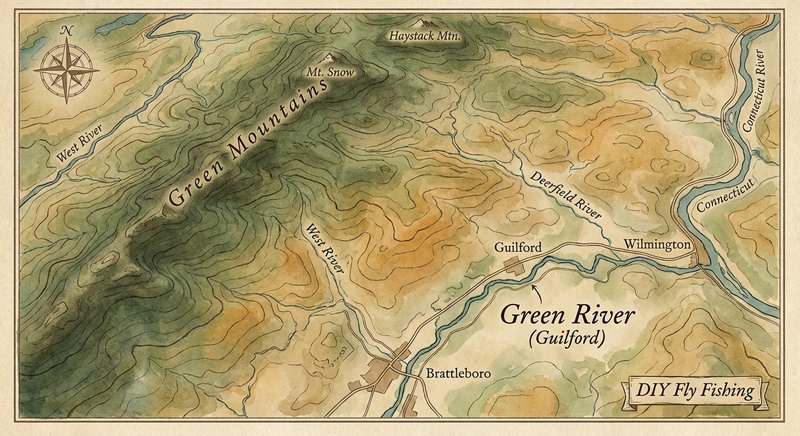
Green River (Guilford)
Fly fishing in Vermont · Intermediate · Best seasons: Spring, Summer, Fall
Target Species
Brown Trout, Brook Trout
About This Water
Southern Vermont gem with wild brown and brook trout. One of the state's most scenic small streams.
Fishing Recommendations
The Green River in Guilford, Vermont, is one of the most picturesque and technically rewarding small-stream fisheries in New England. Flowing through the rolling hills of Southern Vermont and eventually crossing the border into Massachusetts, this river offers a quintessential "classic Vermont" fly fishing experience—covered bridges, stone walls, and crystal-clear pocket water.
Here is your comprehensive guide to fishing the Green River.
🎣 Location Overview
The Green River is a freestone stream characterized by its intimate scale and pristine water quality. Unlike the larger, more famous Deerfield or Connecticut Rivers nearby, the Green is a place for "stealth and stalking."
The river is defined by high-gradient sections featuring plunge pools, tight pocket water, and long, glassy glides. It is heavily shaded by hemlocks and hardwoods, which keeps the water cooler than many other streams in the region during the heat of summer. Anglers love it for its solitude; while it is well-known locally, its technical nature and tight casting quarters keep the crowds away. It feels like a "blue-ribbon" experience in a small, Southern Vermont package.
🐟 Target Species & Behavior
- Wild Brook Trout: Found primarily in the upper reaches and the colder tributaries. These fish are opportunistic but wary. They hold in the "textbook" spots: behind boulders, in the foam lines, and at the very head of pools.
- Brown Trout (Wild and Holdover): The middle and lower sections of the Green are famous for their beautiful Brown Trout. These fish are more selective than the Brookies. They tend to hold in the deeper undercut banks, under overhanging branches, and in the slower "tail-outs" of pools during the evening rise.
- Behavior: Because the water is exceptionally clear, these fish have high visibility. They are easily spooked by shadows, heavy wading, or sloppy casting. Once hooked, they are acrobatic and use the swift current to their advantage.
📅 Best Times to Fish
Optimal Seasons
- Spring (Late April – June): This is the prime window. As the runoff subsides and the water hits the 50°F–55°F mark, the insect activity explodes. Late May is arguably the best time of year for dry fly action.
- Summer (July – August): While other rivers get too warm, the Green stays fishable longer due to canopy cover. However, focus on the early morning or late evening. Terrestrial fishing (ants/beetles) is spectacular now.
- Fall (September – October): A magical time. The Brookies are in their spawning colors, and the Brown Trout become aggressive as they prepare for their own spawn. Low water requires extra stealth.
Best Times of Day
- Spring: Mid-day (11:00 AM – 4:00 PM) when the sun warms the water and triggers hatches.
- Summer: First light until 10:00 AM, and the "Magic Hour" (the last 90 minutes of daylight).
- Fall: Late morning through the afternoon.
🪰 Recommended Flies & Techniques
Top Fly Patterns
- Dry Flies:
- Ausable Wulff (Size 12-16): A classic attractor that floats high in choppy water.
- Elk Hair Caddis (Size 14-18): Tan or olive; the river has massive caddis populations.
- Blue Winged Olive (BWO) (Size 18-22): Essential for cloudy spring/fall days.
- Black Ants & Hippie Stompers (Size 14-18): Lethal in mid-summer.
- Nymphs:
- Pheasant Tail (Size 14-18): Mimics almost everything.
- Prince Nymph (Size 12-16): The extra flash works well in the deeper plunge pools.
- Zebra Midge (Size 20): Crucial for picky fish in low water.
- Streamers:
- Woolly Bugger (Size 10-12) in Olive or Black. Best used during higher water or early spring.
Effective Techniques
- The "Dry-Dropper": This is the most effective way to fish the Green. Use a buoyant dry fly (like a Stimulator) and hang a small nymph 18-24 inches below it.
- Tight-Line Nymphing: In the pocket water sections, a long rod and a European-style nymphing rig allow you to probe the deep holes between rocks where fish hide from the current.
- Stealth Approach: Always fish your way upstream. If you walk downstream, you will send silt and "scare signals" to the fish before you ever cast.
💡 Pro Tips & Local Knowledge
- Focus on the Covered Bridge: The area around the Green River Covered Bridge is iconic, but it sees the most pressure. Use it as a landmark, then hike at least half a mile upstream or downstream to find the less-pressured, larger fish.
- Light Tackle is Key: A 7.5-foot or 8-foot 3-weight or 4-weight rod is perfect. A 9-foot rod can be difficult to maneuver under the heavy tree canopy.
- The "Guilford Shadow": Because the valley is narrow, the sun disappears behind the hills earlier than the official sunset. Be ready for the "evening" hatch to start an hour earlier than you might expect.
- Look for Seeps: In the heat of August, look for small "feeder" trickles entering the main stem. These provide cold-water oxygen "refuges" where trout will stack up.
⚠️ Important Information
- Access: Much of the river runs along Green River Road. While there are many pull-offs, please respect private property. If a section is posted "No Trespassing," move on. There is plenty of open water.
- Regulations: Vermont fishing regulations apply. Ensure you have a valid Vermont Fishing License. As of my last update, this section is generally under general trout regulations, but always check the VT Fish & Wildlife Law Digest for seasonal changes or "Catch and Release only" designations.
- Wading Safety: The rocks in the Green River can be incredibly "greasy" with algae. Felt soles (where legal) or studded rubber boots and a wading staff are highly recommended.
- Ethics: This is a fragile ecosystem. Practice Catch and Release, use barbless hooks, and keep the fish in the water while unhooking them.
Bug Hatches & Matching Flies
| Hatch | Type | Peak months | Time of day | Hook sizes | Matching flies |
|---|---|---|---|---|---|
| Blue Winged Olive Baetis spp. | mayfly | April, May, September, October | Mid-day/Afternoon | #18-22 | BWO Sparkle Dun #18-22, RS2 #20-22, Pheasant Tail #18-20 |
| Hendrickson Ephemerella subvaria | mayfly | April, May | Afternoon | #12-14 | Red Quill #12-14, Hendrickson Emerger #14, Hare's Ear Nymph #12-14 |
| Quill Gordon Epeorus pluralis | mayfly | April, May | Mid-day | #12-14 | Quill Gordon #12-14, Gold Ribbed Hare's Ear #12-14 |
| Grannom Caddis Brachycentrus | caddis | May | Morning/Afternoon | #14-16 | Elk Hair Caddis (Olive) #14-16, Deep Sparkle Pupa #14-16, Holy Grail #16 |
| March Brown Maccaffertium vicarium | mayfly | May, June | Afternoon/Evening | #10-12 | March Brown Dun #10-12, March Brown Wet Fly #12 |
| Light Cahill Stenacron interpunctatum | mayfly | June, July | Evening | #14-16 | Light Cahill #14-16, Cream Usual #14-16 |
| Slate Drake Isonychia bicolor | mayfly | June, September | Late Afternoon/Evening | #10-12 | Iso Parachute #10-12, Zug Bug #10-12, Prince Nymph #10-14 |
| Black Ant Formicidae | terrestrial | July, August, September | All Day | #16-20 | Cinnamon Ant #16-18, Black Foam Ant #16-20 |
| Golden Stonefly Acronuria spp. | stonefly | June, July | Morning/Night | #6-10 | Pats Rubber Legs #6-10, Golden Stimulator #8-12 |
| Trico Tricorythodes | mayfly | July, August | Early Morning | #22-26 | Trico Spinner #22-26 |