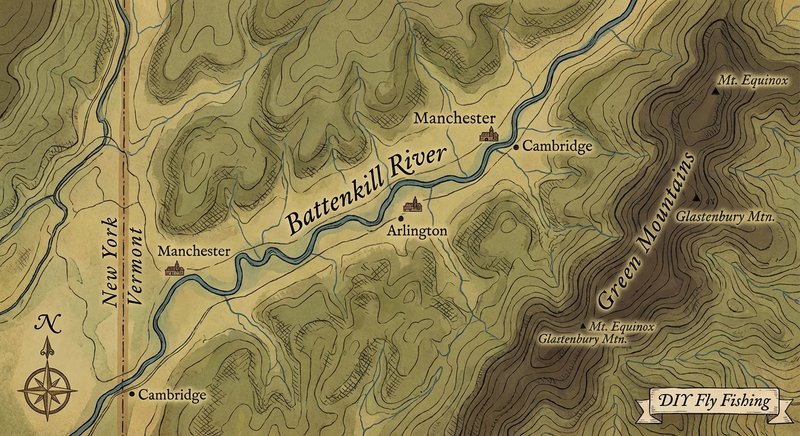
Battenkill River
Fly fishing in Vermont · Advanced · Best seasons: Spring, Summer, Fall
Target Species
Brown Trout, Brook Trout
About This Water
The most famous trout stream in the East. Wild brown trout in classic spring creek water with challenging technical fishing.
Fishing Recommendations
Welcome to the Battenkill River, perhaps the most storied and "holy" water in American fly fishing history. Located in southwestern Vermont, this isn't just a river; it’s a masterclass in patience, stealth, and technical proficiency. As a guide, I tell my clients: if you can consistently catch fish on the Battenkill, you can catch them anywhere in the world.
🎣 Location Overview
The Battenkill is a classic limestone-influenced freestone river that meanders through the lush valleys of Manchester and Arlington. What makes it special—and notoriously difficult—is its wild trout status. The Vermont portion of the river has not been stocked since the 1970s.
The water is crystal clear, often slow-moving, and filled with "micro-currents" that cause instant drag on a fly line. It features iconic covered bridges, deep undercut banks, and heavy woody debris. It is a place of immense beauty and immense challenge, often referred to as a "PhD-level" trout stream.
🐟 Target Species & Behavior
Wild Brown Trout
The undisputed kings of the Battenkill. These fish are 100% wild, incredibly wary, and have "eyes in the back of their heads."
- Behavior: They are highly nocturnal and light-sensitive. During the day, they hold tight against undercut banks or deep under fallen logs.
- Feeding: They are opportunistic but selective. They will rise for major hatches, but a "sip" from a 20-inch brown often looks like a tiny bubble.
Wild Brook Trout
Found more frequently in the upper reaches (near Manchester) and in the colder tributaries.
- Behavior: More aggressive than the browns but still spooky. They favor the swifter runs and "pocket water" where the river has a higher gradient.
📅 Best Times to Fish
Spring (Late April – June)
- The Window: This is the prime season. The famous Hendrickson hatch (late April/early May) brings the big fish to the surface.
- Conditions: Water levels are usually high; wading can be tricky. This is your best chance at a trophy on a dry fly.
Summer (July – August)
- The Window: Early mornings (before 9:00 AM) and late evenings (the "spinner fall" at dusk).
- Conditions: The river gets low and clear. Warning: If water temperatures exceed 68°F, stop fishing to protect the wild trout. Focus on the colder sections near Arlington.
Fall (September – October)
- The Window: Bright afternoons and crisp evenings.
- Conditions: The Brown Trout become aggressive as they prepare for the spawn. This is the best time for streamers and large terrestrial patterns.
🪰 Recommended Flies & Techniques
Dry Flies (The Battenkill Specialty)
- Hendrickson (Size 12-14): Late spring essential.
- BWO (Size 18-22): Necessary for overcast or drizzly days.
- Tricos (Size 22-26): For the frustratingly technical summer mornings.
- Terrestrials: Black Ants and Foam Beetles (Size 14-18) are deadly in August when nothing else is hatching.
Nymphing
- Patterns: Pheasant Tails (Size 16-20), Hare’s Ears, and Zebra Midges.
- Technique: Use a "Long and Fine" approach. Long leaders (12ft+) and very light fluorocarbon tippet (6X or 7X). Traditional strike indicators often spook fish here; consider "Euro" style or using a dry fly as an indicator.
Streamers
- Patterns: Black Ghosts, Woolly Buggers (Olive/Black), and Muddler Minnows.
- Technique: "Pounding the banks." Cast as tight to the wood and undercuts as possible. Retrieve with erratic, short strips.
💡 Pro Tips & Local Knowledge
- The "Downstream Dry Fly" Cast: To avoid lining a spooky brown, many experts fish downstream. Using a slack-line reach cast, you let the fly hit the water first and drift down to the fish before they ever see your leader.
- Stealth is Everything: Do not "stomp" into the water. In fact, try to fish from the bank whenever possible. If you must wade, move like a heron—slow and deliberate.
- The "Battenkill Sip": Don't look for a splash. Look for a tiny ring that looks like a minnow rising. On this river, that is often a 16-inch wild trout.
- Spotlight on Spots:
- Upper River: More Brookies, tighter water.
- Arlington to NY Border: The "Trophy Stretch." Wide, slow, and deep. This is where the legendary browns live.
⚠️ Important Information
- Regulations: The Vermont section of the Battenkill is Catch and Release Only for trout. No exceptions. It is also restricted to Artificial Lures/Flies Only.
- Access: Route 313 follows the river for miles. There are numerous well-marked "Fisherman Access" signs provided by the state. Please respect private property between these access points.
- Gear Recommendation: A 9-foot, 4-weight or 5-weight rod is the standard. You need a rod with a soft tip to protect light tippets, but enough backbone to turn a fish away from a submerged log.
- Local Resources: Stop by The Orvis Flagship Store in Manchester. They invented much of the gear used here and provide up-to-the-minute hatch reports.
Final Piece of Advice: Don't get discouraged. The Battenkill is a river that rewards time spent. One wild Vermont brown trout is worth twenty stocked fish elsewhere. Tight lines!
Bug Hatches & Matching Flies
| Hatch | Type | Peak months | Time of day | Hook sizes | Matching flies |
|---|---|---|---|---|---|
| Hendrickson Ephemerella subvariabilis | mayfly | April, May | Afternoon | #12-14 | Red Quill #12-14, Hendrickson Emerger #12-14, Pheasant Tail #12-14 |
| Blue-Winged Olive (BWO) Baetis / Acerpenna | mayfly | April, May, September, October | Afternoon | #18-22 | RS2 #18-22, Parachute BWO #18-22, BWO Sparkle Dun #18-20 |
| Grannom Caddis Brachycentrus | caddis | April, May | Mid-day/Afternoon | #14-16 | Peacock Caddis #14-16, Green Weenie #14-16, LaFontaine's Deep Sparkle Pupa #14-16 |
| Sulfur Ephemerella invaria/dorothea | mayfly | May, June, July | Evening | #14-18 | Sulfur Parachute #14-18, Sulfur Snowshoe Emerger #16-18, Pale Morning Dun Nymph #14-18 |
| March Brown Maccaffertium vicarium | mayfly | May, June | Afternoon | #10-12 | March Brown Parachute #10-12, Hare's Ear Nymph #10-12, March Brown Wet Fly #10-12 |
| Trico Tricorythodes | mayfly | July, August, September | Morning | #22-26 | Trico Spinner #22-26, Trico Parachute #22-24, Zebra Midge #22-24 |
| Isonychia Isonychia bicolor | mayfly | July, August, September | Late Afternoon | #10-12 | Iso Parachute #10-12, Zug Bug #10-12, Prince Nymph #10-14 |
| Light Cahill Stenacron / Stenonema | mayfly | June, July, August | Evening | #12-16 | Light Cahill #12-16, Cream Usual #14-16, Gold Ribbed Hare's Ear #14-16 |