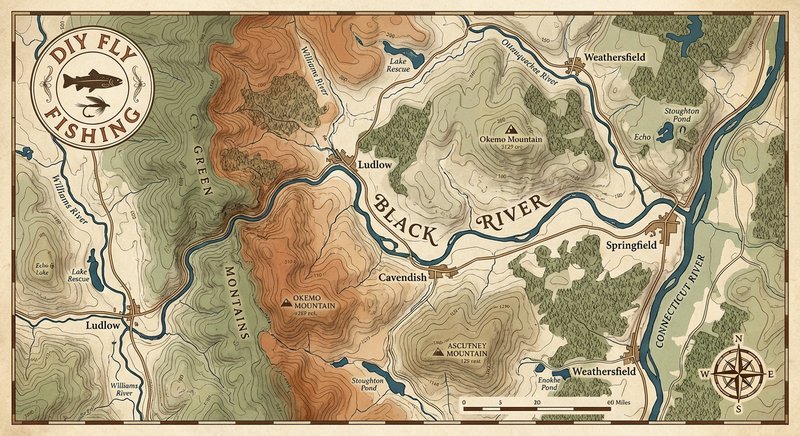
Black River
Fly fishing in Vermont · Beginner · Best seasons: Spring, Summer, Fall
Target Species
Brown Trout, Rainbow Trout
About This Water
Central Vermont stream with brown and rainbow trout. Good hatches and easy access points.
Fishing Recommendations
The Black River in Windsor County, Vermont, is a classic New England freestone stream that offers a diverse range of water, from tumbling pocket water to deep, slow-moving "trophy" pools. While it flows through several towns, including Ludlow (home to Okemo Mountain), it maintains a scenic charm that draws anglers seeking both quantity and the chance at a significant "trophy" fish.
🎣 Location Overview
The Black River is a gem of south-central Vermont. It originates in Plymouth and flows south through a series of lakes (Amherst, Echo, and Rescue) before becoming a river again in Ludlow. What makes this river special is the Trophy Trout Program managed by the Vermont Fish & Wildlife Department.
The river is characterized by two distinct personalities:
- The Upper Sections: Fast-moving, rocky, and classic "pocket water" ideal for wading.
- The Lower Sections (Cavendish to Weathersfield): This is where the "Trophy Section" resides. Here, the river broadens, featuring deep runs and large boulders where massive browns and rainbows lurk.
- The Cavendish Gorge: A rugged, steep, and dramatic section that requires a bit of a hike but offers some of the most beautiful scenery in the state.
🐟 Target Species & Behavior
The Black River is primarily a stocked fishery, but it is one of the best-stocked rivers in Vermont.
- Rainbow Trout: These are the acrobats of the river. They tend to hold in the faster oxygenated water, particularly at the "head" of the pools or in the riffles. They are opportunistic feeders and will often rise to dries even when a hatch isn't in full swing.
- Brown Trout: The "kings" of the Black River. The Trophy Section is stocked with two-year-old browns that can reach 18–20+ inches. Browns are more secretive, holding in the "tail" of pools, under undercut banks, or behind large boulders. They become increasingly predatory as they grow, often switching to a diet of baitfish and crayfish.
📅 Best Times to Fish
- Spring (Late April – June): This is prime time. Once the snowmelt (mud season) subsides and the water hits 50°F, the fish become highly active. May and June offer the most consistent insect hatches.
- Summer (July – August): Water temperatures can become a concern. During heatwaves, the lower sections can get too warm for ethical fishing. Pro Tip: Focus on the early morning (6:00 AM – 10:00 AM) or head to the Cavendish Gorge where the canopy and depth keep the water cooler.
- Fall (September – October): A spectacular time to be on the water. Brown trout become aggressive as they prepare for spawning. The crowds thin out, and the foliage provides a stunning backdrop. Streamer fishing is at its peak during these months.
🪰 Recommended Flies & Techniques
Dry Flies
- Mayflies: Hendrickson (May), Light Cahill (June), Blue Winged Olive (Cloudy days, Spring/Fall).
- Caddis: Elk Hair Caddis (Olive or Tan, sizes 14-18) is a staple here all summer.
- Terrestrials: In August, don't leave home without Foam Ants, Beetles, and Dave’s Hoppers.
Nymphs (The Most Productive Method)
- Attractors: Prince Nymphs and Copper Johns (Red or Blue) work well for freshly stocked fish.
- Naturalistic: Pheasant Tails (beaded and non-beaded) and Hare’s Ears in sizes 14-18.
- Stoneflies: Large Pat’s Rubber Legs (Black or Coffee) are deadly in the Cavendish Gorge and deeper runs.
Streamers
- Woolly Buggers: Black, Olive, or White (Size 6-10).
- Articulated Patterns: For the Trophy Section, don't be afraid to throw larger "Meat Whistle" or "Galloup-style" streamers to entice the big browns.
Techniques
- Tight-Line Nymphing: Extremely effective in the pocket water sections above Cavendish.
- The "Dry-Dropper": A great way to cover water in the summer. Use a buoyant Elk Hair Caddis with a small Pheasant Tail dropped 18 inches below it.
- Swinging Streamers: In the deeper runs of the Trophy Section, cast cross-stream and let the fly swing through the arc to trigger aggressive strikes.
💡 Pro Tips & Local Knowledge
- The "Trophy" Stretch: Focus on the stretch of Route 131 from the bridge in Cavendish downstream to the Howard Hill Road bridge in Weathersfield. This is where the state stocks the largest fish.
- Temperature Check: Always carry a thermometer. If the water temperature exceeds 68°F, stop fishing. Trout are under high stress at these temps and may not survive the release.
- The Gorge Secret: If the main road access points are crowded, hike into the Cavendish Gorge. It’s physical work, but the fish there see less pressure, and the "wild" feel is unparalleled.
- Stealth Matters: Despite being a stocked river, the water can be very clear. Long leaders (9–12 feet) and 5X or 6X tippet are often necessary during the low water of summer.
⚠️ Important Information
- Access: Much of the river follows Route 131. There are numerous pull-offs with "Fishing Access" signs. Respect private property—if it’s posted, stay in the riverbed.
- Regulations: The Black River has specific "Trophy Trout" regulations in certain sections.
- Standard: 2-fish limit on the Trophy Section (though most anglers practice 100% Catch & Release).
- License: A valid Vermont Fishing License is required. You can purchase one online at the VT Fish & Wildlife website.
- Wading Safety: The rocks in the Black River are notoriously "greasy." Felt-soled boots or studs are highly recommended, and a wading staff is a lifesaver in the Gorge.
- Cell Service: It can be spotty once you get into the narrower parts of the valley—download your maps offline before heading out.
Bug Hatches & Matching Flies
| Hatch | Type | Peak months | Time of day | Hook sizes | Matching flies |
|---|---|---|---|---|---|
| Blue-Winged Olive Baetis spp. | mayfly | April, May, September, October | Midday | #18-22 | BWO Sparkle Dun #18-20, Pheasant Tail #18-22, RS2 #20-22 |
| Hendrickson Ephemerella subvaria | mayfly | May | Afternoon | #12-14 | Hendrickson Parachute #12-14, Red Quill #14, Hendrickson Wet Fly #12-14 |
| Grannom Caddis Brachycentrus | caddis | May | Morning/Afternoon | #14-16 | Elk Hair Caddis (Dark) #14-16, Peacock Pupa #14-16, LaFontaine's Deep Pupa #14-16 |
| March Brown Maccaffertium vicarium | mayfly | May, June | Afternoon | #10-12 | March Brown Parachute #10-12, Hare's Ear Nymph #10-12, March Brown Spider #12 |
| Light Cahill Stenacron interpunctatum | mayfly | June, July | Evening | #12-16 | Light Cahill Dry #12-16, Cahill Wet Fly #14, Gold Ribbed Hare's Ear #14-16 |
| Spotted Sedge Hydropsyche | caddis | June, July, August | Evening/Night | #14-18 | Tan Elk Hair Caddis #14-18, Hydropsyche Larva #14-16, Sparkle Pupa #16 |
| Golden Stonefly Acroneuria lycorias | stonefly | June, July | Morning/Evening | #8-12 | Pat's Rubber Leg #8-12, Golden Stimulator #10-12, 20 Incher #10-14 |
| Trico Tricorythodes | mayfly | July, August, September | Early Morning | #22-26 | Trico Spinner #22-26, Sunken Trico Spinner #24, Black Zebra Midge #22-24 |
| Terrestrials (Ants/Beetles) Formicidae / Coleoptera | terrestrial | July, August, September | All Day | #12-20 | Black Foam Ant #16-20, Cinnamon Ant #14-18, Fat Albert (Beetle) #12-14 |