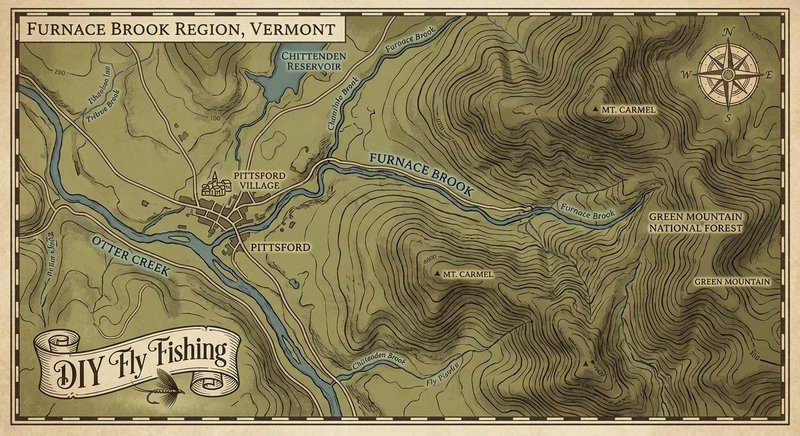
Furnace Brook
Fly fishing in Vermont · Intermediate · Best seasons: Spring, Summer, Fall
Target Species
Brown Trout, Brook Trout
About This Water
Southern Vermont stream near Dorset. Wild brown and brook trout in marble-bedded pools.
Fishing Recommendations
As an expert guide with years of experience navigating the freestones of the Green Mountain State, I can tell you that Furnace Brook is one of Central Vermont's most rewarding "small water" gems. While the nearby Otter Creek gets the glory for size, Furnace Brook offers the technical, intimate, and scenic experience that fly fishing purists crave.
Here is your comprehensive guide to fishing Furnace Brook.
🎣 Location Overview
Furnace Brook is a quintessential Vermont freestone stream located primarily in the town of Pittsford. It originates in the high country near Chittenden and tumbles down through the Green Mountain National Forest before winding through pastoral meadows and eventually joining the Otter Creek.
What makes Furnace Brook special is its gradient and diversity. The upper reaches are characterized by high-gradient "step-pools," boulders, and plunges. As it moves toward the valley floor, it slows down into classic riffle-run-pool sequences. It is a highly productive nursery for wild fish, and its cold-water springs keep it fishable even when larger, more famous rivers in the region are pushing temperature limits in mid-summer.
🐟 Target Species & Behavior
- Brook Trout: In the upper sections (east of Route 7, heading toward the mountains), you will find a vibrant population of wild, native Brook Trout. They are opportunistic, colorful, and aggressive. They hold in the "cushion" in front of boulders or in the deep aeration of plunge pools.
- Brown Trout: As the brook moves toward the Otter Creek confluence, Brown Trout become the dominant species. These fish are wild and wary. They tend to hold under undercut banks, beneath overhanging sweepers, or in the deep "buckets" at the tail-outs of runs.
- Behavior: These fish are highly sensitive to vibration and shadow. Because the water is often crystal clear, a "low and slow" approach is necessary. They feed primarily on a diet of caddis, stoneflies, and small baitfish.
📅 Best Times to Fish
- Spring (Late April – June): This is the prime window. Once the initial snowmelt (runoff) recedes and the water hits 50°F, the fish become extremely active. May is the "Golden Month" for matching hatches.
- Summer (July – August): Unlike larger rivers, Furnace Brook stays relatively cool. Focus on the early morning (sunrise to 10:00 AM) or late evening. This is prime "dry-dropper" season.
- Fall (September – October): This is a magical time. The Brook Trout are in their spawning colors, and large Brown Trout often move up from the Otter Creek into Furnace Brook to prepare for their own spawn. Streamer fishing can be very effective now.
🪰 Recommended Flies & Techniques
Top Fly Patterns
- Dry Flies:
- Elk Hair Caddis (Tan or Olive, sizes 14-18) – The bread and butter of this stream.
- Royal Wulff (Size 14-16) – An excellent attractor for the upper-reach Brookies.
- Light Cahill (Size 14-16) – Great for the late afternoon summer fades.
- Blue Winged Olive (BWO) (Sizes 18-22) – Essential for overcast or rainy days.
- Nymphs:
- Pheasant Tail (Sizes 14-18) – Imitates almost everything.
- Prince Nymph (Sizes 12-16) – Great for the higher, faster water sections.
- Copper John (Red or Chartreuse) – Use as a "heavy" dropper to get down in the pools.
- Streamers:
- Black or Olive Woolly Bugger (Size 8-10) – Dead-drifted through deep holes or swung in the lower reaches.
Effective Techniques
- The "Dink and Link" (Dry-Dropper): This is the most effective way to fish Furnace Brook. Use a buoyant Elk Hair Caddis as your indicator and hang a small Pheasant Tail nymph 18–24 inches below it.
- Tight-Line Nymphing: In the boulder-strewn upper sections, skip the indicator. Use a short line to keep your nymphs bouncing along the bottom of the "pockets."
- Stealth Casting: Always fish from downstream to upstream. Stay low, wear drab clothing, and try not to wade unless absolutely necessary.
💡 Pro Tips & Local Knowledge
- The "Otter Creek Connection": After a heavy rain in the fall, fish the lowest mile of the brook. Large "lake-run" style Browns move out of the main Otter Creek to find the cleaner, oxygenated water of Furnace Brook.
- Focus on the "Shoulders": Most anglers fish the middle of the deep pools. On Furnace Brook, the biggest fish often sit in the "shoulders"—the shallow, fast water right at the head of a pool where the oxygen is highest.
- Rod Choice: Leave the 9-foot 5-weight at home. A 7’6” or 8’0” 3-weight or 4-weight is the perfect tool for this water. You need a rod that can make short, accurate casts under overhanging branches.
- The "Shadow" Rule: If your shadow falls across a pool before your fly does, you’ve likely put the fish down for at least 20 minutes.
⚠️ Important Information
- Access: Much of the brook runs along Furnace Road and Route 7. There are several bridges with small pull-offs. While much of the stream is accessible, Vermont has strict laws regarding private property. Always look for "Posted" signs. If it's not posted, you are generally allowed to fish, but asking permission at local farmhouses is a great way to gain access to the best meadow stretches.
- Regulations: Ensure you have a valid Vermont Fishing License. Furnace Brook typically follows General Trout Water regulations (Open 2nd Saturday in April to Oct 31). Check the current Vermont Fish & Wildlife Digest for any mid-season changes or special terminal tackle restrictions.
- Safety: The rocks in Furnace Brook can be incredibly slick. Felt-soled boots or studs are highly recommended. Watch out for stinging nettles and wild parsnip along the banks in the summer.
Enjoy the silence and the scenery—Furnace Brook is Vermont fly fishing at its most authentic. Tight lines!
Bug Hatches & Matching Flies
| Hatch | Type | Peak months | Time of day | Hook sizes | Matching flies |
|---|---|---|---|---|---|
| Blue-Winged Olive Baetis | mayfly | April, May, September, October | Afternoon | #18-22 | BWO Sparkle Dun #18-22, Pheasant Tail Nymph #18-20, RS2 #20-22 |
| Hendrickson Ephemerella subvaria | mayfly | May | Afternoon | #12-14 | Red Quill #12-14, Hendrickson Nymph #12-14, Hendrickson Emerger #12-14 |
| Grannom Caddis Brachycentrus | caddis | May | Morning/Afternoon | #14-16 | Elk Hair Caddis (Olive) #14-16, Peacock Caddis Larva #14-16, Deep Sparkle Pupa #14-16 |
| March Brown Maccaffertium vicarium | mayfly | May, June | Afternoon/Evening | #10-12 | March Brown Dry #10-12, Hare's Ear Nymph #10-12 |
| Sulphur Ephemerella dorothea | mayfly | June, July | Evening | #14-18 | Sulphur Parachute #16-18, CDC Sulphur Emerger #14-18 |
| Light Cahill Stenacron interpunctatum | mayfly | June, July, August | Evening | #12-14 | Light Cahill Dry #12-14, Gold Ribbed Hare's Ear #12-14 |
| Golden Stonefly Acroneuria | stonefly | June, July | Morning/Evening | #8-12 | Stimulator (Yellow) #8-12, Pat's Rubber Legs #8-12 |
| Cinnamon Caddis Hydropsyche | caddis | June, July, August | Evening | #14-18 | Elk Hair Caddis (Tan) #14-18, Pulsating Caddis Pupa #16-18 |
| Black Ant Formicidae | terrestrial | July, August, September | All Day | #14-20 | Black Foam Ant #14-18, Flying Ant #16-20 |
| Common Grasshopper Orthoptera | terrestrial | August, September | Mid-day/Afternoon | #10-14 | Letort Hopper #12-14, Joe's Hopper #10-12 |