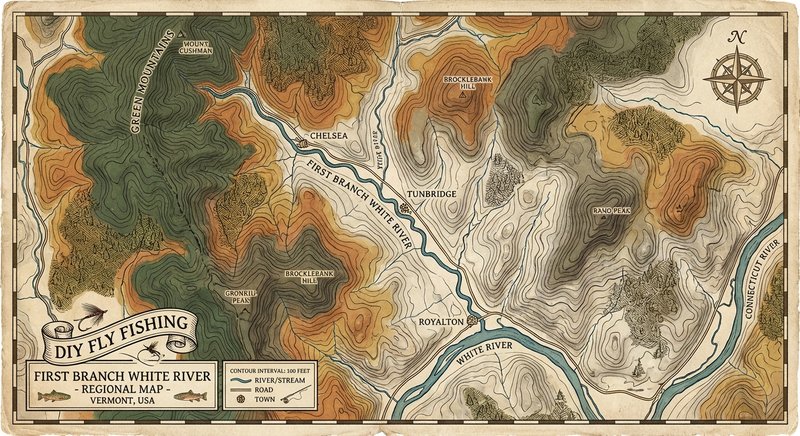
First Branch White River
Fly fishing in Vermont · Beginner · Best seasons: Spring, Summer, Fall
Target Species
Rainbow Trout, Brown Trout
About This Water
Eastern Vermont stream with rainbow and brown trout. Classic New England freestone fishing.
Fishing Recommendations
The First Branch of the White River is one of Vermont’s most charming and productive freestone streams. Flowing through the scenic Chelsea and Tunbridge valleys along Route 110, it offers an intimate "classic Vermont" fly fishing experience. While smaller than the Main Stem or the Third Branch, the First Branch is beloved for its accessibility, consistent hatches, and the high quality of its trout.
🎣 Location Overview
The First Branch is a quintessential New England valley stream. It meanders through a mix of pastoral farmland, hay fields, and wooded corridors. Because it is smaller than the other branches of the White River, it is much easier to read and wade, making it a favorite for both beginners and seasoned technical anglers.
The river character consists of short, bubbly riffles leading into deep, slow-moving "L-pools" and undercut banks. The substrate is primarily gravel and cobble, providing excellent habitat for aquatic insects. What makes it special is the solitude; while the Main Stem of the White River gets the glory, the First Branch offers a quieter, more tactical experience in a stunningly beautiful rural setting.
🐟 Target Species & Behavior
The First Branch is managed with both wild and stocked fish.
- Rainbow Trout: These are the primary targets in the lower and middle sections. They tend to hold in the faster, oxygenated water at the heads of pools and in "pocket water" behind larger boulders. They are generally more aggressive and willing to rise to a dry fly.
- Brown Trout: You will find both stocked and wild browns here. The wild browns are "PhD" fish—they are notoriously spooky and prefer the safety of undercut banks, fallen timber, or the deep, dark guts of pools. They become most active during low-light periods (dawn/dusk) or when the water is slightly stained after a rain.
- Brook Trout: While less common in the lower reaches, the headwaters near Chelsea hold beautiful native Brookies that are eager to take small dries.
📅 Best Times to Fish
Spring (May - June)
This is "Prime Time." As the snowmelt recedes and water temperatures hit the 50s, the river comes alive.
- Key Event: The Hendrickson hatch (mid-May) and the subsequent March Brown and Alder fly hatches.
- Conditions: Water levels can be high; heavy nymphs and streamers are often necessary early in the season.
Summer (July - August)
The First Branch can get low and clear.
- Strategy: Stealth is mandatory. Fish the early mornings and late evenings.
- Temperature Warning: If water temperatures exceed 68°F, please stop fishing to protect the trout from lethal stress. Focus on the cooler water near the mouths of tributary brooks.
Fall (September - October)
A spectacular time to be in Vermont.
- Strategy: Brown trout become aggressive as they prepare for the spawn. This is the best time for streamers.
- Key Event: Blue Winged Olive (BWO) hatches on overcast, drizzly days.
🪰 Recommended Flies & Techniques
Dry Flies
- Hendrickson (Light & Dark): Sizes 12–14 (May).
- Elk Hair Caddis: Sizes 14–18 (Tan or Olive). A staple on this river all season long.
- Parachute Adams: Sizes 14–20. The ultimate "searching" pattern.
- Stimulators: Sizes 10–14 (Orange or Yellow). Great for the faster pocket water.
- Terrestrials: Black Ants (16-18) and Foam Beetles (14-16) are deadly in August.
Nymphs
- Pheasant Tail: Sizes 14–18. Mimics the abundant Mayfly nymphs.
- Hare’s Ear: Sizes 12–16. Great for the "buggy" riffles.
- Prince Nymph: Sizes 12–14. Effective as an attractor in higher spring flows.
- Zebra Midge: Sizes 18–22. Essential for picky fish in slow pools.
Streamers
- Wooly Bugger: Sizes 6–10 (Black or Olive).
- Black Ghost: A classic New England pattern that works wonders here during the fall.
Techniques
- High-Sticking/Tight-Line Nymphing: Very effective in the riffles. Because the river isn't overly wide, you can maintain great control without much fly line on the water.
- Dry-Dropper: This is the "go-to" summer rig. Use a buoyant Stimulator or Hopper on top with a small Pheasant Tail or Hare's Ear 18 inches below it.
- The "Stealth Approach": Because the water is often clear, stay low and cast upstream. Avoid wading into the middle of a pool if you can reach it from the bank.
💡 Pro Tips & Local Knowledge
- The Tunbridge Fairgrounds: The stretch of river running past the Tunbridge Fairgrounds offers excellent access and a variety of water types. It’s a great place to start your day.
- Watch the "Flash": The First Branch is a freestone stream and can "flash" (rise and get muddy) quickly after a heavy thunderstorm. However, it also clears faster than the Main Stem. If the Main Stem is blown out, check the First Branch—it might be fishable.
- The Undercut Banks: Many anglers ignore the slow-moving "meadow" stretches. If you find an undercut bank in a slow section, drop a beetle or ant right against the grass. That is where the "trophy" browns hide.
- Bridge Pools: Route 110 crosses the river multiple times. Almost every bridge has a deep scour pool beneath it. These are high-traffic areas, so use smaller flies and longer leaders (9ft 5X or 6X) to fool these educated fish.
⚠️ Important Information
- Access: Vermont has generous stream access laws (generally, if you are in the riverbed, you are legal), but most of the land surrounding the First Branch is private farmland. Always look for "Posted" signs, and if you see a landowner, ask permission. They are generally friendly to respectful anglers.
- Regulations: The First Branch is generally under "General Fishing Regulations" for Vermont, but always check the current Vermont Fish & Wildlife Law Digest for specific season dates and creel limits.
- Clean Your Gear: To prevent the spread of invasive species like Didymo (rock snot), always dry your waders and boots completely between fishing different bodies of water.
- Parking: Avoid parking in tall grass (fire hazard) or blocking farm equipment gates. Use pull-offs along Route 110.
Tight lines, and enjoy the beauty of the White River Valley!
Bug Hatches & Matching Flies
| Hatch | Type | Peak months | Time of day | Hook sizes | Matching flies |
|---|---|---|---|---|---|
| Blue-Winged Olive (BWO) Baetis | mayfly | April, May, September, October | Mid-day | #18-22 | RS2 #18-22, Parachute BWO #18-20, Pheasant Tail #18-20 |
| Hendrickson Ephemerella subvaria | mayfly | April, May | Afternoon | #12-14 | Red Quill #12-14, Hendrickson Emerger #14, Hare's Ear #12-14 |
| Grannom Caddis Brachycentrus | caddis | May | Morning/Afternoon | #14-16 | Elk Hair Caddis #14-16, Deep Sparkle Pupa #14-16, LaFontaine's Emergent Pupa #14-16 |
| March Brown Maccaffertium vicarium | mayfly | May, June | Afternoon | #10-12 | March Brown Dun #10-12, Gold Ribbed Hare's Ear #10-12 |
| Sulfur Ephemerella invaria/dorothea | mayfly | June, July | Evening | #14-18 | Sulfur Parachute #16-18, Sulfur Emerger #16-18, Pheasant Tail #16-18 |
| Golden Stonefly Acroneuria | stonefly | June, July | Morning/Evening | #6-10 | Golden Stone Nymph #8-10, Stimulator (Yellow) #8-12, Pat's Rubber Leg #8-10 |
| Light Cahill Stenonema ithaca | mayfly | June, July, August | Late Evening | #12-14 | Light Cahill #12-14, Cahill Wet Fly #12-14 |
| Trico Tricorythodes | mayfly | July, August, September | Early Morning | #22-26 | Trico Spinner #22-24, Trico Dun #22-24 |
| Terrestrials (Ants & Beetles) Formicidae/Coleoptera | terrestrial | July, August, September | All Day | #12-18 | Cinnamon Ant #14-18, Black Foam Beetle #12-16 |