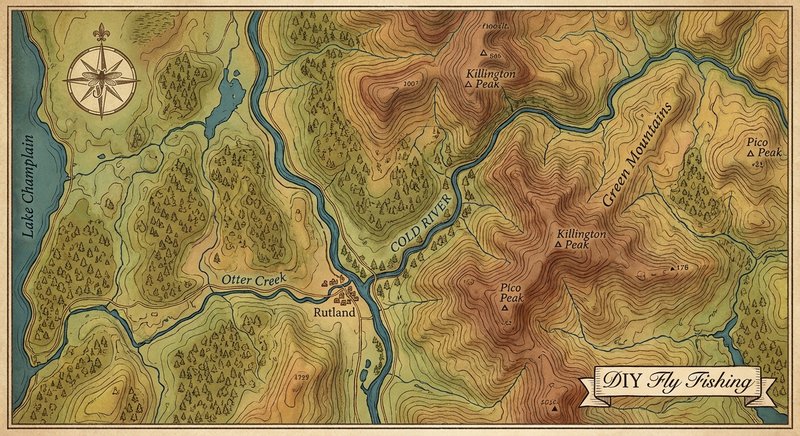
Cold River
Fly fishing in Vermont · Intermediate · Best seasons: Summer, Fall
Target Species
Brook Trout, Brown Trout
About This Water
Southern Vermont stream near Shrewsbury. Wild brook and brown trout in Green Mountain headwaters.
Fishing Recommendations
As an expert guide who has spent significant time in the Green Mountain State, I can tell you that the Cold River (specifically the one near Shrewsbury and Clarendon) is one of Vermont’s best-kept secrets. While many anglers flock to the Battenkill or the Otter Creek, the Cold River offers a more intimate, classic "New England" freestone experience.
Here are my comprehensive recommendations for tackling the Cold River.
🎣 Location Overview
The Cold River is a quintessential Vermont freestone stream that flows from the western slopes of the Green Mountains down toward the Otter Creek valley. Its name is not a marketing gimmick—the river is fed by high-elevation springs and shaded by dense forest canopies, allowing it to maintain much lower water temperatures than other rivers in the region during the heat of July and August.
What makes it special: It is a high-gradient stream characterized by dramatic pocket water, plunging pools, and stair-step falls. Anglers love it because it feels wild. You aren’t just fishing; you are boulder-hopping and navigating a rugged, beautiful landscape. It offers a rare opportunity to catch wild, self-sustaining trout in a setting that feels miles away from civilization.
🐟 Target Species & Behavior
- Brook Trout (Wild): Found predominantly in the upper reaches and the smaller tributaries. These fish are opportunistic and aggressive but extremely "spooky." They hold in the foam lines and right against the granite boulders.
- Brown Trout (Wild & Holdover): As the river widens and moves toward the valley, the Brown Trout become more dominant. They are craftier than the Brookies, typically holding in the deeper "guts" of pools or under undercut banks.
Feeding Behavior: Because this is a nutrient-poor freestone system, these fish aren't usually "picky" about exact imitations, but they are very sensitive to vibration and shadow. If they see you, the fishing is over for that pool.
📅 Best Times to Fish
Optimal Seasons
- Summer (Late June – August): While other Vermont rivers are hitting the 70°F mark (which is lethal for trout), the Cold River stays in the mid-60s. This is the prime window for dry fly action.
- Fall (September – October): This is the magic hour. The Brook Trout take on their brilliant spawning colors, and the larger Browns become aggressive as they prepare for the spawn.
Best Times of Day
- Summer: Mid-morning (after the sun hits the water and wakes up the bugs) through dusk.
- Fall: The warmest part of the day (11:00 AM – 3:00 PM) is often most productive.
Prime Conditions
Look for a "falling barometer" or the day after a light rain. Since it’s a steep river, it clears quickly. A little bit of "color" in the water (slight turbidity) is the best time to hunt for the larger resident Brown trout.
🪰 Recommended Flies & Techniques
Top Fly Patterns
- Dry Flies:
- Royal Wulff or Royal Coachman (Size 12-16): A classic attractor that Brookies cannot resist.
- Elk Hair Caddis (Tan/Olive, Size 14-18): The staple hatch on this river.
- Stimulators (Orange or Yellow, Size 10-14): Great for high-vis in broken water.
- Nymphs:
- Pheasant Tail (Beadhead, Size 16-20): Mimics the small mayflies found under rocks.
- Prince Nymph (Size 12-16): The "flash" works well in the dark, aerated plunge pools.
- Streamers:
- Black or Olive Woolly Bugger (Size 8-10): Best for the deeper pools in the lower sections.
Effective Techniques
- High-Sticking / Tight-Line Nymphing: Because the currents are complex, traditional indicator nymphing often leads to "drag." Keep as much fly line off the water as possible, using the rod tip to guide the nymph through the pockets.
- Dry-Dropper: This is my "go-to" on the Cold River. Use a size 12 Stimulator as your float and hang a small Pheasant Tail about 18 inches below it.
💡 Pro Tips & Local Knowledge
- The "Upstream Stealth" Approach: Always fish moving upstream. Because the water is so clear and the pools are small, if you approach from above, the fish will see your silhouette and vanish.
- Focus on the "Tail-outs": In the summer, fish will often sit at the very back of a pool where the water begins to accelerate again. Most anglers walk right past this water to get to the "bucket" of the pool. Don't make that mistake.
- The Shrewsbury Secret: The stretches around Shrewsbury offer the most "classic" mountain brook fishing. As you move toward Clarendon, the water slows down and the fish get larger, but more pressured.
⚠️ Important Information
- Access: Much of the Cold River runs through private land or tight roadside corridors. Always look for established pull-offs along Route 103 and Upper Cold River Road. Vermont has generous "unposted" land laws, but always respect "Posted" signs and never block farm gates.
- Regulations: Vermont Fish & Wildlife regulations apply. While much of the river is open to general regulations, I strongly recommend Catch and Release to preserve these wild populations. Always check the current Vermont Fishing Guide for seasonal closures.
- Gear Recommendation: A 7’6” or 8’0” 3-weight or 4-weight rod is perfect. Anything longer will get tangled in the overhanging hemlock and maple branches.
- Safety: The rocks here are notoriously slippery (slick granite). Studded wading boots or felt (where legal) are highly recommended. Watch out for rapid water rises after heavy mountain thunderstorms.
Guide’s Final Word: The Cold River isn't about trophy size; it's about the soul of fly fishing. Bring a camera—the colors of a wild Vermont Brook Trout in September are better than any trophy on a wall.
Bug Hatches & Matching Flies
| Hatch | Type | Peak months | Time of day | Hook sizes | Matching flies |
|---|---|---|---|---|---|
| Blue-Winged Olive Baetis | mayfly | April, May, September, October | Midday/Afternoon | #18-22 | BWO Sparkle Dun #18-22, Pheasant Tail Nymph #18-20, RS2 #20-22 |
| Hendrickson Ephemerella subvaria | mayfly | May | Afternoon | #12-14 | Hendrickson Pink Lady #12-14, Red Quill #14, Hare's Ear Nymph #12-14 |
| Grannom Caddis Brachycentrus | caddis | May | Morning/Evening | #14-16 | Elk Hair Caddis (Olive) #14-16, LaFontaine's Deep Sparkle Pupa #14-16, Peacock Caddis #16 |
| March Brown Maccaffertium vicarium | mayfly | May, June | Afternoon | #10-12 | March Brown American #10-12, Gold Ribbed Hare's Ear #10-12 |
| Common Tan Caddis Hydropsyche | caddis | June, July, August | Evening | #14-18 | Elk Hair Caddis (Tan) #14-18, Goddard Caddis #14-16, Holy Grail Caddis Pupa #16 |
| Light Cahill Stenacron interpunctatum | mayfly | June, July | Evening | #14-16 | Light Cahill #14-16, Cream Usual #14-16 |
| Golden Stonefly Acroneuria | stonefly | June, July | Morning/Night | #8-12 | Golden Stone Nymph #8-12, Stimulator (Yellow) #10-12 |
| Slate Drake Isonychia bicolor | mayfly | July, August, September | Late Afternoon | #10-12 | Isonychia Parachute #10-12, Zug Bug #10-12, Prince Nymph #10-14 |
| Trico Tricorythodes | mayfly | August, September | Early Morning | #22-26 | Trico Spinner #22-24, Griffith's Gnat #20-22 |
| Terrestrials (Ants & Beetles) Formicidae / Coleoptera | terrestrial | July, August, September | All Day | #14-18 | Black Foam Ant #16-18, Cinnamon Ant #16-18, Crowe Beetle #14-16 |