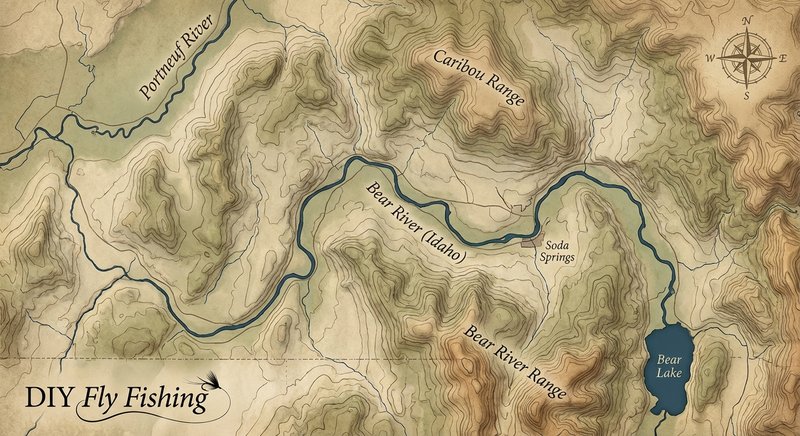
Bear River (Idaho)
Fly fishing in Idaho · Beginner · Best seasons: Summer, Fall
Target Species
Cutthroat Trout, Brown Trout
About This Water
Southeastern Idaho with cutthroat and brown trout. Scenic fishing near Bear Lake.
Fishing Recommendations
The Bear River in Idaho is one of the region’s best-kept secrets. While the crowds flock to the Henry’s Fork or the South Fork of the Snake, the Bear River offers a rugged, scenic, and often technical fly-fishing experience. Known for its unique "U-turn" geography—flowing from Utah into Idaho and then back into Utah—it provides a variety of water types ranging from deep canyons to slow-moving valley meanders.
🎣 Location Overview
The Bear River in Idaho is a tailwater system largely influenced by a series of hydroelectric dams. For the fly angler, the most productive and scenic water is found in the Oneida Narrows (below Oneida Dam) and the Black Canyon stretch near Grace.
What makes this water special is the Bonneville Cutthroat Trout, a native subspecies that has seen significant restoration efforts. The river here is characterized by large basalt boulders, deep pocket water, and classic riffle-run-pool sequences. It’s a "working river," meaning flows can fluctuate due to power generation and irrigation, but when the flows are stable, the fishing is world-class.
🐟 Target Species & Behavior
- Bonneville Cutthroat Trout: These are the stars of the river. They are opportunistic feeders but can be wary in the clearer summer flows. They tend to hold in the softer "cushion" water in front of large boulders or in the tail-outs of runs.
- Brown Trout: The Bear River is famous for producing "shouldery" Brown Trout. These fish are predatory and highly territorial. They hold in deep undercut banks and the dark water beneath overhanging willows. Unlike the Cutthroats, the Browns are more likely to move for a large streamer, especially in low-light conditions.
📅 Best Times to Fish
- Summer (July – August): This is prime time for dry fly action. As the spring runoff subsides and the irrigation demand stabilizes, the hatches begin in earnest.
- Morning: Trico and PMD hatches.
- Mid-day: Terrestrial time (Hoppers and Ants).
- Evening: Strong Caddis returns.
- Fall (September – October): This is arguably the best time for trophy Browns. As temperatures drop, the fish become more aggressive before the spawn. The water clarity is usually at its peak, and the "Blue Winged Olive" (BWO) hatches can be spectacular on overcast days.
- The Flow Factor: Always check the USGS gauges for "Bear River below Oneida Narrows." Ideal wading flows are generally between 300 and 600 cfs. Anything over 1,000 cfs becomes difficult and dangerous to wade.
🪰 Recommended Flies & Techniques
Dry Flies
- Terrestrials (The Summer Staple): Fat Albert (size 8-12), Morrish Hopper (pink or tan), and Chernobyl Ants.
- Mayflies: Parachute Adams (14-18), PMD Sparkle Dun (16), and BWO Cripples (18-20) for the fall.
- Caddis: Elk Hair Caddis (14-16) in olive or tan.
Nymphs
- Stoneflies: Pat’s Rubber Legs (brown/orange) is a must-have for the pocket water.
- Attractors: Prince Nymphs and Rainbow Warriors.
- Technical: Zebra Midges (black or red, size 18-22) and Pheasant Tails (16-18).
Streamers
- The Meat: Gold Sparkle Minnows, Sex Dungeon (olive or black), and Wooly Buggers.
- Technique: "Pounding the banks" from a drift boat or swinging streamers through deep tail-outs.
Techniques
- Hopper-Dropper: This is the most effective summer technique. Use a high-floating hopper pattern and hang a beaded Pheasant Tail or Zebra Midge 2–3 feet below it.
- High-Sticking: In the Oneida Narrows, the current is complex. Using a tight-line or "Euro" nymphing style through the boulder gardens will yield more fish than traditional indicator nymphing.
💡 Pro Tips & Local Knowledge
- The "Oneida Shuffle": When wading, you will often kick up silt and rocks. Look behind you; sometimes fish will move into the "chum line" you’ve accidentally created to grab dislodged nymphs.
- Watch the Dam: The water levels can rise rapidly. If you see the water turn turbid or notice the waterline creeping up the rocks, head for the bank immediately.
- Focus on the Transition: Bonneville Cutthroats love the "seams" where fast water meets slow water. Instead of casting into the middle of the fast current, target the edges where the fish can sit in slow water and watch the "conveyor belt" of food go by.
- Stealth Matters: In the flatter sections of the river near Soda Springs, the fish can see you from a distance. Wear earthy tones and keep a low profile.
⚠️ Important Information
- Access:
- Oneida Narrows: Excellent access via a gravel road that parallels the river for several miles below the dam.
- Black Canyon: This is a "bypass" reach that requires a hike-in. It is rugged and physically demanding but offers great solitude.
- Regulations: An Idaho fishing license is required. Most of the Bear River falls under general Idaho seasons, but always check the Idaho Fish and Game (IDFG) Seasons and Rules booklet, as certain sections may have specific bag limits or tackle restrictions (e.g., barbless hooks or no-bait zones).
- Safety: The rocks in the Bear River are notorious for being "greased lightning." Studded wading boots and a wading staff are not just recommended—they are essential.
- Respect the Land: Much of the river outside the canyon sections flows through private agricultural land. Always ask for permission before crossing private property or stick to established public access points.
Bug Hatches & Matching Flies
| Hatch | Type | Peak months | Time of day | Hook sizes | Matching flies |
|---|---|---|---|---|---|
| Blue-Winged Olive (BWO) Baetis | mayfly | March, April, May, September, October, November | Late Morning/Afternoon | #16-20 | Parachute Adams #16-20, RS2 (Olive) #18-20, Pheasant Tail Nymph #16-20 |
| Salmonfly Pteronarcys californica | stonefly | June | All Day | #4-8 | Rogue River Salmonfly #4-6, Pat's Rubber Legs (Orange/Black) #4-8, Cat Puke #6 |
| Golden Stonefly Hesperoperla pacifica | stonefly | June, July | Late Morning/Evening | #8-12 | Chubby Chernobyl (Golden) #8-12, 20-Incher Stone #8-12, Norm Wood Special #10 |
| Pale Morning Dun (PMD) Ephemerella excrucians | mayfly | June, July, August | Morning/Early Afternoon | #14-18 | PMD Sparkle Dun #16-18, Split Case PMD #16-18, Quigley Cripple #14-16 |
| Spotted Sedge / Mother's Day Caddis Hydropsyche | caddis | May, June, July, August, September | Evening | #12-18 | Elk Hair Caddis (Tan/Olive) #14-18, LaFontaine's Deep Sparkle Pupa #14-16, Holy Grail Caddis #14-18 |
| Trico Tricorythodes | mayfly | August, September | Early Morning | #20-24 | Trico Spinner #20-24, Zebra Midge (Black) #20-22 |
| Grasshopper Orthoptera | terrestrial | July, August, September | Mid-day/Afternoon | #8-12 | Morrish Hopper #8-12, Dave's Hopper #10-12, Thunder Thighs Hopper #10 |
| Midges Chironomidae | midge | January, February, March, December | Late Morning/Afternoon | #18-24 | Griffith's Gnat #18-22, Zebra Midge (Red/Black) #18-24, Mercury Midge #20-22 |