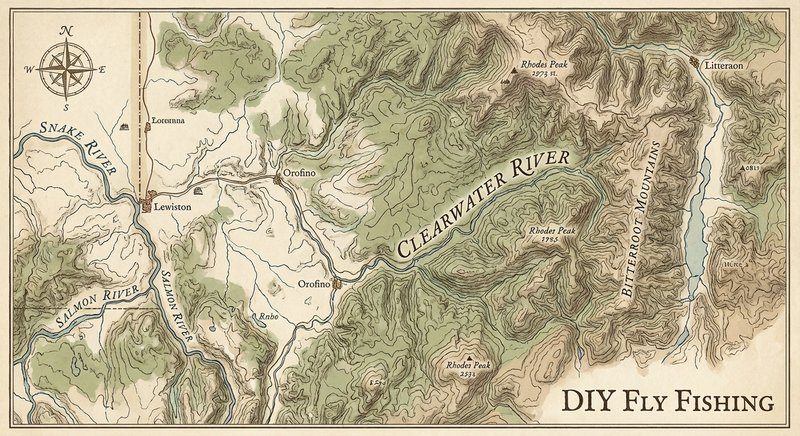
Clearwater River
Fly fishing in Idaho · Intermediate · Best seasons: Fall, Winter
Target Species
Steelhead, Rainbow Trout
About This Water
Famous for its fall steelhead run. Beautiful canyon scenery and excellent fishing for wild steelhead.
Fishing Recommendations
Welcome to the "Big C." As a guide, there are few places I hold in higher regard than the Clearwater River in North-Central Idaho. It is legendary, specifically for its "B-Run" Steelhead—fish that spend two years in the ocean and return as true behemoths, often exceeding 15 to 20 pounds.
Here is your comprehensive guide to fly fishing the Clearwater.
🎣 Location Overview
The Clearwater River is a wide, powerful, and majestic system. Flowing through steep canyons and rolling hills, it is primarily fed by the Dworshak Reservoir (via the North Fork) and the Lochsa and Selway rivers.
What makes it special is its clarity and temperature control. Because of the cold-water release from Dworshak Dam, the Clearwater remains fishable and maintains optimal temperatures even when other regional rivers are too warm or blown out. It is a "big water" experience—expansive gravel bars, long rhythmic runs, and classic "greased line" swings that are the dream of every Spey angler.
🐟 Target Species & Behavior
Steelhead (The Main Event)
- Behavior: The Clearwater is famous for B-Run Steelhead. Unlike the smaller A-run fish, these monsters stay at sea longer and arrive in the Clearwater starting in September. They are known for being aggressive but temperamental.
- Holding Water: They love "walking pace" water. Look for tailouts of big pools, the seams where fast water meets slow water, and submerged boulder gardens. They generally hold in 3 to 6 feet of water.
Rainbow Trout (Westslope Cutthroats & Residents)
- Behavior: While the Steelhead get the glory, the resident Rainbows and Westslope Cutthroats are opportunistic. In the fall, they often shadow spawning salmon or steelhead to gorge on eggs.
- Feeding: They transition from terrestrial insects in the early fall to subsurface nymphs and midges as the water cools in winter.
📅 Best Times to Fish
Fall (September – November)
- The Window: This is the peak for the fly angler. The fish are fresh, the water is warmer (mid-40s to low-50s), and they are more likely to move to a swung fly.
- Conditions: Overcast days are gold. Steelhead are light-sensitive; when the sun hits the water, the "bite" often shuts down until the shadows return to the river.
Winter (December – February)
- The Window: This is "Low and Slow" season. The fish are more lethargic as water temps drop into the 30s.
- Conditions: Look for stable weather patterns. If you get a slight warming trend, the fish can become surprisingly active. You will need to get your fly right in their face during these months.
🪰 Recommended Flies & Techniques
The Spey Swing (Best for Steelhead)
The Clearwater is arguably the best Spey casting river in the lower 48.
- Fall Flies: Smaller, unweighted patterns. Green Butt Skunks, Blue Charms, and Hoh Bo Speys.
- Winter Flies: Big, heavy, and "intrusive" patterns. Intruders (Black/Blue, Pink/Orange), Dirty Hoes, and Leech patterns.
- Technique: Cast at a 45-degree angle, mend to set the depth, and let the fly swing through the arc. Don't trout set! Wait until the line goes tight and the reel screams.
Nymphing (High Success Rate)
- Flies: Glo-Bugs (Eggs) in Oregon Cheese or Roe colors, San Juan Worms, and Beadhead Stonefly nymphs (Size 6-10).
- Technique: Using a long indicator leader, drift eggs and nymphs through deep slots. This is often the most productive method for winter Steelhead and resident Rainbows.
Dry Fly (Early Fall Only)
- Flies: October Caddis (Size 8-10).
- Technique: If you see a splashy rise in October, it’s likely a Cutthroat or a very aggressive Steelhead. Skate a dry fly across the surface to trigger a "boil."
💡 Pro Tips & Local Knowledge
- The "Two-Step" Dance: After every cast and swing, take two steps downstream. This ensures you cover every square inch of a run. Steelhead are often stationary; you have to find them.
- Focus on the Lower River: From the mouth at Lewiston up to Orofino is the prime "Big Water" for Steelhead. The section near "Pink House" and the "Big Eddy" are legendary.
- The Dworshak Effect: Always check the outflow from Dworshak Dam. A sudden increase in flow can "push" fish upriver, but it can also temporarily spook them into holding tight to the bottom.
- Shadow Management: On the Clearwater, "following the shade" is a pro move. Fish the south bank in the morning and the north bank in the evening to keep your fly in shaded, "secure" water.
⚠️ Important Information
- Regulations: Idaho fishing regulations are complex. You must have a valid Idaho Fishing License and a Steelhead Permit.
- Barbless Hooks: Most of the river requires barbless hooks for Steelhead. Check the current year's booklet for specific harvest vs. catch-and-release zones (wild fish have an intact adipose fin and must be released without leaving the water).
- Safety: The Clearwater is big and slippery. Studded wading boots and a wading staff are non-negotiable. A flotation vest is highly recommended, as the drop-offs can be sudden.
- Thermal Protection: In winter, the water is near freezing. Breathable waders with heavy wool layering or 5mm neoprene are essential to prevent hypothermia.
Guide’s Final Word: The Clearwater rewards patience. You might go two days without a strike, and then hook into a 20-pound chrome powerhouse that you'll remember for the rest of your life. Tight lines!
Bug Hatches & Matching Flies
| Hatch | Type | Peak months | Time of day | Hook sizes | Matching flies |
|---|---|---|---|---|---|
| Skwala Stonefly Skwala americana | stonefly | March, April | Afternoon | #8-12 | Skwala Stone Dry #10-12, Pat's Rubber Leg #8-12, Bullet Skwala #12 |
| Blue Winged Olive (BWO) Baetis spp. | mayfly | March, April, September, October | Late Morning/Afternoon | #18-22 | Parachute Adams #18-22, RS2 #20-22, Pheasant Tail Nymph #18-20 |
| Salmonfly Pteronarcys californica | stonefly | May, June | All Day | #4-8 | Chubby Chernobyl (Orange) #6-10, Cat Puke #4-8, Bitch Creek Nymph #4-8 |
| Golden Stonefly Hesperoperla pacifica | stonefly | June, July | Morning/Evening | #8-12 | Norm Wood Special #8-12, Golden Stone Nymph #8-10, Rogue Foam Stone #10-12 |
| Pale Morning Dun (PMD) Ephemerella excrucians | mayfly | June, July, August | Late Morning/Early Afternoon | #16-18 | Sparkle Dun #16-18, PMD Emerger #16-18, Split Case PMD #16 |
| Spotted Sedge Hydropsyche spp. | caddis | July, August | Evening | #14-16 | Elk Hair Caddis #14-16, LaFontaine's Deep Sparkle Pupa #14-16, X-Caddis #14-16 |
| October Caddis Dicosmoecus gilvipes | caddis | September, October | Afternoon/Evening | #8-10 | Stimulator (Orange) #8-10, October Caddis Pupa #8-10, Morrish October Caddis Adult #8-10 |
| Chironomids (Midges) Chironomidae | midge | January, February, March, December | Mid-day | #18-24 | Zebra Midge #18-22, Griffith's Gnat #20-22, Ice Cream Cone Midge #18-20 |